Since 2023, The Wonders of Physics Outreach Fellows program has been training graduate students who are interested in and committed to conducting physics outreach. Fellows receive mentoring from the department’s public engagement staff and participate in one or more outreach events over the course of the year, from presenting demos at local school STEM nights to starring in The Wonders of Physics Annual Shows. At the end of their Fellowship year, students must document their activities in some way. For example, we now have a repository of detailed activity instructions and best practices for dozens of physics demos available on our website. Some Fellows make sharable videos of their demos; others, like Natalie Hilliard, write about what being an Outreach Fellow means to them.
By Natalie Hilliard, Physics PhD student and Wonders of Physics Outreach Fellow
As we celebrate the 100th birthday of quantum mechanics with the “International Year of Quantum” this year, 2025, we also turn the page to a new chapter of physics as companies and countries race to build the first useful quantum computer. In joining the Otten Group for theoretical quantum information science at the start of this year, I have likewise joined this new chapter of the field. Even with all the excitement, however, as the focus of my study has increasingly narrowed towards my specific niche in quantum computing, I have realized how quickly tunnel vision can set in and obscure the motivation and broader picture for my work. But with the opportunities provided through the Wonders of Physics Outreach Fellowship — and the endless curiosity of the children I worked with — I have reconnected with my own curiosity that first motivated me to pursue quantum physics.
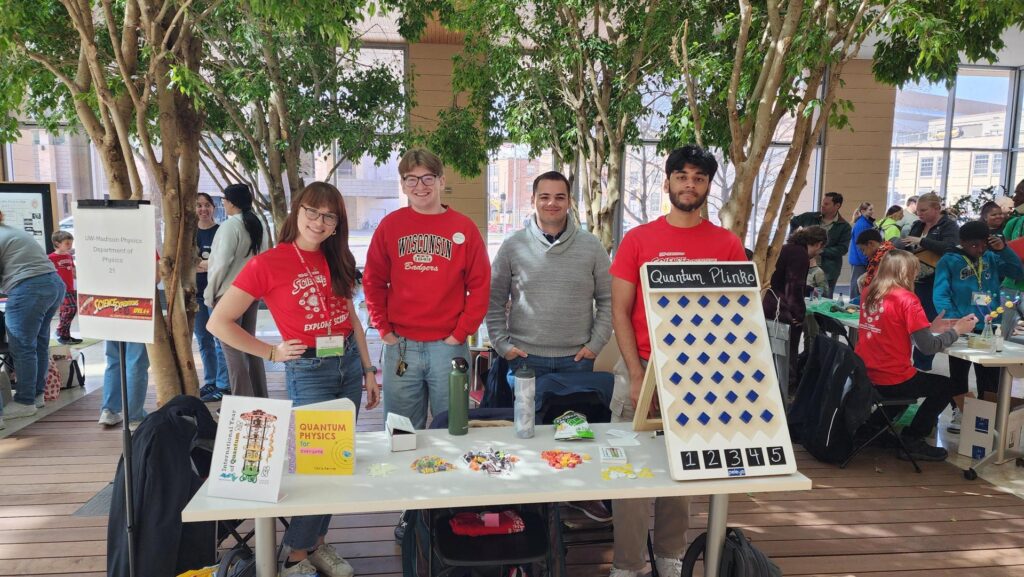
The opportunities of this fellowship afforded me participation in events of all scales: the physics department’s single-day, in-house Physics Fair, the multi-day, campus-wide UW–Madison Science Expeditions expo, and the week-long, single-classroom Summer Science Camp in the nearby Wisconsin Heights school district. Together with the Hybrid Quantum Architectures and Networks (HQAN–an NSF research institute) outreach manager Sarah Parker at these events, I brought quantum physics demos and experiments to the public and into the middle school classroom. In particular, I want to focus on my experiences with the summer camp at Wisconsin Heights. There, Sarah and I co-developed and co-taught the five-day quantum physics unit for middle school students.
At times, matching the level of the material with the students’ background proved difficult, but we managed to bridge their understanding with liberal use of analogies and by focusing the content on something familiar — light. By deconstructing the everyday experience of light with diffraction grating spectra and other demonstrations, we introduced quantum concepts like superposition and photons. This new experience of a familiar topic successfully activated that pool of curiosity and thus the subsequent recurrent phrase: “But why?” Channeling the students’ questions and refining them into something testable led to my two groups’ experiments investigating the following: light mixing with their handmade optical elements, and refraction changes with different liquids and with different source light wavelengths. With our assistance, the students collated their results into a poster presentation for other students and parents.
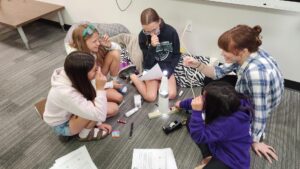
Reflecting on my role in fostering the students’ curiosity with these projects, I realized that I likewise have a responsibility to deliberately cultivate and nurture that same curiosity in myself during my own research. I have since felt reinvigorated when chasing down my own “But why’s,” and I hope that the momentum I gain from outreach will carry through my early research career. Through the larger outreach events, I have also felt gratitude and a reconnection to the public that supports our scientific endeavors in quantum computing. I hope that I can return the favor with work that will bring us closer to realizing tangible, positive impacts in daily life. Finally, as we turn the page and enter this next 100 years of the field, I look to the future with optimism that our outreach efforts will usher in a broader generation of students who feel welcome to pursue physics and for the transformative advances their own curiosity will bring.