Other Student Awards and Honors

PhD student Gage Erwin was named a U.S. Department of Energy Computational Science Graduate Fellow. The 2025-2026 incoming fellows will learn to apply high-performance computing (HPC) to research in disciplines including machine learning, quantum computing, chemistry, astrophysics, computational biology, energy, engineering and applied mathematics.

PhD students Sam Kramer, Michelle Marrero Garcia, and Isaac Barnhill were named to this year’s L&S Teaching Mentors program. These mentors are the heart of L&S’s Teaching Assistant (TA) Trainings. They are exceptionally passionate and knowledgeable teachers with proven track records for teaching excellence who work closely with the L&S TA Training and Support Team to facilitate various trainings and mentor L&S TAs. Kramer and Marrero Garcia earned Lead Teaching Mentor designation, meaning that they have served as Teaching Mentors more than once and are taking on an additional leadership role within the program.

The Astronaut Scholarship Foundation named undergraduate physics and math major Nathan Wagner to its 2025 class of Astronaut Scholars. ASF’s Astronaut Scholarship is offered to junior and senior-year college students pursuing degrees in STEM. This year, a total of 74 undergraduate students from 51 universities and colleges across the United States were selected.

Physics, astronomy-physics, mathematics and French major Caleb Youngwerth won the Meeting Award for Undergraduate Student Posters at the Fall 2024 meeting of the Eastern Great Lakes Section of APS. His poster presented work conducted in the chemical and biological engineering group of Prof. Rose Cersonsky.

PhD student Omar Nagib won first place at the Wisconsin Quantum Institute’s Best Student Paper competition.

Four physics majors have earned 2025 Hilldale Fellowships. They are: Ruben Aguiló Schuurs, computer sciences and physics major, working with Prof. Mark Saffman (Physics); Zijian Hao, astronomy-physics and physics major, working with Prof. Paul Terry (Physics); Nathaniel Tanglin, astronomy-physics and physics major, working with Prof. Elena D’Onghia (Astronomy); and Michael Zhao, AMEP and physics major, working with Prof. Saverio Spagnolie (Mathematics). Additionally, Qing Huang, a data science, information science, and statistics major working with Prof. Gary Shiu (Physics) also earned an award. The Hilldale Undergraduate/Faculty Research Fellowship provides research training and support to undergraduates. Students have the opportunity to undertake their own independent research project under the mentorship of UW–Madison faculty or research/instructional academic staff.

PhD students Mason Austin, Isaac Barnhill, Mason Kennedy, Puxin Liu, and R. Sassella were awarded Graduate Assistance in Areas of National Need (GAANN) fellowships. These department-administered U.S. Department of Education fellowships support students who are committed to contributing to physics research in critical national priority areas while developing skills that will make them effective teachers and educators.
The Power of Planned Giving

Leave a Lasting Impact

By utilizing a variety of gift planning options, you can leave a lasting impact on the Department of Physics and the University of Wisconsin–Madison. From an estate gift to a gift of real estate or a gift from an IRA, you can choose to establish your legacy at Wisconsin through your long-term financial plans and maximize benefits for yourself and the Department.

To learn more about incorporating your future gift into your overall financial, tax, and estate plans, please contact: Mae Saul, Senior Development Director at (608) 216-6274 or mae.saul@supportuw.org


If it weren’t for my experiences at UW, especially under the mentorship of Albert Erwin, I would not be who I am and where I am today. Those undergraduate and graduate years at UW were some of the best years of my life. Because of that, I want to give back for those who will be tomorrow’s trailblazers. The purpose of my planned gift is to fund in perpetuity the Erwin-Durandet Award Fund, a fund I established in memory of Albert Ewrin to support the department’s graduate students.

Casey Durandet ’89, MS’91, PhD’95


Planned Giving in Practice: The Ray MacDonald Fund for Excellence in Physics

This fund was established as a planned gift by Ray MacDonald MS’75 to promote excellence in all areas of the Department of  Physics: research, teaching, and outreach. An annual competition is open only to departmental faculty and staff, making the award rate greater than almost any other funding opportunities. The MacDonald Fund is fully flexible and provides seed funding for research that goes on to secure larger extramural grants and for outreach and teaching activities that are otherwise competing for very limited funds in those areas. Examples include:

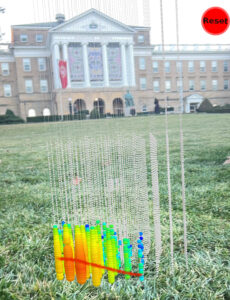
a rainbow array of dots shows the track of detection in the Icecube detector, but since it's shown on an app on a phone screen, the array is positioned in front of Bascom Hall
The IceCubeAR app shows visual representations of the patterns of a high-energy neutrino event at the Observatory.

Outreach

Augmented Reality (AR) lets users immerse themselves into 4D space — perfect for visualizing a high energy neutrino event as if you were in the depths of the IceCube detector or for interacting with the quantum properties of an atom. Prof. Lu Lu has already developed IceCuBEAR, an AR phone app that also works with Microsoft HoloLens goggles. She is using her MacDonald grant to support the current outreach with HoloLens, while also developing it for the higher-capacity Apple Vision Pro platform.

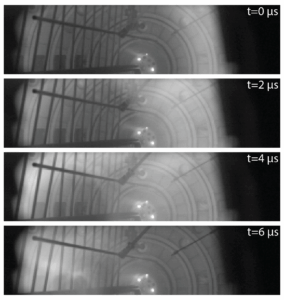
4 panels of images from the same spot inside a piece of research equipment show how the experiment changes over time, from 0 to 6 microseconds
A magnetic reconnection layer implosion on BRB captured by the ultrafast camera. Brighter areas correspond to emission from the plasma

Research

Plasmas travel fast — up to 100 km/hr — requiring very fast diagnostics to investigate the underlying physics. Prof. Jan Egedal’s MacDonald grant provided the balance of funds needed to purchase an ultrafast camera to help diagnose the plasma systems in the lab. The Phantom T3610 allows the plasma physics team to capture movies of visible light emission from the plasma at rates down to nearly 1µs per frame and can visualize much of the large-scale structure better than probes alone.

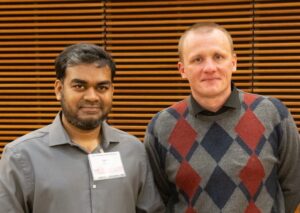
two men stand next to each other
Hasan (left) and Levchenko at the annual department awards banquet

Student Support

Exploring the theory behind the properties of new superconducting devices such as Josephson diodes, interferometers, and anomalous junctions might only require a computer, pencil, and paper, but the research still requires excellent students. Prof. Alex Levchenko’s MacDonald grant supported grad student Jaglul Hasan on an RA appointment as he finished his thesis. With the added flexibility, Hasan was able to explore ideas that weren’t initially part of the project, leading to fruitful results that were included in Levchenko’s successful NSF grant renewal.

Wonders of Physics Outreach Fellows

Since 2023, The Wonders of Physics Outreach Fellows program has been training graduate students who are interested in and committed to conducting physics outreach. Fellows receive mentoring from the department’s public engagement staff and participate in one or more outreach events over the course of the year, from presenting demos at local school STEM nights to starring in The Wonders of Physics Annual Shows. At the end of their Fellowship year, students must document their activities in some way. For example, we now have a repository of detailed activity instructions and best practices for dozens of physics demos available on our website. Some Fellows make sharable videos of their demos; others, like Natalie Hilliard, write about what being an Outreach Fellow means to them.


By Natalie Hilliard, Physics PhD student and Wonders of Physics Outreach Fellow

As we celebrate the 100th birthday of quantum mechanics with the “International Year of Quantum” this year, 2025, we also turn the page to a new chapter of physics as companies and countries race to build the first useful quantum computer. In joining the Otten Group for theoretical quantum information science at the start of this year, I have likewise joined this new chapter of the field. Even with all the excitement, however, as the focus of my study has increasingly narrowed towards my specific niche in quantum computing, I have realized how quickly tunnel vision can set in and obscure the motivation and broader picture for my work. But with the opportunities provided through the Wonders of Physics Outreach Fellowship — and the endless curiosity of the children I worked with — I have reconnected with my own curiosity that first motivated me to pursue quantum physics.

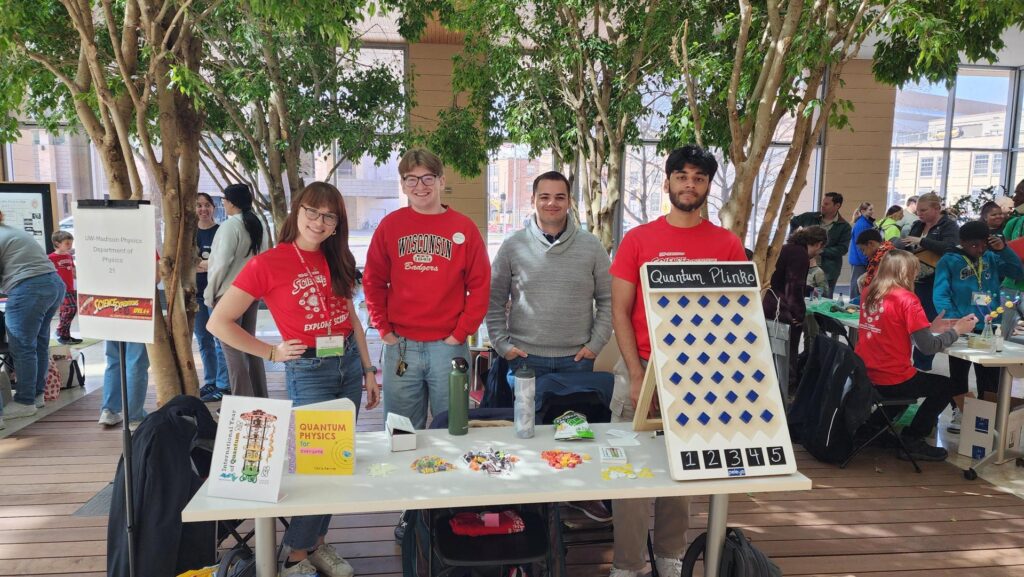
four people stand behind a table that contains physics demos
Fellows, including Natalie Hilliard, left, present demos at science expos like the Wisconsin Science Festival

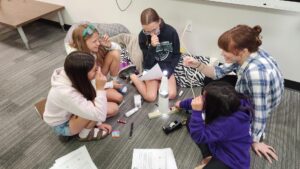
The opportunities of this fellowship afforded me participation in events of all scales: the physics department’s single-day, in-house Physics Fair, the multi-day, campus-wide UW–Madison Science Expeditions expo, and the week-long, single-classroom Summer Science Camp in the nearby Wisconsin Heights school district. Together with the Hybrid Quantum Architectures and Networks (HQAN–an NSF research institute) outreach manager Sarah Parker at these events, I brought quantum physics demos and experiments to the public and into the middle school classroom. In particular, I want to focus on my experiences with the summer camp at Wisconsin Heights. There, Sarah and I co-developed and co-taught the five-day quantum physics unit for middle school students.

At times, matching the level of the material with the students’ background proved difficult, but we managed to bridge their understanding with liberal use of analogies and by focusing the content on something familiar — light. By deconstructing the everyday experience of light with diffraction grating spectra and other demonstrations, we introduced quantum concepts like superposition and photons. This new experience of a familiar topic successfully activated that pool of curiosity and thus the subsequent recurrent phrase: “But why?” Channeling the students’ questions and refining them into something testable led to my two groups’ experiments investigating the following: light mixing with their handmade optical elements, and refraction changes with different liquids and with different source light wavelengths. With our assistance, the students collated their results into a poster presentation for other students and parents.

Natalie with Wisconsin Heights School District students at Summer Science Camp

Reflecting on my role in fostering the students’ curiosity with these projects, I realized that I likewise have a responsibility to deliberately cultivate and nurture that same curiosity in myself during my own research. I have since felt reinvigorated when chasing down my own “But why’s,” and I hope that the momentum I gain from outreach will carry through my early research career. Through the larger outreach events, I have also felt gratitude and a reconnection to the public that supports our scientific endeavors in quantum computing. I hope that I can return the favor with work that will bring us closer to realizing tangible, positive impacts in daily life. Finally, as we turn the page and enter this next 100 years of the field, I look to the future with optimism that our outreach efforts will usher in a broader generation of students who feel welcome to pursue physics and for the transformative advances their own curiosity will bring.

Welcome, new BoV members

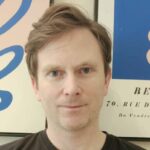
profile photo of William Cottrell
William Cottrell

William Cottrell earned his PhD in theoretical physics at UW–Madison in 2017 with research touching upon various topics in gauge-gravity duality. Following postdocs at the University of Amsterdam and Stanford, he went on to a career in finance as a quantitative researcher at Jump Trading where he applies machine-learning techniques to construct mid-frequency portfolios.  He also teaches a course on crypto currencies at the University of Chicago.

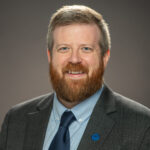
Profile photo of Jeremiah Holbauer
Jeremiah Holzbauer

Jeremiah Holzbauer graduated from UW–Madison with an AMEP degree before attending Michigan State for his PhD. At MSU, he discovered particle accelerators and has been working on them ever since. His postdoc at Argonne National Laboratory and 10+ years at Fermi National Accelerator Laboratory have been layering on experience in this deeply applied field, including cryogenic engineering, high power engineering, and precision RF engineering. He is currently a Senior Scientist and Project Manager for about a quarter of the PIP-II Project at FNAL, responsible for delivering ~10 different systems for this major upgrade to the accelerator complex. He is also the lab’s lead expert on delicate equipment transport, hazardous material transport, and is lead for the ASPIRE internship. He is a regular instructor at the US Particle Accelerator School.

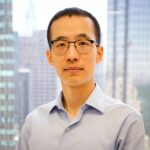
profile photo of Jiajun Xu
Jianjun Xu

Jiajun Xu earned his PhD in Theoretical Physics from Cornell University and went on to complete a postdoctoral fellowship at the University of Wisconsin–Madison. Trained in analytical modeling, mathematics, and computer science, he later transitioned into the world of finance, where he applies his interdisciplinary expertise to the complexities of global markets.

Driving the Future: The Vital Role of the Physics Board of Visitors

By Bill Nichols, BoV Chair
If you’ve considered supporting the Department of Physics, then the Physics Board of Visitors (BoV) wants you! This invitation highlights the crucial and engaging opportunities available to friends and alumni of the department. The BoV, an independent council of dedicated supporters, meets biannually to advise on matters of importance. It serves as a critical bridge between the department’s academic mission and the broader community, helping to steer its future and to enhance its impact.

A Comprehensive Mission

The BoV operates under a formal charge to champion the Department of Physics from every angle. Its core responsibilities are comprehensive: serving as ambassadors to increase public awareness of the department’s achievements, assisting in fundraising efforts, and advocating for its interests.

Beyond advocacy, the board provides high-level strategic advice. This includes advising on optimizing the impact of the department’s research activities and helping to assess the societal impact of new research directions. The BoV is also directly committed to the student body, providing mentoring, networking opportunities, and career assistance to undergraduates, graduate students, and post-doctoral associates.

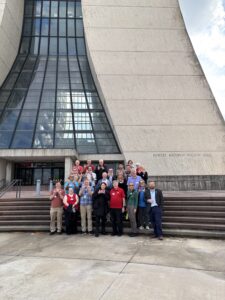
a group of about 20 people pose on stairs in front of a Fermilab building
The Physics and Astronomy Boards of Visitors took a tour of Fermilab in October 2025 | photo: Mae Saul

Current Initiatives: Enhancing Prestige and Building Pipelines

The BoV’s current broad emphasis is on enhancing the department’s long-term prestige. A key component of this strategy is supporting the growth of the faculty which, thanks to the support of Letters & Science Dean Eric Wilcots, is approaching historic highs. This growth translates directly into more impactful research, prestigious awards, and successful graduates, building on the department’s long history of producing top-tier PhDs for academia, national labs, and industry.

A major recent focus, prompted by Dean Wilcots, is to strengthen the pipeline for undergraduate physics majors seeking employment immediately after their bachelor’s degree. While a physics degree and successful programs like AMEP have always provided a strong foundation, the BoV advised on recent changes to the Physics curriculum to make students even more competitive. This new curriculum increases flexibility, allowing students to acquire in-demand skills like computing and large data set analysis. Concurrently, the BoV is identifying and securing summer internships, which are considered vital by many employers.

Our newest initiative is to mitigate today’s budget challenges by leveraging the department’s key technology thrusts including quantum information systems, fusion research, artificial intelligence, and others, to forge partnerships with industry and government programs. This initiative has just been launched, and we are actively soliciting new members to help bring it to fruition.

The Adventures of the Board

Service on the BoV is not just hard work; it is also an intellectual adventure. Members satisfy their own curiosity at every meeting with research presentations from students and faculty, offering a front-row seat to the department’s cutting-edge work.

The role also includes field trips to some of the world’s most advanced research facilities. This fall, we joined the Astronomy BoV for a daylong tour of Fermilab. In the recent past, BoV members have visited CERN in Geneva, Switzerland; Lawrence Berkley National Laboratory in California; and the Physical Science Laboratory in Stoughton, Wisconsin — home of the WHAM plasma fusion device and where IceCube’s Digital Optical Modules are made.

Please consider joining the BoV not only to assist the Department of Physics in defining and achieving its goals, but also to have privileged access to leading-edge research, intellectual stimulation, and tours of some of the most famous and awe-inspiring physics laboratories in the world.

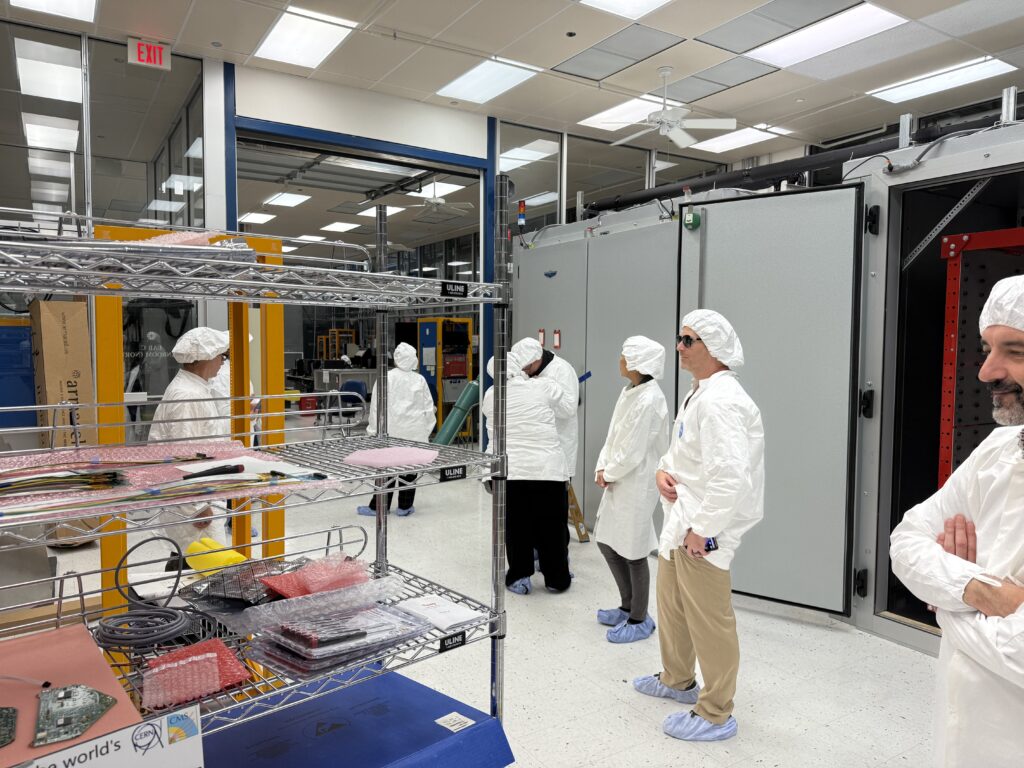
people wearing anti-static lab coats and hair coverings in a research lab
BoV members actively explore cutting-edge physics research. | Photo: Kevin Black

Degrees Awarded — Fall 2024-Summer 2025

Doctoral Degrees

Fall 2024

Benjamin Harpt
Advisor: Eriksson

Merritt Losert
Advisor: Friesen

John Podczerwinski
Advisor:  Timbie

Avirup Roy
Advisor: McCammon

Victor Shang
Advisor: Bose

CV Ambarish
Advisor: McCammon

Vedant Basu
Advisor: Karle

Shu-Tian Eu
Advisor:  Everett

Zach Huemann
Advisor:  McMillan/Dasu

Preston Huft
Advisor: Saffman

Bradley Kumm
Advisor: Egedal/Stechmann

Cody Poole
Advisor: Saffman

Abigail Shearrow
Advisor: McDermott

Summer 2025

Ryan Albosta
Advisor: Brar

Margaret Fortman
Advisor: Brar

Jimena Gonzalez-Lozano
Advisor: Bechtol

David Guevel
Advisor:  Fang

Zach Krebs
Advisor: Brar

Abhishikth Mallampalli
Advisor: Dasu

Hruday Deepak Malloubhotla
Advisor: Joynt

Rachel Myers
Advisor: Sarff

Jacob Scott
Advisor: Saffman

Emily Shelton
Advisor: Campagnola/Yavuz

Jessie Thwaites
Advisor: Vandenbroucke

MS in Physics — Quantum Computing

Fall 2024

Shoufil Abdul Kareem Subaida
James Fitzwater
Paul Franco
Simeon Ignace
Salizhan Kylychbekov
Scott Lynch
Lucas Rogers
Tyler Schmaltz
Georgia Stricklen
Anosh Ben Asher Wasker
Songtai You

Spring 2025

Nikola Dimitrov
Naga Sai Krishna Vinayswami Kapakayala
Yujiang Pu
Yasif Rahman

Summer 2025

Lucas Anderson
Ben Cramer
Megan Dalldorf
David Pagel
George Simonovich
Jiakai Wang

MA/MS

Arjav Sharma

Undergraduate Degrees

Fall 2024

Emily Devine
John Marek
Karanvir Singh
Benjamin White
Jiacheng Yan
Jianfeng Ye

Spring 2025

Kalin Ahmad
Andrew Barnes
Zachariah Bath
Ben Biorn
Dylan Bowers
Mikaela Brown
Ella Chevalier
Ian Crawshaw
Joseph De Boom
Haiyue Duan
Carson Ellenwood
Paulina Engovatov
William Griffin
Aiden Gustafson
Tianyang Huang
Charles Jungwirth
Jack Kresich
Joshua Kruger
Luke Lowther
Erica Magee
Nicholas Marston
Quinn Meece
Elias Mettner
Jackson Millin
Jakob Mills
Leah Napiwocki
Coleman Nelson
Dakota Photinos
Corbin Polka
William Pryor
Jaden Radcliff
Jenna Roderick
Isaac Ruder
Tyler Schey
Jake Strobel
Britta Thompson
Tyler Voigts
Patrick Walsh
Nina Weichmann
Collin Welke
Alexander Williamson Junk
Mengtian Yang
Junqi Zhang

Summer 2025

Erik Giese
Joshua Hall
Ruishu Huang
Madison Ludwig
Haoxuan Mu


Game on! New course explores the physics of sports

text text text

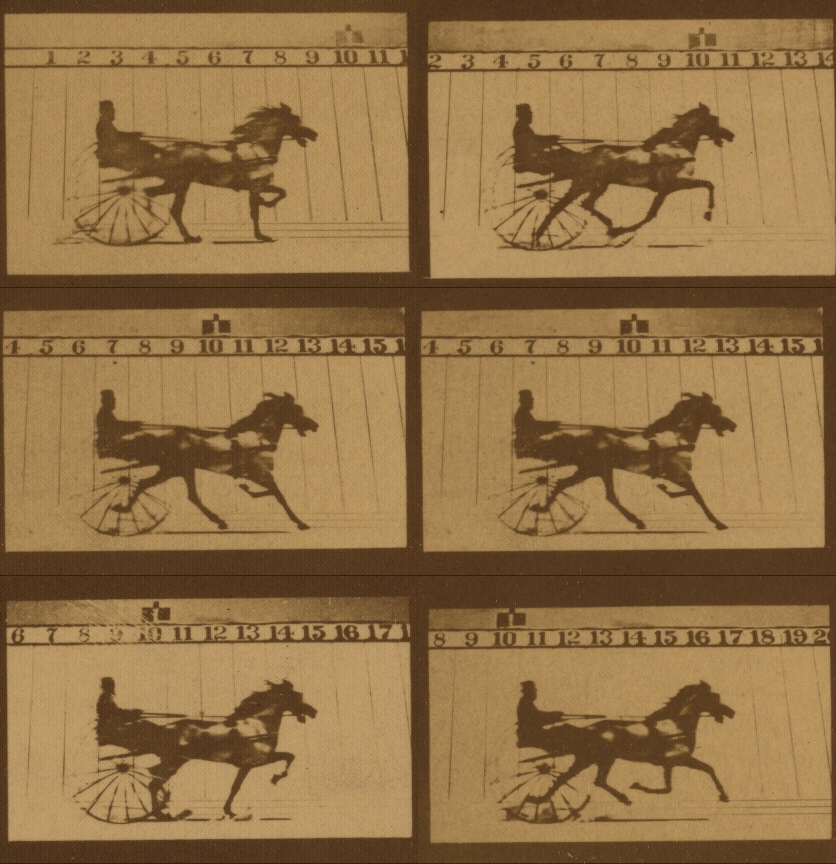
“Abe Eddington at the trot” is the first sports movie ever made. Eadweard Muybridge pioneerd a method of showing images using a zoopraxiscope. This animated GIF, compiled by Jim Reardon, helps to recreate the movie.

Simple, cost-effective trapped ion qubit technology developed

Physics professor Mark Saffman, affiliate professor Mikhail Kats and their groups have developed a simplified but ingenious method for trapping atoms of different species to make quantum bits or qubits, they published in Science Advances.

Capturing two types of neutral atoms next to each other, the method creates interleaved grids of cesium and rubidium atoms that can be used as qubits in quantum computing and quantum sensing. The setup is much simpler and cost-effective than previous efforts and is already being used in early-stage quantum devices.

“Other groups have trapped two types of neutral atoms, but their setups are pretty sophisticated, use multiple lasers, and are expensive,” Kats says. “We have demonstrated that you can do this kind of trapping with a single laser and single micro-fabricated mask.”

As quantum computing emerges, there is no clear consensus on which material should be used to make the qubits which are the building blocks of quantum computers. Researchers are looking into qubits made of superconductors, diamond, trapped ions, and other specialized materials. But one relatively scalable qubit candidate is neutral atoms — those, like rubidium and cesium, that have a net zero electrical charge — that can be isolated, or “trapped,” using lasers.

All qubits are sensitive to their environment and need to stay as isolated from the outside world as possible so they maintain their quantum state: external influences can cause them to “decohere” and lose information. However, when the time is right, otherwise well-isolated qubits need to be able to interact with each other and with external inputs.

Trapping two types of neutral atoms next to each other is a promising approach to these seemingly contradictory requirements for components of quantum computers and quantum sensors. To isolate two types of atoms in the same space, the team fabricated a specialized optical mask using ultrathin layers of gold and the semiconductor germanium.

Sending a specific frequency range of laser light through this semitransparent mask divides it into a pattern of bright, dark, and intermediate areas, which interact to form the traps. The researchers filter and demagnify the light pattern before it enters a vacuum cell filled with cesium and rubidium atoms. Rubidium is attracted to the areas with high electromagnetic field, called bright traps. Conversely, the cesium migrates into the dark traps. The result is two sets of neutral atoms in distinct patterns in close proximity to each other.

These interleaved patterns of atoms can then be used for computing; one set of undisturbed atoms is for computation while the other set communicates commands and information with users. The atoms can also be used for sensing, with one set of atoms interacting with and collecting data from the environment while the other set records and processes the signals.

-Jason Daley, College of Engineering

Generating attosecond hard X-ray pulses

Once only a part of science fiction, lasers are now everyday objects used in research, healthcare and even just for fun. Previously available only in low-energy light, lasers now come in wavelengths from microwaves through X-rays, opening up a range of different downstream applications.

In a study in Nature, a team led by UW–Madison scientists generated the shortest hard X-ray pulses to date through the first demonstration of strong lasing phenomena. The resulting pulses can lead to several potential applications, from quantum X-ray optics to visualizing electron motion inside molecules.

“We have observed strong lasing phenomena in inner-shell X-ray lasing and been able to simulate and calculate how it evolves,” says Uwe Bergmann, physics professor at UW–Madison, and senior author on the study.

The inner-shell X-ray lasing process is similar as it is in optical lasing, just at much shorter wavelengths. Because inner-shell electrons are tightly held, powerful X-ray pulses, like those from X-ray free-electron lasers (XFEL), are required to excite enough of them simultaneously to result in lasing. In turn, the photons they emit in this process are also at X-ray wavelengths. But XFEL pulses are generally “dirty,” with each pulse really being made of several short, intense spikes in time, and a range of spikes with different wavelengths, limiting some of their applications.

“They’re just not clean, beautiful pulses (like visible lasers),” says Thomas Linker, joint postdoctoral researcher at UW–Madison and the Stanford PULSE Institute at SLAC and lead author of the study. “But it’s the only thing we have.”

Here, the researchers tightly focused XFEL pulses onto a sample made of copper or manganese. The input pulse is still dirty, but very short and incredibly powerful: the equivalent of focusing all the sunlight that hits the Earth into one square millimeter. The emitted X-ray photons hit instrumentation that disperses them by wavelength, much like a prism disperses visible light into a rainbow, reflects it based on its angle, then is read by a detector.

Their results show that emitted light contained all of the expected wavelengths, but spatially, it showed a few hotspots instead of the expected smooth signal. Applying a 3D simulation, Linker calculated that the emitted X-rays underwent filamentation, a strong lasing phenomenon.

When they further increased the intensity of the input pulse, they saw another unexpected result: instead of seeing hotspots of one wavelength, they observed spectral broadening and sometimes multiple spectral lines. They ran the simulation on this new data and realized that this result can only be explained by another lasing phenomenon called Rabi cycling, where the pulse is so strong that the sample will cyclically absorb photons and emit them by stimulated emission. They used their simulation to plot the emitted pulse intensity over time and found that their dirty input pulses resulted in extremely short stimulated emission pulses — the shortest hard X-ray pulses observed by anyone to date.

“We have generated hard X-ray pulses, 60 to 100 attoseconds in duration, with these strong lasing phenomena,” Linker says.

An attosecond is one quintillionth of a second, and this extremely short pulse duration is what could drive new, advanced LASER applications. “If you want to see electron dynamics, how they move inside their orbitals, that’s the attosecond timescale,” Linker says.

Adds Bergmann: “There are so many nonlinear technologies and phenomena that the laser community uses now, but very few of those have dared to have been tried with hard X-rays. This work is a step towards pushing the exciting field of real laser science into this powerful hard X-ray regime.”

Vera C. Rubin Observatory celebrates first images, start of 10-year survey

The first images of the greatest cosmic movie ever made were released by the Vera C. Rubin Observatory this past summer, and one of the “directors” was UW–Madison physics professor Keith Bechtol.

It’s a story a decade in the making for Bechtol, who served in a leadership role as the observatory’s System Verification and Validation Scientist and has been part of the international collaboration since 2016. He and his UW–Madison research group have been key players on a team of thousands of people that brought the observatory to the main stage. In 2025, its state-of-the-art telescope started taking the first images of the night sky.

“Rubin Observatory is a confluence of technology that allows us to map the universe faster than we’ve ever been able to before,” Bechtol says. “It will catalog more stars, galaxies, and Solar System objects during the first year of science operations than all previous telescopes combined. We will chronicle how the universe changes over time.”

Space-based telescopes like Hubble and James Webb typically focus on one spot for a prolonged time. In contrast, the ground-based Rubin Observatory, positioned on a mountaintop in Chile, is quickly scanning the sky, taking an image with its 3.2-billion-pixel camera every 40 seconds and collecting 20 terabytes of data each night. The observatory is running the “Legacy Survey of Space and Time,” capturing the entire southern hemisphere sky every three nights over its anticipated 10-year run.

In his role, Bechtol was one of five technical group leaders who organized the observatory’s commissioning effort — the building, implementation, and testing that happens on the way to a fully operating observatory. Bechtol oversaw the science deliverables of the project.

“I gather the evidence to show that all components of Rubin Observatory are working together to produce the most detailed time-lapse view of the cosmos ever made,” he says. “I’ve been responsible for anticipating things that could go wrong and helping to address those challenges, designing observation plans, rehearsing observatory operations, and implementing tests of increasing sophistication as we built the observatory. It’s been many years of preparation to get to this point.”

In April, Rubin Observatory achieved “first photon.” In June, people across the globe celebrated the release of the first images, including a viewing party in Chamberlin Hall.

Bechtol and his group will use the data to probe fundamental questions related to dark matter, dark energy, and the early universe.

“We’re using the whole universe as a laboratory to ask big, open questions about the nature of matter, energy, space, and time. What is the universe made of? How did the universe begin? How will it end?” Bechtol says. “We use measurements of strong and weak gravitational lensing and the clustering of galaxies to study dark energy, as well as so-called ultrafaint galaxies to learn about dark matter.”

By Sarah Perdue, Department of Physics