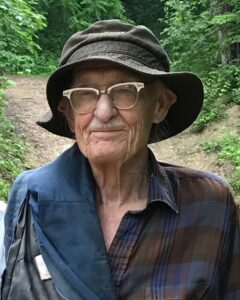
Colleagues and friends are encouraged to send thoughts and memories about Prof. Charles (Charlie) Goebel, who passed away February 18, 2026. Please email your submission to Sarah Perdue (saperdue@wisc.edu).
Read the department obituary
Read the family obituary
Bill Friedman
Charlie was a wonderful sounding-board for research in many fields in the department. His door was always open, and his technical advice was sought, and greatly appreciated by many of his colleagues. His careful analysis and wise suggestions, freely offered, were always useful. His fundamental grasp of both physics and mathematics allowed him to contribute over a very broad range of topics, and his ability to communicate clearly with his colleagues was invaluable.
On a personal note — for the better part of 30 years I enjoyed the privilege and pleasure of walking home with him after work. Our homes were both in the University Heights area. Conversations would range over both technical and non-technical topics, and provided me with a wonderful continuing extension of my education, which I immensely appreciated.
Finally, both Charlie and I were players of brass musical instruments, he the French horn and I the trumpet. In the early 1970’s we would occasionally get together to play with a few other wind players from the department, along with Charlie’s son, John, on oboe. This was for our own amusement. We sometimes played from string quartet scores. Charlie provided me with copies of several horn pieces which I enjoyed playing on my own instrument.
Vernon Barger
Charlie, as we liked to call him, was a legend in the physics department in numerous ways. I liked to think of him as the physicist’s physicist for his generosity in helping numerous faculty to solve their most difficult research and teaching questions. Martin Olsson and I consulted him continuously when we were writing our undergraduate books on classical mechanics and electromagnetism and he would spend hours coming up with perfect expositions. On the lighter side, Charles rode an antique bicycle but he could outride the young generation on very long trips to physics picnics in the country. On other occasions he led visitors on hikes up-over (literally) the boulders at Devils Lake Park or on cross-country ski trails on winding slopes through the forest. In Madison, Charlie regularly walked with his dog in the school forest. I benefitted so much from his kindness and friendship as did so many others. He showed humility in his lifestyle and I carry this image of him with his tan pants rolled at the cuff at the ready for his next bike commute.
Ron Johnson
I first met Charlie when I was a PostDoc at the University of Wisconsin–Madison. In the 1960s. My first wife, the late Betty Johnson, and I were new PhDs in a new town, and in my case a new country, still finding our feet in Physics and married life. With amazing kindness and generosity, Charlie, already an established Faculty member, and his wife Belle, made friendly overtures which quickly led to meals and shared evenings at their home. On a typical evening, following a feast of Belle’s excellent cooking, we would retire to the cellar and enjoy a concert with Charlie on the French horn and Betty on the piano. Of course, Belle and I also had to sit through a period of false starts, peculiar horn noises and strange piano sections before Charlie and Betty had ironed out all the music problems, but it was worth it.
In addition to being a fine horn player, Charlie owned and regularly used a canoe big enough to take Betty and me as well as Charlie, Belle and the two boys, George and John. What a thrill! I have happy memories of summer days on the Wisconsin River or one of Madison’s lakes doing my share of paddling. At least I hope I did my share!! My memory is shaky on this point. Charlie was a great walker. Going with Charlie on one of his walks in the Wisconsin countryside was always an unforgettable experience. He would invariably take the opportunity to expound on some topic in science (not just Physics) or in the surrounding countryside that had caught his interest, usually about some insight he had gained because he had thought through the relevant issues himself. I was in awe of wide range of his knowledge.
Charlie was a great physicist. He worked and published in fields that did not usually overlap with my much more limited range of expertise. He was an inspiration, but in a very special sense. He showed that a successful physicist could have a deeper and more cultured knowledge of the world than is usually associated with the general public’s image of a physicist. I know of no one who had spent time with Charlie who did not come away feeling that their life had been enriched.
Professor Ronald C Johnson, PhD DSc (Manc) FInstP APS Fellow EPS Fellow
Emeritus Professor, Department of Physics
University of Surrey, Guildford, Surrey, UK
Peter Timbie
Charlie had an encyclopedic mind full of unexpected knowledge. He was on the preliminary exam committee for one of my graduate students, Slade Klawikowski. During the exam, Slade described his proposed PhD research, which involved measuring the polarization of the cosmic microwave background radiation. Charlie asked him the following question: “It is well known that light becomes circularly polarized when reflected from the body of the scarab beetle. Why is that?” Neither Slade nor anyone else in the room had any idea what the answer was. When pressed to explain, Charlie seemed surprised we didn’t know that “the exoskeletons of these beetles have microscopic helical structures that naturally produce left-circularly polarized light. Apparently, male scarab beetles are able to sense this polarized light and use it to find mates!” Slade was not easily flustered and passed the exam with flying colors. But I’ll bet he remembers that question.
Francis Halzen
I could compete with Charlie in cycling, thanks to his rusted steel versus my aluminum bike, as mentioned by Vernon Barger. In physics, I could not compete. There was a time when, often during long rides, I would explain to Charlie what I was doing. Charlie was interested in absolutely everything and would usually end up pushing the envelope on a subject well beyond what I had imagined. That is how Charlie and I wrote papers together, and I guess that he would not have cared whether or not I had recognized his contribution. One time was different. With a postdoc, Jacques Leveille, I was trying to figure out the origin of radiation zeroes in QCD using computer techniques, unsuccessfully. Charlie found the answer and, what had never happened before, was interested in writing the paper with us. He had discovered a relation between perturbative scattering amplitudes in QCD. It reflected the structure of the gauge theory in a novel and fundamental way. He knew that he had done something important. The relation grew into the study of perturbative scattering amplitudes in gauge theories as well as perturbative gravity à la Feynman by Bern, Dixon, Kosower, Witten, Dvali. …
Charlie moved on. But occasionally, for instance, at the end of a review paper, a reference is slipped in to Charlie’s first example of a color-kinematic duality relation. He had done something important and did so on other occasions. He was a remarkable scientist.