This post is derived from content originally published by the University of Toronto
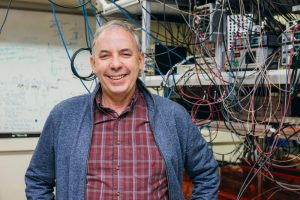
Congrats to Mark Saffman, the Johannes Rydberg Professor of Physics and director of the Wisconsin Quantum Institute, on earning the ninth Biennial John Stewart Bell Prize for Research on Fundamental Issues in Quantum Mechanics and Their Applications.
He shares the prize with Antoine Browaeys (CNRS, Université Paris-Saclay) and Mikhail Lukin (Harvard) for their pioneering contributions to quantum simulation and quantum computing with neutral atoms in optical tweezer arrays, including the development of large-scale programmable arrays for scalable quantum computation. The prize will be given at the eleventh international conference on Quantum Information and Quantum Control, University of Toronto.
Saffman’s career-spanning work was also recognized last month with the American Physical Society’s Ramsey Prize in AMO Physics and in Precision Tests of Fundamental Laws and Symmetries, a prize he shares with Browaeys.
The John Stewart Bell Prize for Research on Fundamental Issues in Quantum Mechanics and their Applications (short form: “Bell Prize”) was established in 2009, and is awarded every other year, for significant contributions first published in the preceding 6 years. The award is meant to recognize major advances relating to the foundations of quantum mechanics and to the applications of these principles – this covers, but is not limited to, quantum information theory, quantum computation, quantum foundations, quantum cryptography, and quantum control. The award is not intended as a “lifetime achievement” award, but rather to highlight the continuing rapid pace of research in these areas, and the fruitful interplay of fundamental research and potential applications. It is intended to cover even-handedly both of these aspects, and to include both theoretical and experimental contributions.