neutral atoms
Mark Saffman wins Bell Prize
This post is derived from content originally published by the University of Toronto
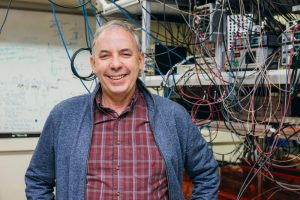
Congrats to Mark Saffman, the Johannes Rydberg Professor of Physics and director of the Wisconsin Quantum Institute, on earning the ninth Biennial John Stewart Bell Prize for Research on Fundamental Issues in Quantum Mechanics and Their Applications.
He shares the prize with Antoine Browaeys (CNRS, Université Paris-Saclay) and Mikhail Lukin (Harvard) for their pioneering contributions to quantum simulation and quantum computing with neutral atoms in optical tweezer arrays, including the development of large-scale programmable arrays for scalable quantum computation. The prize will be given at the eleventh international conference on Quantum Information and Quantum Control, University of Toronto.
Saffman’s career-spanning work was also recognized last month with the American Physical Society’s Ramsey Prize in AMO Physics and in Precision Tests of Fundamental Laws and Symmetries, a prize he shares with Browaeys.
The John Stewart Bell Prize for Research on Fundamental Issues in Quantum Mechanics and their Applications (short form: “Bell Prize”) was established in 2009, and is awarded every other year, for significant contributions first published in the preceding 6 years. The award is meant to recognize major advances relating to the foundations of quantum mechanics and to the applications of these principles – this covers, but is not limited to, quantum information theory, quantum computation, quantum foundations, quantum cryptography, and quantum control. The award is not intended as a “lifetime achievement” award, but rather to highlight the continuing rapid pace of research in these areas, and the fruitful interplay of fundamental research and potential applications. It is intended to cover even-handedly both of these aspects, and to include both theoretical and experimental contributions.
Mark Saffman awarded 2026 APS Ramsey Prize
Mark Saffman, the Johannes Rydberg Professor of Physics and director of the Wisconsin Quantum Institute, won the American Physical Society’s 2026 Norman F. Ramsey Prize in Atomic, Molecular, and Optical Physics, and in Precision Tests of Fundamental Laws and Symmetries.
The Ramsey prize recognizes outstanding accomplishments in the two fields of Norman Ramsey: atomic, molecular, and optical (AMO) physics; and precision tests of fundamental laws and symmetries. Saffman won “for seminal developments of quantum information processing with neutral atoms that allow the investigation of many-body problems that are intractable by classical computing.” He shares the prize with Antoine Browaeys at the Institut d’Optique in France.
Saffman joined the UW–Madison physics faculty in 1999 with ideas for his research program but struggled to acquire enough funding. Then, he started reading theory papers about the relatively new field of quantum computing and how to develop qubits, or quantum bits.
“This was in an era when people were proposing all these different ideas for qubits,” Saffman says. “I read this paper about using Rydberg gates to entangle atomic qubits and thought, ‘This looks interesting, let’s do that.’ That was the smartest decision I ever made in my career.”
An atom can be induced into a Rydberg state by a strong laser, when one of its outer shell electrons is excited into a very high energy state. The atom is effectively much larger than usual, and can lead to interesting quantum properties. Relatively inexperienced in experimental atomic physics, Saffman approached Thad Walker, a professor in the department and an expert on how to laser cool atoms, about collaborating. A decade later, they had their major success: a Rydberg blockade.
“The basic interaction is that you excite one atom to a Rydberg state and then you cannot excite a second one close by,” Saffman says. “That blockade interaction lies behind the ability to do a logic gate — a CNOT gate — and entangle two qubits.”
A year later, Saffman and Walker demonstrated the first CNOT gate for atomic qubits. These qubits, also called neutral atom qubits, quickly are now one of the leading platforms for achieving fault tolerant quantum computing.
Over the next decade Saffman started to realize that building a fully functional quantum computer was not just a scientific effort, it was a major engineering effort, one that was likely outside the scope of an academic research group.
“It became clear to me that to compete at the forefront, I needed more resources. I wanted to go faster,” Saffman says. “So, I ended up joining forces with ColdQuanta (now Infleqtion), an existing small cold atom sensing and components company .”
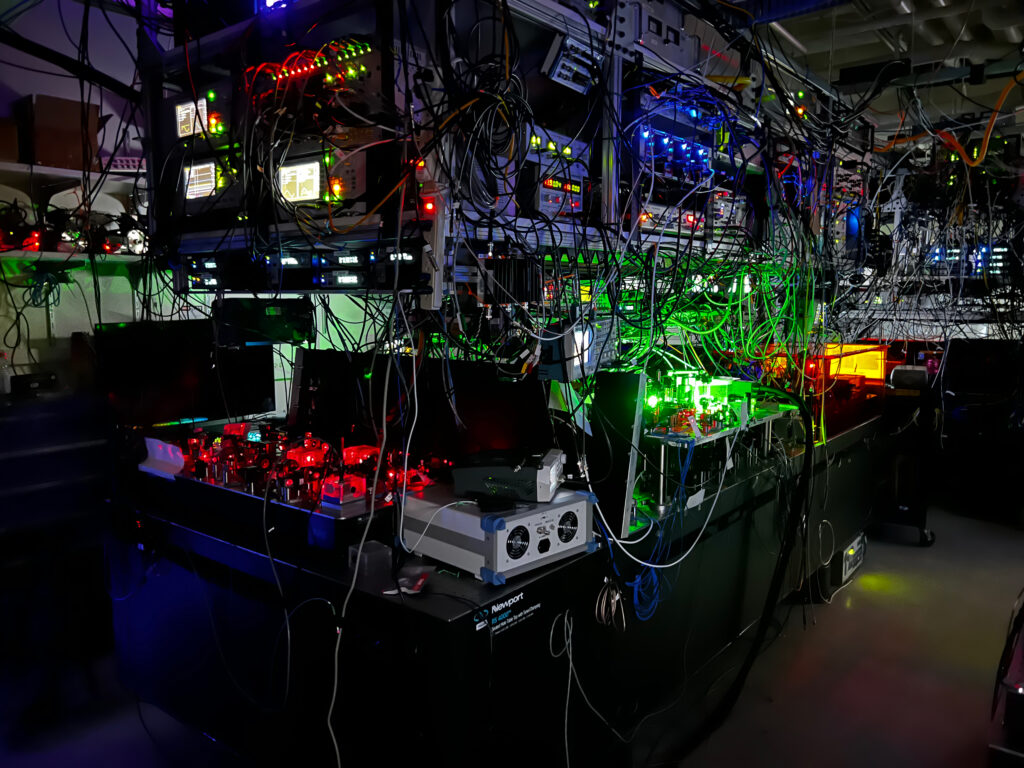
Saffman brought his quantum computing ideas to the company as Chief Scientist for Quantum Information at Colorado-based Infleqtion in 2018, and the company now has a satellite office in Madison.
The partnership with Infleqtion did, in fact, accelerate Saffman’s research. In 2022, his group, including long-time scientist and group member Trent Graham, co-authored a paper with engineers at Infleqtion where they demonstrated the first quantum algorithm to be run on an atomic quantum computer. It was a huge proof of principle and significant step forward in the field.
Quantum information research has emerged as a major topic within the AMO physics community. At UW–Madison, Saffman has been a key player in that shift. In 2019, he helped develop the Wisconsin Quantum Institute, an interdisciplinary effort of all quantum information science and engineering researchers on campus. That same year, he was named the institute’s director.
“UW–Madison was one of the first places to have multiple serious efforts in qubits: Thad and I pioneered neutral atoms, (physics professor) Mark Eriksson pioneered silicon spin qubits, (physics professor) Robert McDermott has superconducting qubits,” Saffman says. “Now, a huge fraction of new faculty coming out of academia and starting their own groups are working in quantum information-related science and engineering, including many of our new faculty. The state of quantum computing at UW–Madison is very strong.”
Welcome, Prof. Josiah Sinclair!
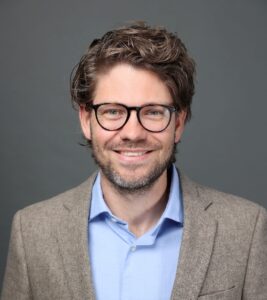
When he was younger, UW–Madison assistant professor of physics Josiah Sinclair wanted to be a scientist-inventor when he grew up. In high school, he would ask questions in biology and chemistry classes that his teachers said were really physics questions. So, when he began his undergrad at Calvin University, he majored in physics, believing that experimental physics would be at the intersection of his interests. In the end, it was quantum physics that really fascinated him, motivating him to complete a PhD in experimental quantum optics and atomic physics at the University of Toronto. He says, “The ethos of my PhD group was this idea that with modern technology, maybe we can invent an apparatus that can reproduce the essential elements of this or that classic thought experiment and learn something new.” After completing a postdoc at MIT, Sinclair joined the UW–Madison physics department as an assistant professor in August, where he will tinker in the lab as an experimental quantum physicist, and just maybe invent a new kind of neutral atom quantum computer.
Please give an overview of your research.
There’s a global race underway to build a quantum computer—a machine that operates according to the laws of quantum mechanics and uses an entirely different, more powerful kind of logic to solve certain problems exponentially faster than any classical computer can. Quantum computers won’t solve all problems, but there’s strong confidence they’ll solve some very important ones. Moreover, as we build them, we’re likely to discover new applications we can’t yet imagine.
The approach my group focuses on uses arrays of single neutral atoms as qubits. Right now, the central challenge in practical quantum computing is how to scale up quantum processors without compromising their quality. Today’s atom-array quantum computers are remarkable, hand-built systems that have reached hundreds or even thousands of qubits in recent years—a truly impressive feat and possible in part due to pioneering work done right here in Madison. However, as these systems grow larger, we’re hitting fundamental size limits that call for new strategies.
My lab is working to develop modular interconnects for neutral-atom quantum computers. Instead of trying to build a single massive machine, we aim to link multiple smaller systems together using single photons traveling through optical fibers. The challenge is that single photons are easily misplaced, so to make this work, we need to develop the most efficient atom–photon interfaces ever built—pushing the limits of our ability to control the interaction between one atom and one photon.
Once we get these quantum links working, we’ll have realized the essential building block for a truly scalable quantum computer and maybe someday the quantum internet. Beyond computing, these technologies could also enable new kinds of distributed quantum sensors, where multiple quantum systems work together to detect extremely faint signals spread across a large area, like photons arriving from distant planets.
What are the one or two main projects your new group will work on?
Our main focus will be to build two neutral atom quantum processors in adjacent rooms and link them together with an optical fiber. This project will teach us how to integrate highly efficient photonic interfaces—such as optical cavities—with atom arrays, and how to precisely control the interactions between atoms and photons. Step by step, we aim to demonstrate atom-photon entanglement and eventually send quantum information back and forth through the fiber.
We’re collaborating with a new company called CavilinQ, a Harvard spin-out supported by Argonne National Lab, to integrate a new cavity design with the geometry we want to explore for atom-photon coupling. Because we intend to iterate rapidly on the cavity design, our setup will be built on a precision translation stage, allowing us to easily slide the system in and out and swap out cavity components.
Another project in the lab will focus on developing a new kind of cold-atom quantum sensor. Most current sensors rely on magneto-optical traps, which require bulky electromagnets and impose constraints that limit performance. We plan to explore magnetic-field-free trapping techniques that could lead to simpler, more compact, and ultimately higher-performance quantum sensors.
What attracted you to Madison and the university?
Well, for me professionally, Madison’s a powerhouse in atomic physics and quantum computing. There are groups here that have been highly influential since the beginning in developing neutral atoms as a platform for quantum information science. So there’s a strong atomic physics community here that has incredible overlap with my research interests, and a thriving broader quantum information community as well. Some people work best in isolation, but that is not who I am, so the prospects of joining this vibrant collaborative environment was very appealing to me.
I also really enjoyed all my interactions with the members of the search committee and other faculty here both during my interview and subsequent visits. On the personal side, my wife’s family is all in the Chicago area, so the prospects of being so close to one side of the family were very appealing. We have a 18-month-old daughter, and when we visited, we just had such a positive impression of Madison as a place to have a family and to grow up.
What is your favorite element and/or elementary particle?
It’s rubidium. I worked with it in my PhD, I worked with it in my postdoc, and I will work with it again. It’s simple. It has one electron in the outer valence shell, which makes it easy to work with. It was one of the first atoms to be laser cooled and one of the first to be Bose condensed, but I think it still has some tricks for us up its sleeve. I believe the first quantum computers are going to be built out of rubidium atoms. Some people (and companies) think we will need a more complicated atom, like strontium or ytterbium, but I think we already have the atom we need—we just need to figure out how to make it work.
What hobbies and interests do you have?
In the last year: spending time with my eighteen-month-old daughter. It’s been a special time. I also enjoy photography. I do some photography of research labs, but mostly I do adventure photography. I don’t think of myself as a particularly talented photographer, my specialty is more being willing to lug a heavy camera up a mountain. I also really enjoy cycling, rock climbing, reading, and traveling.