
Uncategorized
UW-Madison research on planetary engulfment is featured in the New York Times
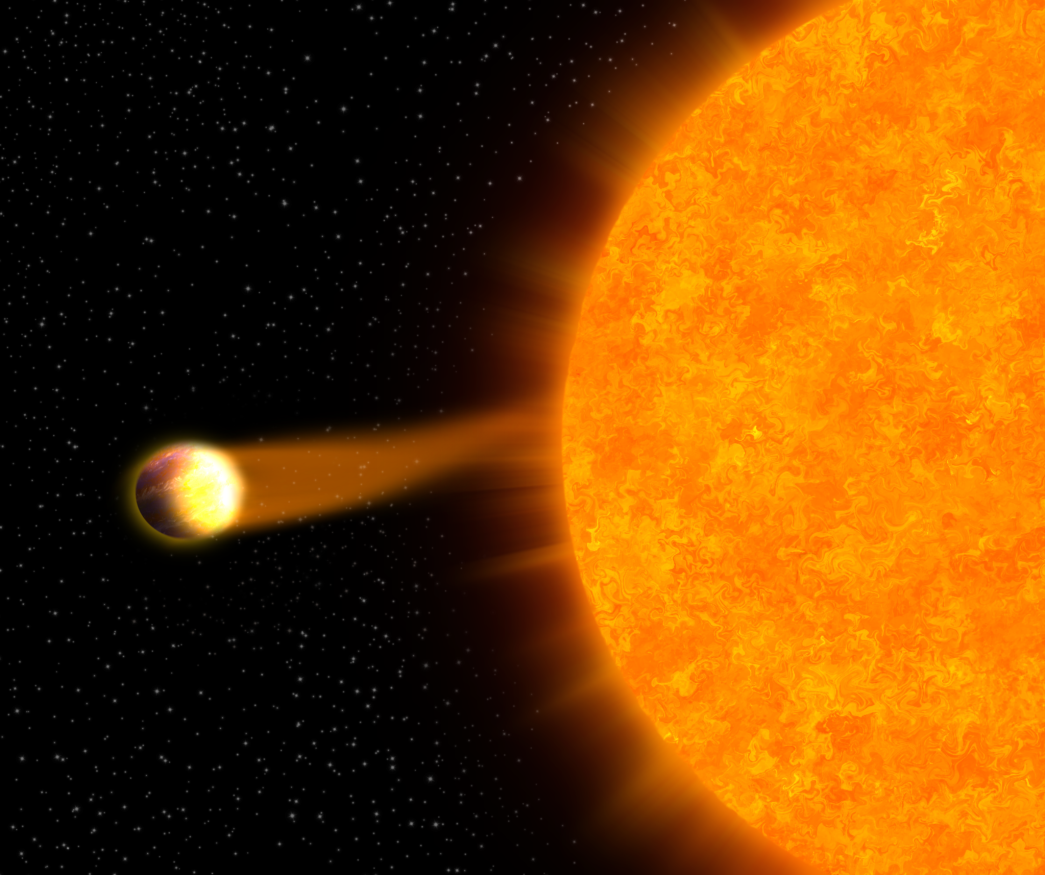
Two recent publications led by UW-Madison astrophysicists were featured in a July 9 New York Times article on planetary engulfment, the process by which a star consumes an orbiting companion. Both center on TOI-5882, an evolved subgiant star hosting a massive brown dwarf (22 Jupiter masses) on a tight, 7-day orbit, and together they reconstruct both the chemical fingerprint and the physical fate of that doomed companion.
The first paper (Kotten et al. 2026) shows that TOI-5882 carries an unusually strong lithium signature, best explained by the star having engulfed a super-Earth to Neptune-mass planet. The second (Narayan et al. 2026) develops a new, self-consistent framework for how tides drain orbital energy and angular momentum from the companion, demonstrating that internal gravity waves accelerate the brown dwarf’s inspiral far faster than classical models predict.
The work was led by two former UW-Madison undergraduates: Brooke Kotten, a former astronomy and physics major who is now an NSF Graduate Research Fellow at the University of Michigan, and Ritvik Sai Narayan, an astronomy major now heading to MIT this fall. Both students were mentored by Professor Soares-Furtado (Depts of Physics and Astronomy), who directed Brooke’s project and co-mentored Ritvik’s alongside Professor Rich Townsend. Townsend (Dept of Astronomy), who holds a Physics affiliation, played a key role in developing the computational model the team built to understand the fate of the brown dwarf. That two undergraduates drove research at this level speaks to the mentorship and research opportunities UW-Madison offers.
This project is closely aligned with the goals of WiCOR (Wisconsin Center for Origins Research; Physics and Astronomy are both department members). When a star consumes a planet, traces of the planet’s chemical makeup are left behind in the stellar atmosphere, allowing us to reconstruct its bulk composition. This matters for the search for life because a planet’s ability to support life depends largely on its interior chemistry. That chemistry determines whether the planet can form a rocky surface, maintain a protective magnetic field, and create an atmosphere. That interior chemistry is normally hidden beneath clouds and surface layers. Engulfment is one of the only ways to probe far beneath a planet’s atmosphere and determine the bulk composition of its interior. Stars like TOI-5882 provide a rare window into the ingredients that determine whether worlds like these could ever support life.
Oh, the places quantum might go! – read the WSJ article by Matt Otten
Read the full article at:
https://madison.com/exclusive/fueling-discovery/article_ce94d8c7-061b-4f85-bd69-904c06177dcf.html
Wonders of Quantum Physics program inspires the next generation of scientists with classroom kits
 Read the full article at:
Kids embrace science at Hands-On Expo
Spread throughout the main floor of the Discovery Building, the event offered kids the opportunity to hold brains, make objects float with superconductivity and jump into an immersive Virtual Reality experience.
Read the full article at: https://news.wisc.edu/kids-embrace-science-at-hands-on-expo/Join us for Nite @ the Lab!
Astronomers Discover Planets in NASA Kepler’s Final Days of Observations
This story was originally published by NASA

A team of astrophysicists — including a UW–Madison physics major — and citizen scientists have identified what may be some of the last planets NASA’s retired Kepler space telescope observed during its nearly decade-long mission.
The trio of exoplanets – worlds beyond our solar system – are all between the size of Earth and Neptune and closely orbit their stars.
”These are fairly average planets in the grand scheme of Kepler observations,” said Elyse Incha ’23. “But they’re exciting because Kepler observed them during its last few days of operations. It showcases just how good Kepler was at planet hunting, even at the end of its life.”
A paper about the planetary trio led by Incha was published in the May 30, 2023 issue of the journal Monthly Notices of the Royal Astronomical Society.
Gary Shiu awarded DOE funding to apply string theory lessons to AI
This post is modified from one originally published by the US Department of Energy
The U.S. Department of Energy (DOE) announced $4.3 million in funding for 16 projects in artificial intelligence (AI) research for high energy physics (HEP), including one from UW–Madison physics professor Gary Shiu for his work on applying knowledge gained from string theory research to improving AI techniques.
These awards support the DOE Office of Science initiative in artificial intelligence research to use AI techniques to deliver scientific discoveries that would not otherwise be possible, and to broaden participation in high energy physics research.
“AI and Machine Learning (ML) techniques in high energy physics are vitally important for advancing the field,” said Gina Rameika, DOE Associate Director of Science for High Energy Physics. “These awards represent new opportunities for university researchers that will enable the next discoveries in high energy physics.”
String theory addresses one of the deepest problems of contemporary physics, namely the reconciliation of gravity and quantum theory. It presents an enormously complex system that is well suited as a testbed for advancing AI techniques. The space of string theory solutions is vast, and the associated energy landscape is high-dimensional, computationally complex, and in general non-convex with unknown hidden structures. In recent years, a variety of AI methods have been used to tackle the string landscape.
“Now, the time is ripe for the pendulum to swing back: through studies of the string landscape, novel optimizers as well as AI techniques for discovering hidden structures of complex multi-dimensional data spaces are emerging,” Shiu says. “We propose to export lessons from string theory to advance AI algorithms generally for computationally complex constrained systems.”
Shiu expects that lessons drawn from this work would then be applied generally to AI applications in other large-scale computational problems.
Collaboration between NSF quantum centers finds path to fault tolerance in neutral atom qubits
Like the classical computers we use every day, quantum computers can make mistakes when manipulating and storing the quantum bits (qubits) used to perform quantum algorithms. Theoretically, a quantum error correction protocol can correct these errors in a similar manner to classical error correction. However, quantum error correction is more demanding than its classical counterpart and has yet to be fully demonstrated, putting a limit on the functionality of quantum computers.
In a theory paper published in Nature Communications, UW–Madison physicist Shimon Kolkowitz and colleagues show a new way that quantum errors could be identified in one type of qubit known as neutral atoms. By pinpointing which qubit experienced an error, the study suggests that the requirements on quantum error correction can be significantly relaxed, approaching a level that neutral atom quantum computers have already achieved.
The study is a collaboration between two National Science Foundation Quantum Leap Challenge Institutes, Hybrid Quantum Architectures and Networks (HQAN) and Robust Quantum Simulation (RQS). UW–Madison is a member of HQAN.
“In quantum computing, a lot of the overhead in an error-correcting code is figuring out which qubit had the error. If I know which qubit it is, then the amount of redundancy needed for the code is reduced,” Kolkowitz says. “Neutral atom qubits are right on the edge of what you would call this fault-tolerant threshold, but no one has been able to fully realize it yet.”
Neutral atom qubits are made up of single atoms trapped with light. The logical gates between the atoms are performed by exciting the atoms to “Rydberg” states where the atom’s electron is excited far beyond its normal location. This quantum computing technique was first pioneered and experimentally demonstrated at UW–Madison by physics professors Mark Saffman and Thad Walker.
Currently, one error-corrected “logical” qubit is expected to require around 1000 physical qubits, exceeding the maximum number of qubits anyone has managed to wire together in any quantum computing system. Researchers have been studying different elements in Rydberg form as qubits for decades, gradually increasing their performance but not yet reaching the level required for error correction.
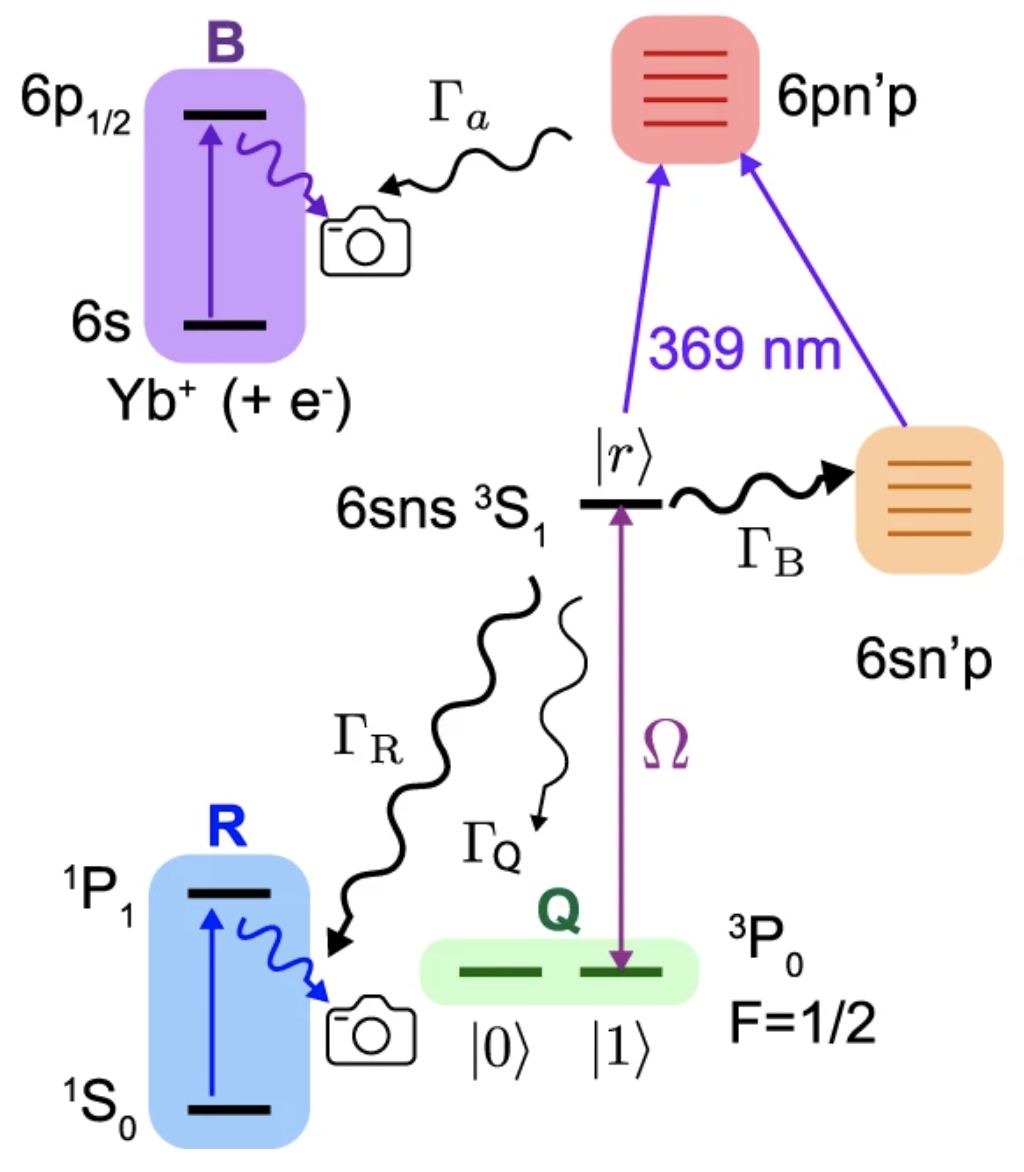
Knowing that eliminating qubit errors is not practical, Kolkowitz and colleagues instead asked if there might be a way to convert the errors into a type known as erasure errors. Named for the fact that the qubit has effectively vanished, or been erased, erasure errors can be beneficial because it is much easier to tell if a qubit is missing than if it is in the correct state or not.
They investigated the largely unstudied (in this context) element ytterbium because it has a relatively simple outer electron structure and its nucleus can only exist in two quantum spin states, +1/2 and -1/2. When manipulated into a metastable electronic state — a temporary state different than the true ground state — the qubit states are then set by the nuclear +1/2 and -1/2 spin states, and the quantum gates involve coupling one of these two qubit states to the Rydberg state.
“We knew that if an atom falls out of the metastable electronic state to the true ground state, we can detect that with a laser and still not screw up any of the other qubits at all,” Kolkowitz says. “But what that means is if I can set up a situation where errors manifest themselves as falling down into the ground state, I can just shine this laser and constantly check for errors and identify the qubit it happened in.”
In their first calculations using this metastable ytterbium platform, they showed that though errors still occur in the qubits as expected, around 98% of them would be converted to the detectable erasure errors.
But is that 98% error conversion rate good enough for a quantum computer in practice? The answer depends on the error threshold, a value that differs depending on the gates and qubits being used. The researchers next ran simulations of different numbers of quantum gates with a 98% erasure error conversion rate, or no conversion to erasure errors at all (as is currently standard).
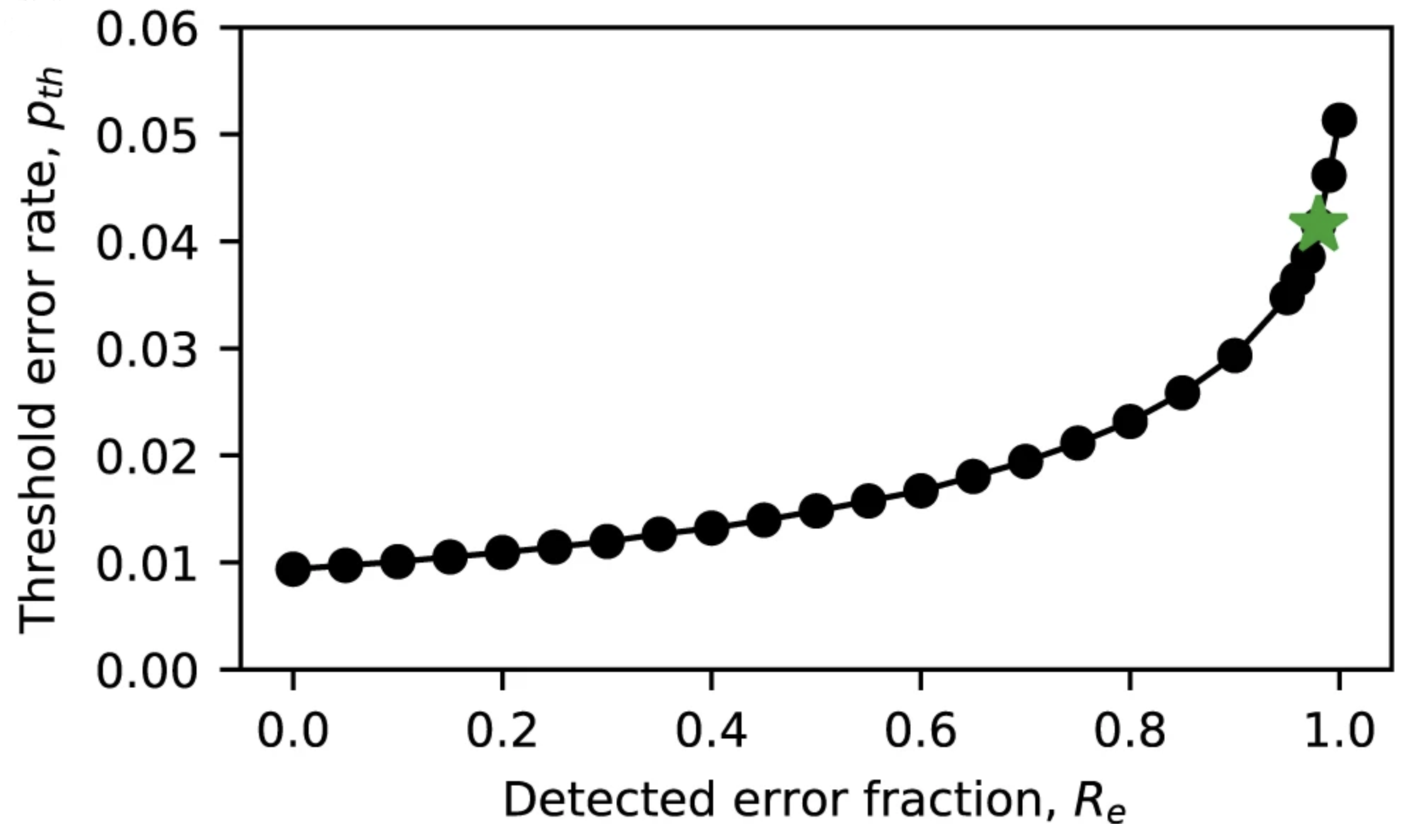
Without erasure error conversion, the error threshold is just shy of 1%, meaning each quantum gate would have to operate at over a 99% success probability to be fault tolerant. With erasure error conversion, however, the error threshold increases 4.4-fold, to just over 4%. And, for example, Saffman’s group has already demonstrated better than 4% error rates in neutral atom qubits.
The higher error threshold also means that there can be a higher ratio of logical qubits to physics qubits. Instead of one logical qubit per 1000 physical qubits, there could be around ten.
“And that’s the point of this work,” Kolkowitz says. “We show that if you can do this erasure conversion, it relaxes the requirements on both the error rates and on the number of atoms that you need.”
Co-author Jeff Thompson, an RQS investigator at Princeton, is already working to demonstrate these results experimentally in his lab. While other elements have been used in neutral atom quantum computing experiments before, until recently ytterbium was largely an unknown. Thompson’s group did much of the preliminary work to characterize the element and show that it could work well as the building block for a quantum computer.
“There were many open questions about ytterbium, and I’d say a lot of people who were using other elements are now moving into ytterbium based on Jeff’s groundwork,” Kolkowitz says. “And I expect that this study will accelerate that trend.”
Yue Wu and Shruti Puri at Yale University collaborated on this study. This work was supported by the National Science Foundation QLCI grants OMA-2120757 and OMA-2016136. Kolkowitz’s part of the work was additionally supported by ARO W911NF-21-1-0012.
Physics & math senior Gage Siebert awarded NSF GRFP

Congratulations to Gage Siebert for being awarded a National Science Foundation Graduate Research Fellowship! Gage is a senior math and physics major who has been conducting research in radio astronomy and cosmology. He is working on the optics of NASA’s EXCLAIM mission and constructing a periodicity search using the Tianlai Radio Array. Gage is also a 2021 Hilldale Fellow and Goldwater Scholar, and has won the department’s Hagengruber Scholarship, Liebenberg Family Scholarship, and Henry & Eleanor Firminhac Scholarship. He plans to attend graduate school but has not decided where yet.
Peter Timbie, Gage’s research advisor, says:
Congratulations Gage on winning one of these exceedingly rare awards! We’re really proud of you,Best of luck with you proposal to search for periodic signals in cosmological survey data and your plans for graduate school.
21 UW–Madison students in total received the fellowship, a highly sought and competitive award. The Graduate Research Fellowship Program supports high-potential scientists and engineers in the early stages of their careers. Each year, more than 12,000 applicants compete for 2,000 fellowship awards.
Awardees from UW–Madison, including both undergraduate and graduate students, represent a variety of specializations across science, engineering, and technology. Another 23 UW–Madison students were recognized with honorable mentions.
The program provides awardees with three years of financial support consisting of a $34,000 annual stipend and a $12,000 education allowance. UW–Madison contributes toward fringe benefits.