Events at Physics |
Events on Monday, September 21st, 2026
- Theory Seminar (High Energy/Cosmology)
- Beyond Δm²: Absolute Mass Sensitivity in Neutrino Oscillations
- Time: 11:30 am - 1:00 pm
- Place: Chamberlin 5280
- Speaker: André de Gouvêa, Northwestern University
- Abstract: Conventional wisdom says that neutrino oscillations measure only mass-squared differences and not the absolute neutrino mass scale. This is true, however, only at leading order in the expansion parameters m_i/E, the ratios of the neutrino masses m_i (i = 1, 2, 3) to the neutrino energy E. At next-to-leading order, the oscillation phase includes terms proportional to m_i^4 − m_j^4 = Δm²_ij (m_i^2 + m_j^2), and is therefore sensitive to the absolute mass scale. I discuss the next-to-leading-order corrections using a wave-packet treatment and taking into account the neutrino-production kinematics. The result can be applied to reactor neutrinos and, it turns out, the JUNO experiment is sensitive to neutrino masses of a few hundred keV.
- Host: Joshua Foster
- Plasma Physics (Physics/ECE/NE 922) Seminar
- Waves in a Plasma Ocean: Wave-Particle Interactions Throughout the Solar System
- Time: 12:00 pm - 1:00 pm
- Place: 2241 Chamberlin Hall
- Speaker: Allison Jaynes, University of Iowa
- Abstract: All planetary and smaller bodies in our solar system are embedded in a sea of plasma, like boulders in a terrestrial ocean. Their surfaces or magnetic fields run into this ocean of space plasma, generated primarily by our Sun, and create a whole range fascinating effects as a result. Waves in interplanetary space and waves produced by solar wind-planetary interactions both initiate wave-particle interactions across a variety of scale sizes. These wave-particle interactions can fuel many phenomena: from the ‘killer electrons’ in the Van Allen radiation belts that affect spacecraft and Earth’s atmosphere to the echoes of distant magnetic structures we can observe at the edge of our solar system and beyond with the Voyager spacecraft. This process can also cause the local aurora above our heads and it plays a role in the giant particle accelerator that is Jupiter’s magnetosphere. In this talk, I will present recent significant insights we’ve gained about wave-particle interactions across our solar system and illustrate how this fundamental plasma physics process underlies a vast scope of the space environment: from different worlds to the furthest reaches of our space exploration.
- Host: Vladimir Zhdankin
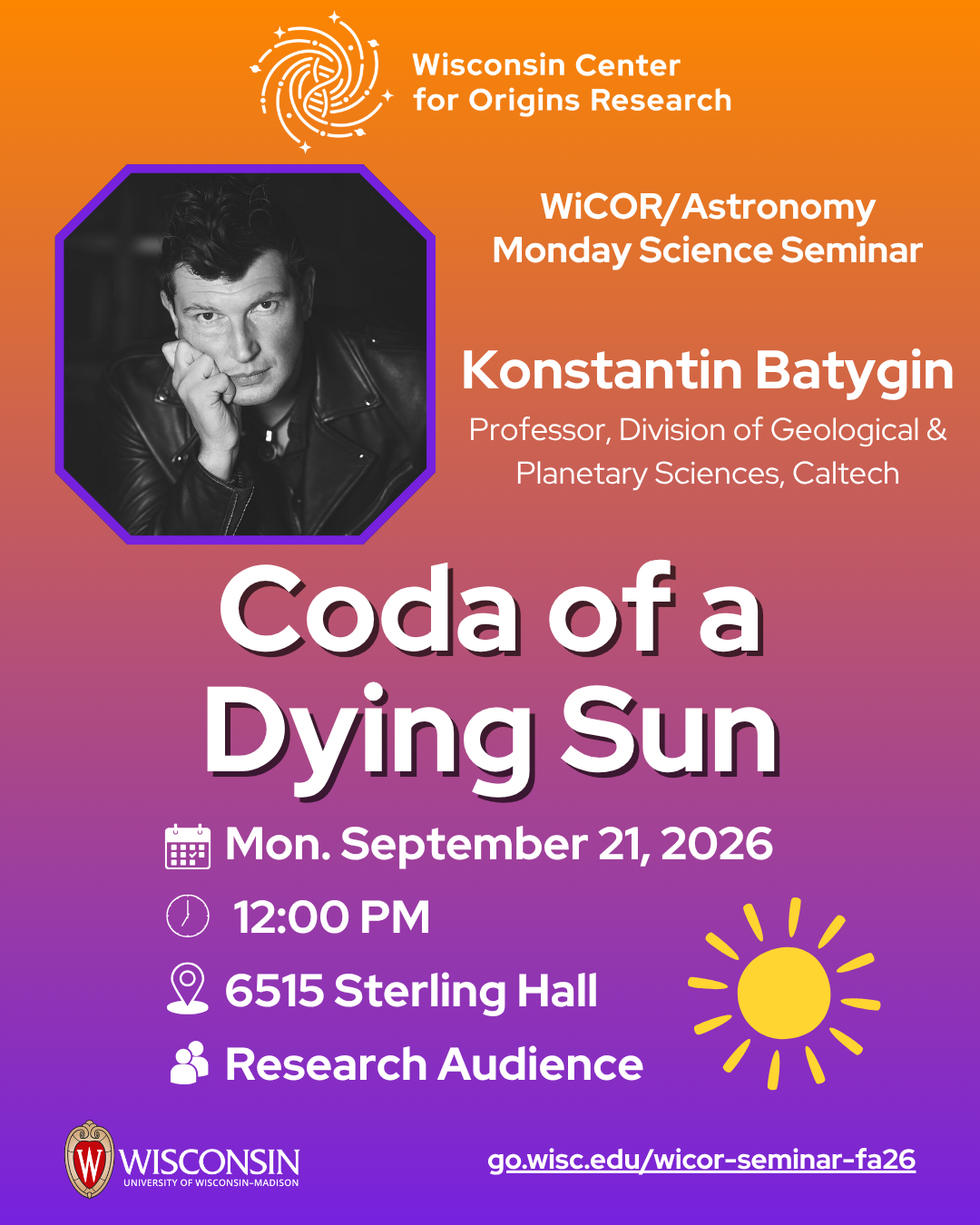
- WiCOR/Astronomy Monday Science Seminar
- Coda of a Dying Sun
- Time: 12:00 pm - 1:00 pm
- Place: WiCOR Space, 6515 Sterling Hall
- Speaker: Konstantin Batygin, Professor, Division of Geological & Planetary Sciences, Caltech
- Abstract: From its birth, celestial mechanics has been deeply intertwined with the question of the Solar System’s dynamical stability. For the inner planets, this question is now statistically settled: Mercury’s orbit carries roughly a 1 percent chance of destabilization before the Sun leaves the main sequence. The outer Solar System has seemed more secure, with an intrinsic dynamical lifetime estimated at approximately 10^18 years. Even accounting for solar mass loss and stellar flybys, the orbital architecture of the giant planets has been expected to persist for roughly 100 billion years.
Here, we show that these estimates rest on the assumption that solar mass loss is smooth. The recently measured recoil of white dwarfs instead points to asymmetric mass loss, most readily attributed to discrete, independently directed ejections that impulsively perturb stellar motion. As the Sun sheds its envelope in such parcels, the planetary orbits undergo a random walk whose amplitude is determined by the granularity of the mass loss. For granularity consistent with observationally permitted kicks, this stochastic forcing restructures the outer Solar System concurrently with the Sun’s death.
Our numerical experiments reveal that orbit crossing can begin on the red giant branch, with roughly 40 percent of realizations undergoing disruption or violent scattering before the white dwarf forms and roughly 90 percent self-destructing within 3 billion years. The dynamical lifetime of the outer Solar System thus collapses from approximately 10^18 years to about a billion years after white dwarf formation. - Host: WiCOR, Juliette Becker