Detailed molecular picture of tooth enamel reveals adaptions to diets, Gilbert and colleagues find

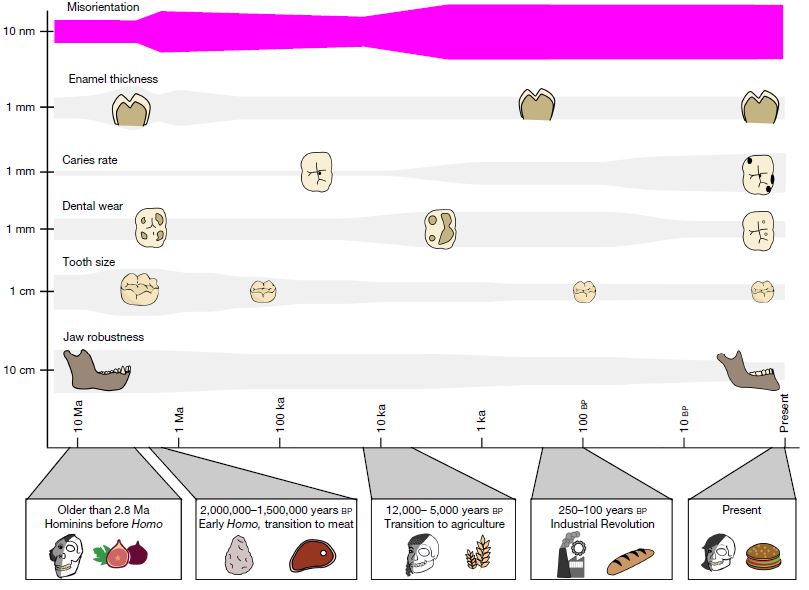
graph that shows evolution of enamel as diet changes
Hominin dentitions have changed in relation to dietary changes over the past 10 million years. Compared with the earliest hominins, modern humans have less robust jaws, smaller posterior teeth and thinner enamel. At the nanoscale (10 nm), modern humans have more misoriented enamel than the earliest hominins, as reported here in magenta.

From chewing to chomping to grinding, teeth suffer from a lifetime of repeated mechanical stress. It makes sense, then, that enamel is one of the hardest natural materials. University of Wisconsin–Madison physics professor Pupa Gilbert and colleagues previously showed that the hydroxyapatite nanocrystals that make up enamel are arranged perfectly parallel to one another, like hairs in a ponytail, but their crystal lattices are not co-oriented — a structure that contributes to the biomaterial’s resistance to fracture, also known as toughness.

In a new study published on June 3 in the journal Nature, Gilbert and her colleagues developed a technique to quantitively measure enamel nanocrystal orientation angles across human and non-human primate enamel from different epochs, finding a strong correlation between how tough food is and the misorientation angle. The results help explain enamel evolution and have implications for modulating strength in bioinspired materials.

“Our work demonstrates that the misorientation of adjacent nanocrystals in enamel correlates very strongly with the hardness of food that primates eat,” Gilbert says. “Overall, the misorientation angles measured were small, all falling between 1.3 and 7.2 degrees, which makes sense with our earlier work where we found that small misorientation angles between thin, long, morphologically parallel nanocrystals deflect cracks and therefore toughen enamel.”

In all primates, enamel is arranged into 5-micrometer-wide bundles of elongated ~50-nanometer-wide hydroxyapatite nanocrystals. When grown synthetically, hydroxyapatite nanocrystals grow as needles, and they always have the crystalline axis along the long axis of the crystal. In enamel they do not.

Gilbert’s new work uses a new technique she developed, called PELICAN, that displays crystal orientations quantitatively and precisely measures the misorientation of adjacent nanocrystals. This technique allows the researchers to measure the misorientation angle of one nanocrystal relative to eight neighboring crystals, with nine million angles per area. They display the data in false-colored PELICAN maps where different colors represent the range of angles, and they make histograms of the frequency of each misorientation angle.

The researchers first compared enamel structure from non-human primates, including currently living and fossilized species whose diets range from soft fruit to hard seeds and nuts. The data show a clear increase in adjacent nanocrystal misorientation angles as the primates’ food hardness increases — with a nearly six-fold increase from ripe fruit to nutshells, from 1.3 to 7.2 degrees.

Next, they looked at primates in the human lineage, first comparing three species that lived at the same time and in the same region, ~1.6 million years ago in Kenya, but ate no meat, some meat, or mostly meat. They found that the non-meat-eater had lower misorientation angles compared to the meat eaters — 2.1 to 3-3.5 degrees — with no statistical difference between the meat eaters. Their next comparison was between Homo sapiens (paleolithic and modern humans) from before (~40,000 years ago) and after (1550 and 700 years ago) the switch to agriculture, where food in general is softer, yet they still saw an increase in crystal misorientation. However, Gilbert’s anthropologist co-author Mackie O’Hara notes that stone grinding introduced stone grit into food, making it harder and abrasive at the microscale. As in non-human primates, a general trend emerges that harder or tougher food is associated with larger misorientation angles of adjacent enamel nanocrystals.
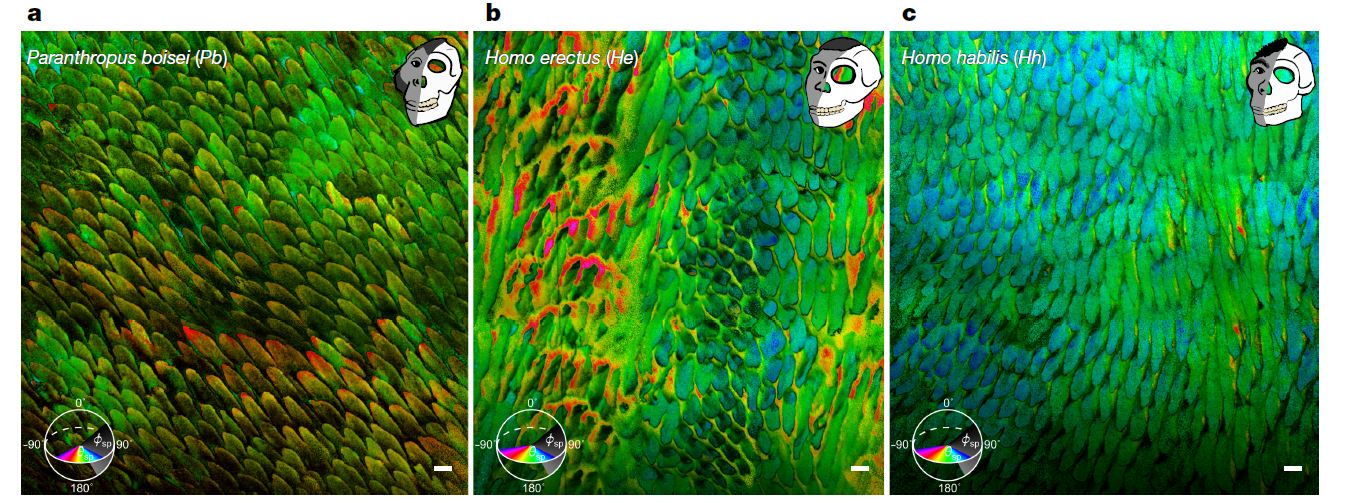
measurements that show misorientation of enamel nanocrystals
The consumption of meat in hominin diets correlates with an increase in misorientation angle. PELICAN maps of the occlusal enamel region from P. boisei (Pb; no meat; a), H.erectus (He; regular meat consumption; b) and H. habilis (Hh; occasional meat consumption; c).

Lastly, they looked at a modern human sample from 50 years ago, about 200 years after the Industrial Revolution when diets became much softer. Nanocrystal misorientation still went up slightly relative to the two post-agriculture Medieval samples, but the increase was not statistically significant, thus, the Industrial Revolution did not affect enamel nanostructure. Gilbert acknowledges that more research is needed to understand why misorientation angles did not decrease. One idea is that enamel adapts and evolves on a timescale greater than a few hundred years; another is that enamel is but one variable in the overall picture.

“The enamel nanostructure is only one component of a complex set of changes,” Gilbert says. “Our brains grew significantly in the last 2 million years, our jaws shrank in the last 12,000 years, we developed language, and many other changes occurred over human evolution. Even beyond genetic changes, physical characteristics change all the time, for example, crowding of the teeth toward the front of the mouth didn’t happen until after the Industrial Revolution.”

Overall, Gilbert and her team’s work suggests that primates have evolved to protect their teeth with stronger enamel as food becomes tougher. The team has not nailed down the exact misorientation angle at which maximum protection can occur, but the 1.3-7.2 degrees they measured in this study fits nicely within what materials scientists call low-angle grain boundaries, typically lower than 10-15 degrees.

“These results could also be harnessed for the synthesis of new materials that resist fracture with small misorientation of adjacent nanocrystals, such as self-assembling spherulites” Gilbert says.

Velocity gradients key to explaining large-scale magnetic field structure

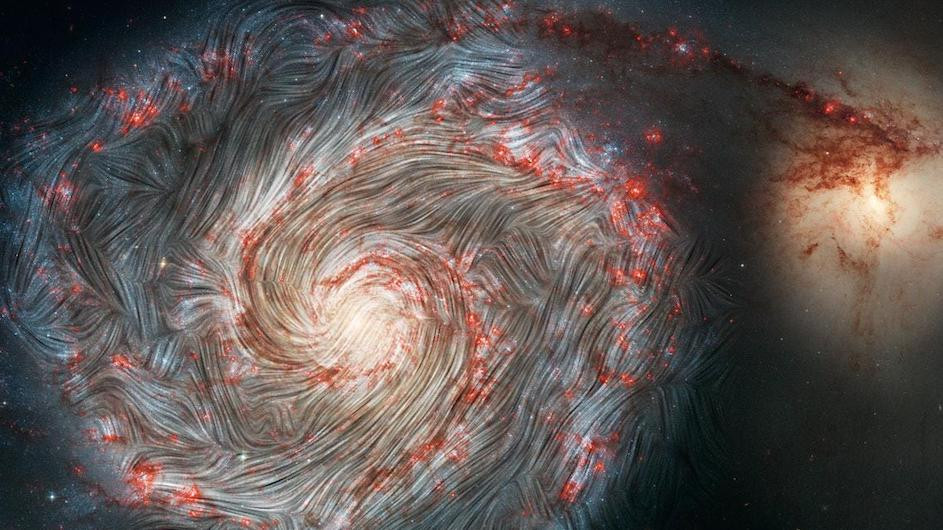
a whirled, wispy, spiral galaxy has white magnetic field lines overlaid on the image, showing that the magnetic field structure is organized in large, long structures over the entirety of the galaxy

All celestial bodies — planets, suns, even entire galaxies — produce magnetic fields, affecting such cosmic processes as the solar wind, high-energy particle transport, and galaxy formation. Small-scale magnetic fields are generally turbulent and chaotic, yet large-scale fields are organized, a phenomenon that plasma astrophysicists have tried explaining for decades, unsuccessfully. 

In a paper published January 21 in Nature, a team led by scientists at the University of Wisconsin–Madison have run complex numerical simulations of plasma flows that, while leading to turbulence, also develop structured flows due to the formation of large-scale jets. From their simulations, the team has identified a new mechanism to describe the generation of magnetic fields that can be broadly applied, and has implications ranging from space weather to multimessenger astrophysics.

profile photo of Bindesh Tripathi
Bindesh Tripathi

“Magnetic fields across the cosmos are large-scale and ordered, but our understanding of how these fields are generated is that they come from some kind of turbulent motion,” says the study’s lead author Bindesh Tripathi, a former UW–Madison physics graduate student and current postdoctoral researcher at Columbia University. “Given that turbulence is known to be a destructive agent, the question remains, how does it create a constructive, large-scale field?” 

Before working on three-dimensional (3D) magnetic fields, Tripathi investigated systems with hydrodynamic flows and two-dimensional (2D) magnetic fields. After staring at the movies and images of 3D magnetic turbulence, he noticed similarities in the shapes of large-scale flows and large-scale magnetic field structures. But it wasn’t as simple as applying fluid dynamic theory to magnetic field generation: the former may be solved as a 2D problem, whereas the latter must be solved in 3D, making it a much more complex, difficult-to-solve problem.

Tripathi and his colleagues decided to tackle the problem with two key changes from previous research. 

The first difference was the input: a constantly replenished velocity gradient. A cyclist hitting a curb head-on, say, experiences a velocity gradient: the wheels stop, but momentum can cause the cyclist to fly over the handlebars. Velocity gradients exist throughout the universe; for example, within different layers of the sun or when two neutron stars merge. The team reasoned that this gradient is likely important to include while studying 3D magnetic fields. 

Second, they ran perhaps the most complex simulation to date of magnetic fields in the presence of an unstable velocity gradient — 137 billion grid points in 3D space. Altogether, they ran around 90 simulations, generating 0.25 petabytes of data and using nearly 100 million CPU hours on the Anvil supercomputer at Purdue University.

Ordered magnetic fields spontaneously emerge out of chaotic, tangled fields. This finding is consistent with astrophysical observations. Streamlines of magnetic fields are 3D-rendered and are colored red–blue by the x-component of the field. Streamlines of the electric current density are shown in green; color represents magnitude. Poloidal fields are displayed on the (y,z)-plane, after averaging them over the azimuthal (x) direction. Credit: Tripathi et al.

“We start our simulations with a flow that has a velocity gradient, then we add some tiny perturbations, like moving one fluid particle infinitesimally, we let that perturbation propagate over the system and grow, and then analyze the data over time,” Tripathi says. “Initially, these perturbations lead to turbulent flows and magnetic fields in small-scale structures, then, over time, they emerge into larger, ordered structures.” 

When Tripathi ran the same simulations where the initial velocity gradient had decayed over time, the simulation only produced the chaotic, small-scale patterns. “So that’s really the main key: to have a steady, large-scale gradient in velocity,” he emphasizes. 

Adds Paul Terry, physics professor at UW–Madison and senior author of the study: “Magnetic field generation via dynamos has been extensively studied for 70 years, with the frustrating result that the generated fields almost always end up at small scales and highly disordered, unlike observations. This work, therefore, potentially resolves a long-standing issue.”

Though the theory cannot be tested in the distant universe, a lab-based experiment does support the team’s findings: in 2012, colleagues at the Wisconsin Plasma Physics Laboratory were trying to better understand the nature of the magnetic field generation process in a laboratory experiment, but their data did not fit any of the previous models. Tripathi and colleagues’ new theory of magnetic field generation more closely matches the experimental data and helps to resolve the confounding findings.

“This work has the potential to explain the magnetic dynamics relevant in, for example, neutron star mergers and black hole formation, with direct applications to multimessenger astronomy,” Tripathi says. “It may also help better understand stellar magnetic fields and predict gas ejections from the sun toward the earth.”

Top image: The magnetic fields in large-scale structures are organized despite local areas of turbulence. The magnetic field in the Whirlpool Galaxy (M51), captured by NASA’s flying Stratospheric Observatory for Infrared Astronomy (SOFIA) observatory superimposed on a Hubble telescope picture of the galaxy. The image shows infrared images of grains of dust in the M51 galaxy. Their magnetic orientation largely follows the spiral shape of the galaxy, but it is also being pulled in the direction of the neighboring galaxy at the right of the frame. (Credit: NASA, SOFIA, HAWC+, Alejandro S. Borlaff; JPL-Caltech, ESA, Hubble)


This work was supported by the National Science Foundation (2409206) and U.S. Department of Energy (DE-SC0022257) through the DOE/NSF Partnership in Basic Plasma Science and Engineering. Anvil at Purdue University was used through allocation TG-PHY130027 from the Advanced Cyberinfrastructure Coordination Ecosystem: Services & Support (ACCESS) program, which is supported by National Science Foundation (2138259, 2138286, 2138307, 2137603 and 2138296).