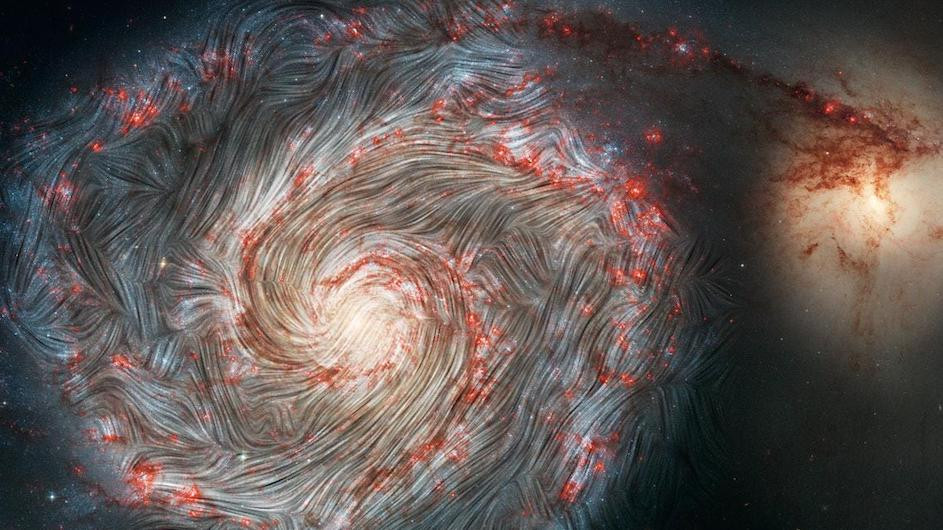
Velocity gradients key to explaining large-scale magnetic field structure

a whirled, wispy, spiral galaxy has white magnetic field lines overlaid on the image, showing that the magnetic field structure is organized in large, long structures over the entirety of the galaxy

All celestial bodies — planets, suns, even entire galaxies — produce magnetic fields, affecting such cosmic processes as the solar wind, high-energy particle transport, and galaxy formation. Small-scale magnetic fields are generally turbulent and chaotic, yet large-scale fields are organized, a phenomenon that plasma astrophysicists have tried explaining for decades, unsuccessfully. 

In a paper published January 21 in Nature, a team led by scientists at the University of Wisconsin–Madison have run complex numerical simulations of plasma flows that, while leading to turbulence, also develop structured flows due to the formation of large-scale jets. From their simulations, the team has identified a new mechanism to describe the generation of magnetic fields that can be broadly applied, and has implications ranging from space weather to multimessenger astrophysics.

profile photo of Bindesh Tripathi
Bindesh Tripathi

“Magnetic fields across the cosmos are large-scale and ordered, but our understanding of how these fields are generated is that they come from some kind of turbulent motion,” says the study’s lead author Bindesh Tripathi, a former UW–Madison physics graduate student and current postdoctoral researcher at Columbia University. “Given that turbulence is known to be a destructive agent, the question remains, how does it create a constructive, large-scale field?” 

Before working on three-dimensional (3D) magnetic fields, Tripathi investigated systems with hydrodynamic flows and two-dimensional (2D) magnetic fields. After staring at the movies and images of 3D magnetic turbulence, he noticed similarities in the shapes of large-scale flows and large-scale magnetic field structures. But it wasn’t as simple as applying fluid dynamic theory to magnetic field generation: the former may be solved as a 2D problem, whereas the latter must be solved in 3D, making it a much more complex, difficult-to-solve problem.

Tripathi and his colleagues decided to tackle the problem with two key changes from previous research. 

The first difference was the input: a constantly replenished velocity gradient. A cyclist hitting a curb head-on, say, experiences a velocity gradient: the wheels stop, but momentum can cause the cyclist to fly over the handlebars. Velocity gradients exist throughout the universe; for example, within different layers of the sun or when two neutron stars merge. The team reasoned that this gradient is likely important to include while studying 3D magnetic fields. 

Second, they ran perhaps the most complex simulation to date of magnetic fields in the presence of an unstable velocity gradient — 137 billion grid points in 3D space. Altogether, they ran around 90 simulations, generating 0.25 petabytes of data and using nearly 100 million CPU hours on the Anvil supercomputer at Purdue University.

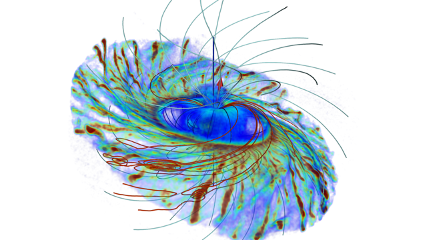
Ordered magnetic fields spontaneously emerge out of chaotic, tangled fields. This finding is consistent with astrophysical observations. Streamlines of magnetic fields are 3D-rendered and are colored red–blue by the x-component of the field. Streamlines of the electric current density are shown in green; color represents magnitude. Poloidal fields are displayed on the (y,z)-plane, after averaging them over the azimuthal (x) direction. Credit: Tripathi et al.

“We start our simulations with a flow that has a velocity gradient, then we add some tiny perturbations, like moving one fluid particle infinitesimally, we let that perturbation propagate over the system and grow, and then analyze the data over time,” Tripathi says. “Initially, these perturbations lead to turbulent flows and magnetic fields in small-scale structures, then, over time, they emerge into larger, ordered structures.” 

When Tripathi ran the same simulations where the initial velocity gradient had decayed over time, the simulation only produced the chaotic, small-scale patterns. “So that’s really the main key: to have a steady, large-scale gradient in velocity,” he emphasizes. 

Adds Paul Terry, physics professor at UW–Madison and senior author of the study: “Magnetic field generation via dynamos has been extensively studied for 70 years, with the frustrating result that the generated fields almost always end up at small scales and highly disordered, unlike observations. This work, therefore, potentially resolves a long-standing issue.”

Though the theory cannot be tested in the distant universe, a lab-based experiment does support the team’s findings: in 2012, colleagues at the Wisconsin Plasma Physics Laboratory were trying to better understand the nature of the magnetic field generation process in a laboratory experiment, but their data did not fit any of the previous models. Tripathi and colleagues’ new theory of magnetic field generation more closely matches the experimental data and helps to resolve the confounding findings.

“This work has the potential to explain the magnetic dynamics relevant in, for example, neutron star mergers and black hole formation, with direct applications to multimessenger astronomy,” Tripathi says. “It may also help better understand stellar magnetic fields and predict gas ejections from the sun toward the earth.”

Top image: The magnetic fields in large-scale structures are organized despite local areas of turbulence. The magnetic field in the Whirlpool Galaxy (M51), captured by NASA’s flying Stratospheric Observatory for Infrared Astronomy (SOFIA) observatory superimposed on a Hubble telescope picture of the galaxy. The image shows infrared images of grains of dust in the M51 galaxy. Their magnetic orientation largely follows the spiral shape of the galaxy, but it is also being pulled in the direction of the neighboring galaxy at the right of the frame. (Credit: NASA, SOFIA, HAWC+, Alejandro S. Borlaff; JPL-Caltech, ESA, Hubble)


This work was supported by the National Science Foundation (2409206) and U.S. Department of Energy (DE-SC0022257) through the DOE/NSF Partnership in Basic Plasma Science and Engineering. Anvil at Purdue University was used through allocation TG-PHY130027 from the Advanced Cyberinfrastructure Coordination Ecosystem: Services & Support (ACCESS) program, which is supported by National Science Foundation (2138259, 2138286, 2138307, 2137603 and 2138296).


 

Ke Fang, Ellen Zweibel earn Simons Foundation funding to study electrodynamics in extreme environments

Much of what we understand about fundamental physics is based on experiments done in the convenient “lab” of earth. But our planet is just one location, with its own relatively mild electromagnetic field. Do forces and energies work the same on earth as they do in all corners of the universe?

profile photo of Ellen Zweibel
Ellen Zweibel
profile photo of Ke Fang
Ke Fang

“It’s never guaranteed, as we see many theories break down at extreme environments,” says University of Wisconsin­–Madison physics professor Ke Fang. “For example, a neutron star offers a magnetic field that is trillions of times stronger than on the Earth, and magnetars offer a field that is hundreds of trillions of time stronger. They are natural places to test many fundamental physics theories.”

Fang and UW–Madison astronomy and physics professor Ellen Zweibel are part of a new research collaboration announced August 21 by the Simons Foundation. The Simons Collaboration on Extreme Electrodynamics of Compact Sources (SCEECS) will study how electrodynamics — the interaction of electric currents and magnetic fields — behave in extreme environments in the distant universe using a combination of theory, simulation, and observation.

SCEECS has six main research questions, three centered on understanding electrodynamics in neutron stars and three centered in black holes. Each question pairs at least one senior-level investigator with an early-career co-investigator. Zweibel serves as the lead investigator on her black hole question, and she is paired with Richard Anantua at UT-San Antonio. Fang is co-investigator on a neutron star question, and she is paired with Anatoly Spitkovsky at Princeton.

a wispy, circular set of colorful lines emanate from a center point, indicating the electromagnetic field shooting out of a neutron star
“Particle in cell” simulation of the magnetic field and electric current associated with a spinning and strongly magnetized neutron star (adapted from Philippov and Kramer 2023) | From SCEECS

The neutron star “labs” that Fang is using are amongst the most dense stars in the universe — as small as 10 kilometers in diameter and with densities a million billion times that of water. High energy particles streaming from neutron stars are detectable on Earth, but they tend to be significantly altered by the time they make it here.

“How do those particles survive, in the sense that these extreme energy particles would interact with the surrounding media and produce secondary particles, and how do these interactions play a role in converting what you see on Earth?” Fang’s research asks. “There are also several major questions revealed by recent observations, such as extended TeV gamma-ray halos around neutron stars that are completely new phenomena. We would like to go from first principle physics to understand these phenomena.”

Zweibel’s research will use the extreme environment of spinning black holes, where the electromagnetic field has recently been identified as a major factor in accretion flows, or the movement of gases into the dense center. Her question asks how these accretion flows contribute to magnetizing black holes to form relativistic jets, or powerful emissions of radiation and high-energy particles.

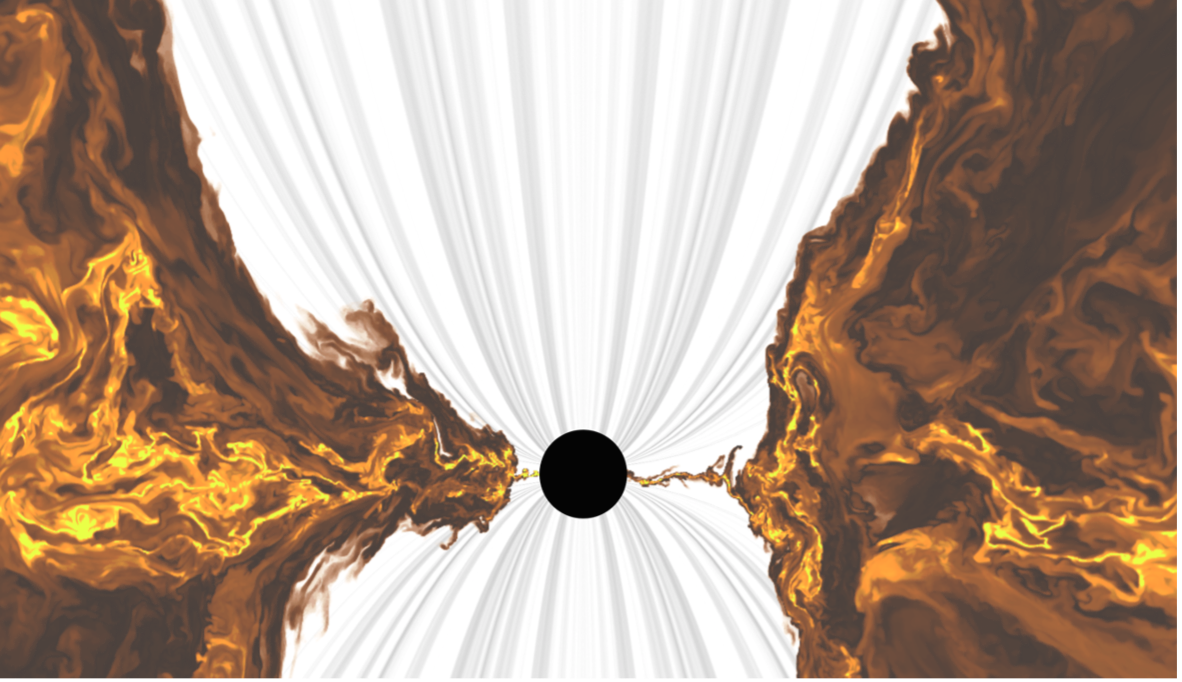
a small black point at the center of the image is flanked by two brown-ish blobs made of flowing lines, like magma flowing down a volcano. Grey parabolic lines also shoot out the top and bottom.
Simulation of the magnetic field threading the black hole and confined by orbiting gas (adapted from Ripperda et al. 2022) | From SCEECS

“Accretion disks, their magnetic fields, and their magnetized jets are found throughout the Universe. They play essential roles in star formation, in the evolution of double, or binary stars, and in many other astrophysical settings,” Zweibel says. “The magnetized accretion disks surrounding black holes are by far the most extreme, and test our theories to the limits. Remarkably, we can circle back to laboratory plasma experiments, including some right here at UW, to study magnetized disks and jets as well.”

SCEECS is housed at Stanford University and includes researchers from 14 other US and international universities. UW­–Madison and Columbia University are the only universities that have more than one investigator in the collaboration. Most of the funding will be used to support investigators, postdoctoral fellows, and graduate students.

The collaboration plans to host an in-person kick-off in October at Stanford with regular virtual meetings throughout the year. Those meetings will be a place where everyone involved in the research, including students, postdocs, and faculty, can provide updates and seek feedback. Larger-scale collaborations such as this one are nothing new to physicists, but those groups are almost always made up of experimental physicists.

“It’s rare for theorists to be in a larger collaboration because we’re usually working alone or in a small group,” Fang says. “This program is exciting because it collects leading theorists in the field from many different institutions and provides a network for us to collaborate with each other.”

The Simons Foundation’s mission is to advance the frontiers of research in mathematics and the basic sciences. The Foundation makes grants in four areas, including Mathematics and Physical Sciences, through which this collaboration is supported.

New study provides understanding of astrophysical plasma dynamics

Stars, solar systems, and even entire galaxies form when astrophysical plasma — the flowing, molten mix of ions and electrons that makes up 99% of the universe — orbits around a dense object and attaches, or accretes, on to it. Physicists have developed models to explain the dynamics of this process, but in the absence of sending probes to developing stars, the experimental confirmation has been hard to come by.

In a study published in Physical Review Letters September 25, University of Wisconsin–Madison physicists recreated an astrophysical plasma in the lab, allowing them to investigate the plasma dynamics that explain the accretion disk formation. They found that electrons, not the momentum-carrying ions, dominate the magnetic field dynamics in less dense plasmas, a broad category that includes nearly all laboratory astrophysical plasma experiments.

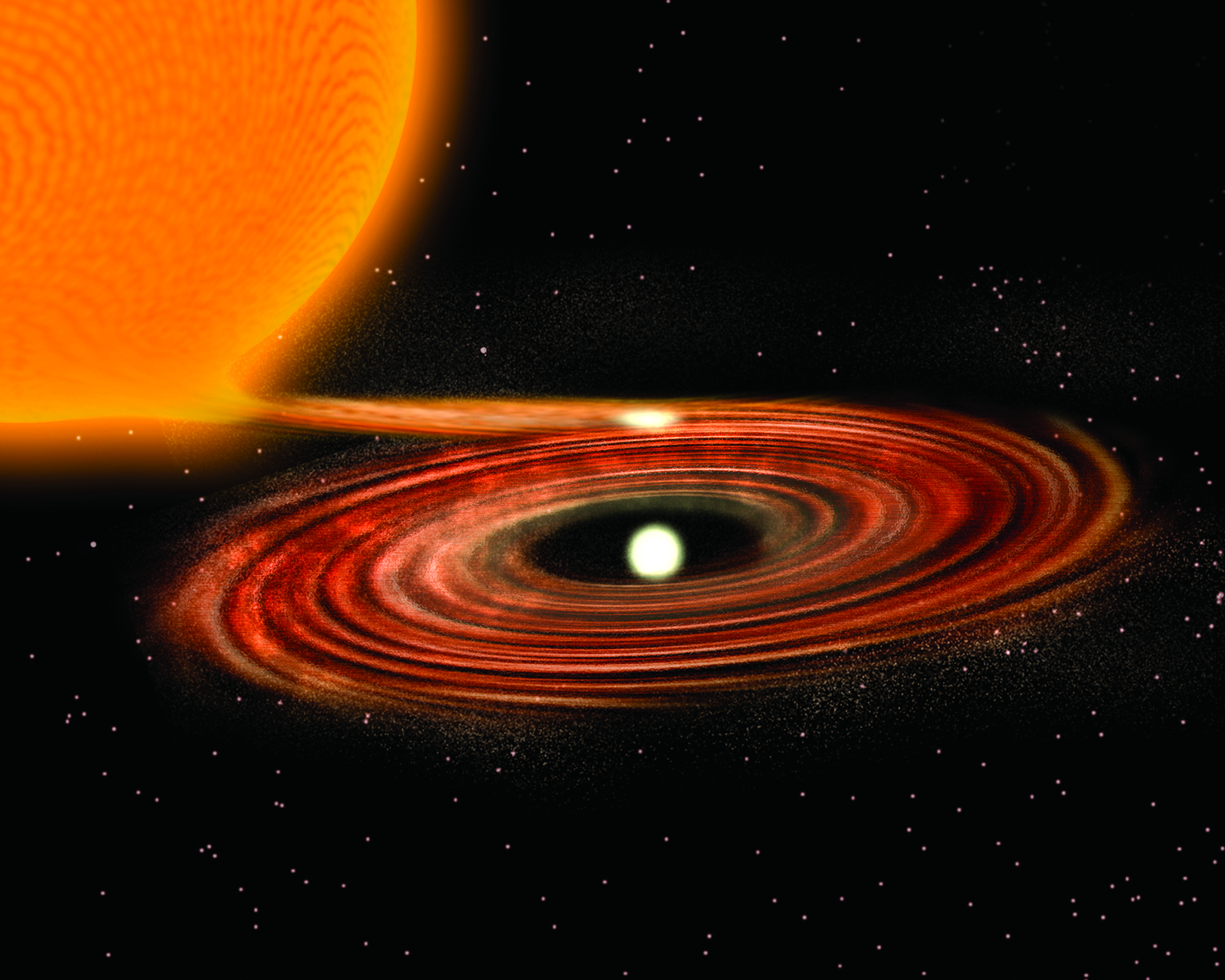
plasma from a sun-like star in the upper left corner is coming out like a string that swirls like a whirlpool around a dot in the center of the image
An artist’s conception of the accretion disk | Credit: P. Marenfeld/NOAO/AURA/NSF

Like water swirling around and down an open drain, plasma in an accretion disk spins faster nearer the heavy object in the center than further away. As the plasma falls inward, it loses angular momentum. A basic physics principle says that angular momentum needs to be conserved, so the faster rotating plasma must be transferring its momentum away from the center.

“This is an outstanding problem in astrophysics — how does that angular momentum get transported in an accretion disk?” says Ken Flanagan, a postdoctoral researcher with the department of physics at UW–Madison and lead author of the study.

The simplest explanation is friction, but it was ruled out when the corresponding accretion times, in some cases, would be longer than the age of the universe. A model developed by theoretical physicists posits that turbulence, or the chaotic changes in plasma flow speeds, can explain the phenomenon on a more realistic time scale.

“So ad hoc, astrophysicists say, ‘Okay, there’s this much turbulence and that explains it,’” Flanagan says. “Which is good, but you need to call in the plasma physicists to piece together where that turbulence comes from.”

Flanagan and colleagues, including UW­–Madison physics professor Cary Forest, wanted to build off an idea that the turbulence was coming from an intrinsic property of some plasmas known as magnetorotational instability. This instability is seen in plasmas that are flowing fastest near the center and are in the presence of a weak magnetic field.

“And it’s lucky because there are weak magnetic fields all around the universe, and the flow profile in the accretion disks is set by the gravitational force,” Flanagan says. “So, we thought this plasma instability could be responsible for turbulence, and it explains how accretion disks work.”

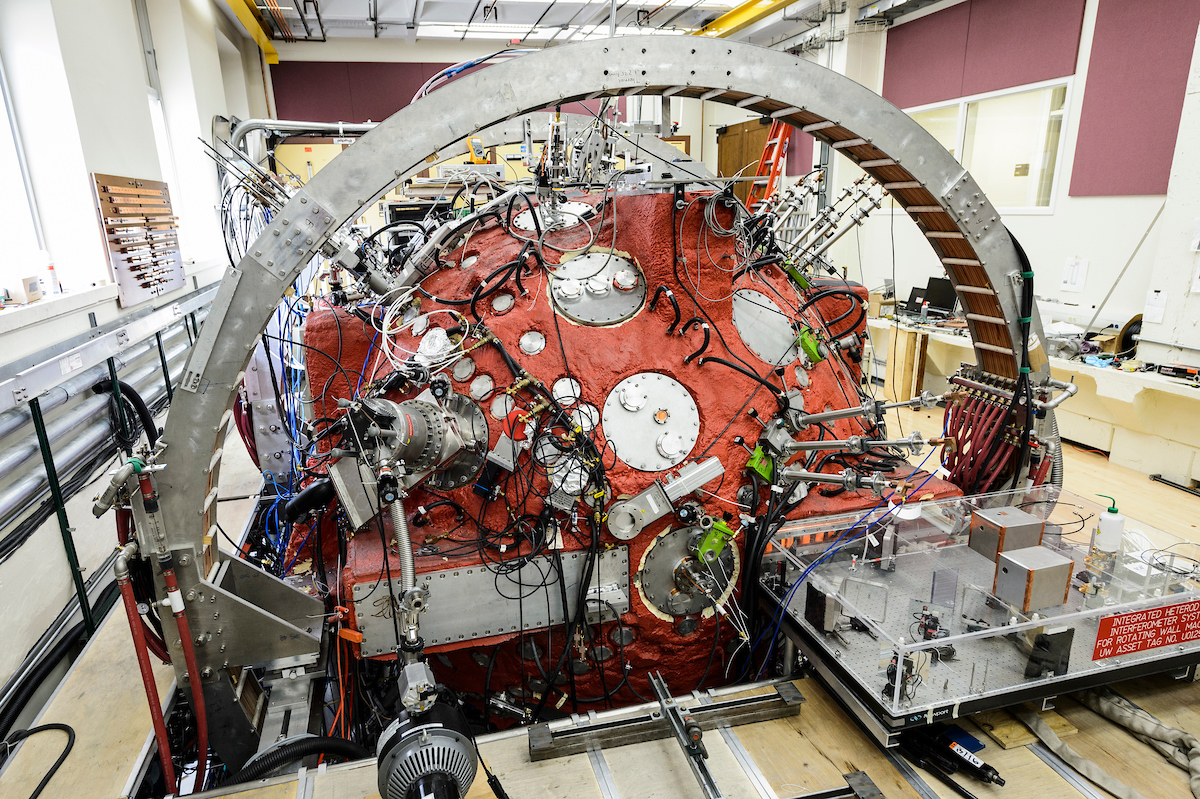
To investigate if this intrinsic plasma instability explained the observation, the researchers turned to the Big Red Ball (BRB), a three-meter-wide hollow sphere with a 3000 magnets at its inner surface and various probes inside. They activate a plasma by ionizing gas inside the BRB, then applying a current to drive its movement.

a 3-meter-diameter sphere, painted red and with tons of probes all around it
The Big Red Ball is one of several pieces of scientific equipment being used to study the fundamental properties of plasma in order to better understand the universe, where the hot, ionized gas is abundant. | Photo by Jeff Miller / UW–Madison)

Because they had previously been encountering problems in driving very fast flows, they tried a new technique to drive the flow across the entire volume of plasma, as opposed to just the edges. Fortuitously, the BRB had magnetic field probes from a previous experiment still attached, and when they activated the plasma under these conditions, they found that this new flow setup amplified the magnetic field strength with a peak at the center nearly twenty times the baseline strength.

“We didn’t expect to see that at all, because usually in plasma physics the simplest model is to think of plasmas as one fluid with the heavier ions dominating momentum,” Flanagan says. “The results suggested that the plasma is in the Hall regime, which means the electrons and their motion are entirely responsible for the plasma moving around magnetic fields.”

If they were correct in assuming it was the Hall effect that was driving magnetic field amplification, the equations governing magnetic fields and electric currents say that if you drive the current in the opposite direction, the strength of the magnetic field would be canceled out. So, they switched the current and measured the magnetic field strength: it was zero, supporting the Hall regime explanation.

While the results are not directly applicable to the plasma accretion disks around, say, a very dense black hole, they do directly impact the earth-bound experiments that attempt to recreate and study them.

“Nearly all plasma astrophysical experiments operate in the Hall regime, and so this sort of large qualitative effect is something you’re going to have to pay attention to when you make these sorts of flows in laboratory astrophysical plasmas,” Flanagan says. “In that sense, this work has a pretty broad impact for lots of different research areas.”

This research was supported in part by the National Science Foundation (#1518115) and by the U.S. Department of Energy (#DE-SC0018266).