In search of new particles like the Higgs Boson

Could there be more particles like the Higgs boson? For the first time, the CMS experiment has searched for the decay of the Higgs boson into two more Higgs-boson-like particles with unequal masses.

Written by: Ashling Quinn and Anagha Aravind (physics PhD student), originally published by the CMS Collaboration

Some theories suggest that the Higgs boson might occasionally decay into particles that have never been seen before and have Higgs-boson-like properties. These new particles are unstable and quickly decay to known Standard Model particles in the CMS detector. While past CMS results have explored scenarios where the Higgs boson decays to such short-lived particles of identical masses, in this study we searched for a new possibility: what if the Higgs boson decays into two different new particles instead of two identical ones?

Calling the new particles ɸ1 and ϕ2 (ϕ2 is the heavier one), we consider cases where one of the ɸ decays to two bottom quarks, and the other decays to two 𝜏 leptons. This final state is favourable, since it has a relatively large probability of occurring and can be used to select interesting signal-like events from our datasets.

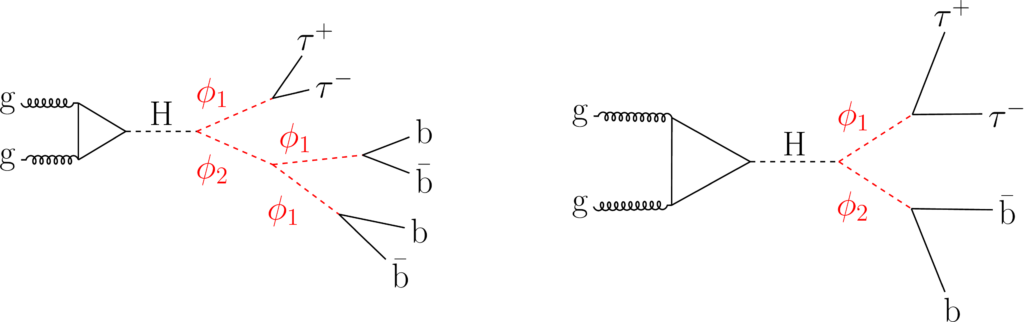
If the ϕ2 particle is at least twice as heavy as ϕ1, it could decay into an intermediate state with two ϕ1 before these decay into Standard Model particles. “We call this ‘cascade’ decay,” says Ashling Quinn, a PhD student working on the analysis,  “since the extra step makes it resemble a waterfall.” So the decays can look like: H→ ɸ1ϕ2 → 2𝜏2b (non-cascade) or H→ ɸ1ϕ2 → 2𝜏4b (cascade). These are shown in the figure below.
particle decay schematic
Schematic (Feynman) diagrams depicting cascade (left) and non-cascade (right) decays of the Higgs boson into new Higgs-boson-like particles.

The strategy of this search is to reconstruct the decay of the ɸ1 boson into two 𝜏 leptons and to obtain the ɸ1 mass distribution. The presence of the ɸ1 signal is expected to appear as a peak on top of a flat background distribution.

To enhance the separation between signal and background events, we trained a machine learning model with several kinematic distributions as input. Another PhD student, Anagha Aravind, describes how this works: “Since the ɸ bosons have relatively low mass, their final state will be collimated in a narrow cone. The machine learning model exploits this feature, along with other subtle differences, to classify events as either signal or background.”

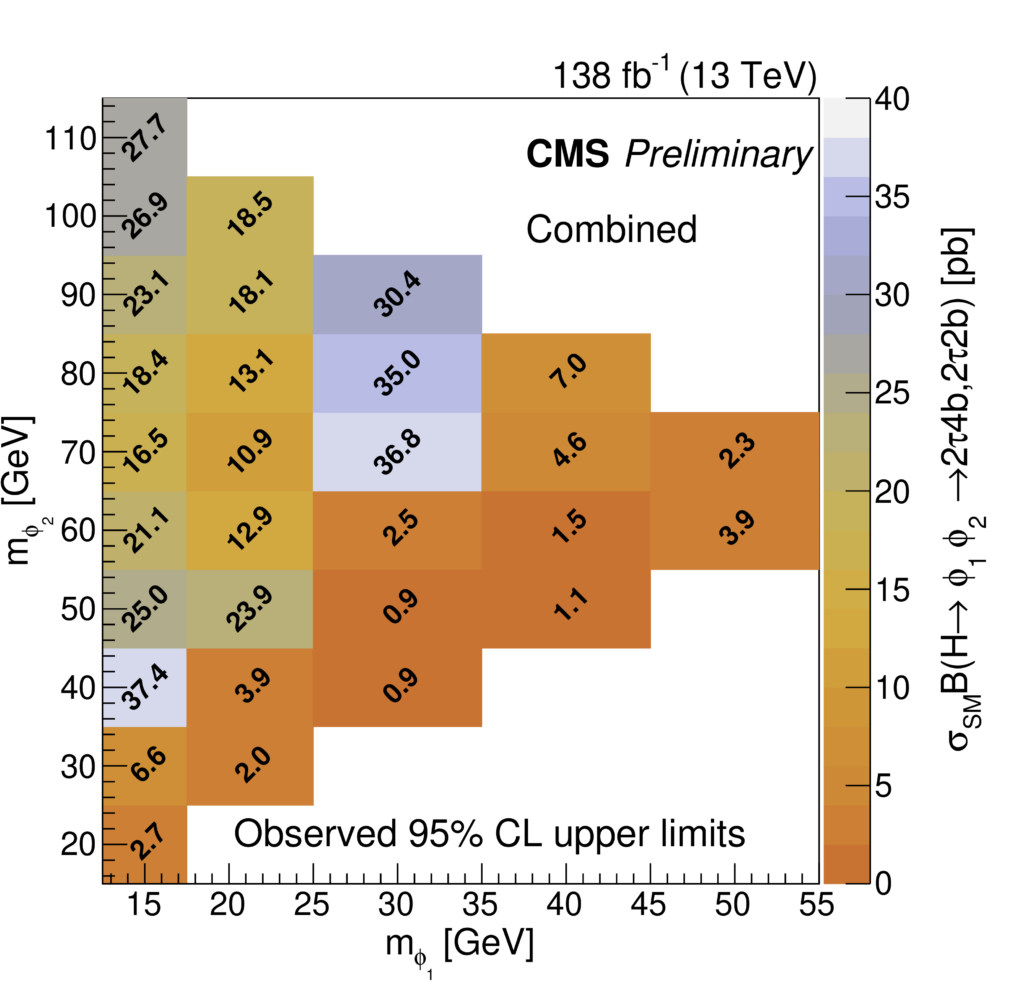
No significant excess of events was observed in the mass distribution. Upper limits were extracted on the rates – or “cross section” – of the considered processes for a range of ɸ1, ϕ2 boson masses. These results provide valuable constraints on theoretical models predicting such signatures and help guide future theoretical and experimental efforts.
heatmap graph showing the processes described in the caption
Upper limits on the rates – or “cross section” – of the considered processes. Mass of the lighter new particle ɸ1 on the x-axis and the heavier ɸ2 on the y-axis.

This was the first search within the CMS Collaboration for Higgs boson decays into two Higgs-boson-like particles with unequal masses. The results pave the way for a promising future: the dominant source of uncertainty was statistical, which means more data from Run 3 and the High-Luminosity LHC will improve the sensitivity. If we think of ourselves as detectives hunting for new particles, more data means more clues to solve the mystery.

Josh Weber earns L&S Academic Staff Teaching Excellence Award

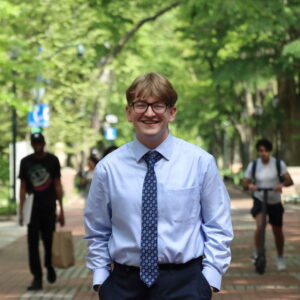
Congrats to Josh Weber for earning a College of Letters & Science Academic Staff Teaching Excellence Award!

Sometimes, the path to teaching excellence is swift and measured. Despite joining the instructional team in the Department of Physics just four short years ago, Joshua Weber has already made his mark, impressing both his colleagues and the students he teaches.

Weber is the course manager and primary instructor for Physics 201 and 202, the two-semester introductory courses taken by nearly 1,000 future engineering students. He has worked closely with his teaching assistants — the same teaching assistants who compete to work with him and whose classes he steps in to cover when they’re ill or indisposed — to adapt traditional physics labs into structured quantitative labs, in which students focus on building lab skills that allow them to “think like scientists” instead of just reproducing results they’ve seen in class. Weber views his role as an instructor as a facilitator, creating a welcoming environment that sparks collaborative learning.

He’s clearly winning the hearts and expanding the minds of his students. As one student recently shared with one of Weber’s TAs:

“Josh is really nice and a great instructor. He led my discussion section once, and I felt nervous, because I felt kind of rusty on the chapter we were working on. But he said, ‘I’m a lot more scared of you than you are of me’ kind of as a joke, and it set the tone for the class and didn’t make it feel like our big scary professor was going to run the discussion section and eat us alive for not being an expert on the material.”

Sam Kramer, Benjamin Beyer named L&S Teaching Mentors

This post is adapted from the L&S teaching mentor website

L&S announced their 2026 Teaching Mentors, including physics PhD students Sam Kramer and Benjamin Beyer. Kramer earned the additional honor of being named a Lead Teaching Mentor.

The L&S Teaching Mentors are the heart of our college level Teaching Assistant (TA) Trainings. They are exceptionally passionate and knowledgeable teachers with proven track records for teaching excellence who work closely with the L&S TA Training and Support Team to facilitate various trainings and mentor L&S TAs. Each Teaching Mentor is chosen through a competitive selection process for their enthusiasm and capacity to help others develop as effective and equitable teachers. They not only serve as role models, but also as sources of support and knowledge for both new and returning TAs.

Lead Teaching Mentors have served as Teaching Mentors more than once and take on an additional leadership role within the program. They support first-time Teaching Mentors as they learn to facilitate the TA Training curriculum. They also work with L&S TA Training and Support Team leadership to strengthen program offerings. In short, they are an invaluable source of expertise, creativity, and serve as deeply valued collaborators.

profile picture of Sam Kramer
Sam Kramer

Sam is a fourth-year Ph.D. candidate in the Department of Physics and has been teaching for Physics 202, a course for engineering major undergraduates that focuses on electricity, magnetism, and optics, since arriving in Madison. Sam also taught for a similar course as an undergraduate at Saint Louis University. In this role, he leads both discussions, which focus on problem solving, and labs, which provide hands-on experience with the concepts being taught. Physics can be an overwhelming subject, so Sam tries to distill the material into manageable chunks for the students, emphasizing the broader concepts underlying the formulas students use and drawing explicit connections between parts of the curricula. This is meant to develop the dynamic problem solving skills students need when encountering problems they have not seen before.

Profile photo of Benjamin Beyer
Benjamin Beyer

As an undergraduate, Benjamin began teaching introductory courses in physics. Since matriculating as a graduate student in the Department of Physics, Benjamin has continued to teach a wide range of courses, from courses emphasizing experimental laboratory skills to courses with a theoretical flavor. His approach blends connecting with students with breaking down complicated subjects, such that students can connect with the material in the context of their own experiences. He believes that learning physics is just as much about learning how to troubleshoot and make mistakes safely as it is about getting the right answer. Ultimately, his favorite part of teaching is helping to take the intimidation factor out of physics and watching students gain confidence in their own abilities.

Congrats, Wisconsin Space Grant Consortium award winners!

The Wisconsin Space Grant Consortium (WSGC) recently announced its 2026 Spring Awardees, including several UW–Madison physics students. WSGC award winners are Wisconsin students, educators, faculty, and research teams conducting NASA-aligned research, STEM education, and aerospace outreach across the state. These awards strengthen Wisconsin’s STEM workforce pipeline through hands-on research, outreach programming, academic advancement, and national aerospace collaborations.

Physics graduate student winners, who all won the WSGC Graduate and Professional Research Fellowship Award, include:

  • Robin Chisolm
  • Zachary Curtis-Ginsberg
  • Maggie Ju
  • Alicia Mand
  • Julia Sheffler
  • Faizah Siddique
  • Perri Zilberman

Physics undergraduate winners (and their department research group, if applicable), include:

  • Natalie Broderick (Zweibel group), Undergraduate Research Award
  • Henry DePew (McCammon group), Undergraduate Scholarship Award

Other undergraduates conducting research in physics department labs include:

  • Annelise Alvin (Soares-Furtado group), Undergraduate Scholarship Award
  • Anna Castello (Bechtol group), Undergraduate Scholarship Award
  • Chris Pate (Timbie group), Undergraduate Research Award


Through the 2026 Spring Awards, WSGC:

  • Funds 59 competitive awards at 12 institutions statewide
  • Invests $341,951 in scholarships, internships, outreach, faculty initiatives, and research
  • Expands aerospace outreach through educators, nonprofit partners, and community programming
  • Supports undergraduate, graduate, and faculty research directly aligned with NASA priorities
  • Enables students to participate in NASA internships and industry workforce development experiences
  • Builds capacity for future aerospace and STEM professionals in Wisconsin

WIPAC scientists observe a spectral change in the astrophysical neutrino flux

The IceCube Neutrino Observatory, embedded in a cubic kilometer of Antarctic ice, searches for weakly interacting particles called neutrinos that are able to travel undisturbed through the cosmos. Of interest are high-energy astrophysical neutrinos that can arise from cosmic ray interactions with matter or photons in astrophysical sources. Thus far, the dominant sources of the [...]

Read the full article at: https://wipac.wisc.edu/wipac-scientists-observe-a-spectral-change-in-the-astrophysical-neutrino-flux/

Lekshmi Thulasidharan earns campus TA award

This post is modified from one posted by the Graduate School

profile photo of Lekshmi Thulasidharan
Lekshmi Thulasidharan

Thirty-two exceptional graduate students, including physics PhD student Lekshmi Thulasidharan, have been selected as recipients of the 2025-26 Campus-Wide Teaching Assistant Awards, recognizing their strengths and commitment surrounding the craft of teaching.

UW–Madison employs over 2,400 teaching assistants (TAs) across a wide range of disciplines. Their contributions to the classroom, lab, and field are essential to the university’s educational mission. To recognize the excellence of TAs across campus, the Graduate School, the College of Letters & Science, and the Morgridge Center sponsor these annual awards.

Volunteer judges selected awardees for four categories: early excellence, advanced achievement, capstone teaching, and community-based learning.

Thulasidharan earned both a Capstone Teaching Award and a Dorothy Powelson Award. The Capstone Teaching Award recognizes dissertators at the end of their graduate program with an outstanding teaching record over the course of their UW–Madison tenure. The Dorothy Powelson Awards recognize outstanding performance by TAs in the natural sciences.

Thulasidharan is a student in astronomy professor and physics affiliate professor Elena D’Onghia’s group. Her research focus is on galactic dynamics. She has taught quite a few courses during her years at UW–Madison, with her favorite being Modern Physics. She has also really enjoyed teaching the physics course about Mechanics.

As a teacher, her favorite thing is working closely with students as they learn to tackle difficult physics problems.

“Many students start out feeling intimidated by the material, but through discussions and guided problem-solving sessions they begin to see the logic behind it and grow more confident. Watching that growth over the semester is the most rewarding part of teaching,” she said. “Over the years, teaching has also helped me grow as a person. It has helped me develop confidence and strengthened my communication and mentoring skills.”