TeachQuantum helps high school teachers bring quantum to the classroom
Read the full article at:
https://pme.uchicago.edu/news/teachquantum-helps-high-school-teachers-bring-quantum-classroom
Congratulations to Associate Professor Ke Fang on her promotion with tenure, to Professor Justin Vandenbroucke on his promotion to full professor, and to Profs. Dan Hooper and Britton Plourde who were both granted tenure!
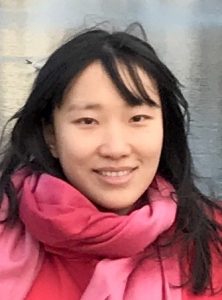
Prof. Fang is an experimental particle astrophysicist and WIPAC investigator who studies the origins of subatomic particles and their fundamental nature by detecting messengers from throughout the universe. She has made major contributions to the analysis of data from the High Altitude Water Cherenkov (HAWC) Observatory, the IceCube Observatory and the NASA Fermi satellite.
In 2021, Fang received the Shakti P. Duggal Award for Early Career Contributions in Cosmic Ray Physics. In 2023, she received the NSF CAREER award. In 2024, she was named a Sloan Fellow. Later that year, she was named the inaugural recipient of the Bernice Durand Faculty Fellowship, a departmental award named in honor of Durand, one of the first two women faculty members in the UW–Madison physics department. She also served as the US spokesperson for HAWC in 2023-2025.
“Ke Fang is one of the most impactful astroparticle phenomenologists of her generation,” says physics department chair and professor Kevin Black. “Her work is highly original and broad with strong implications for the emerging area of multi-messenger astronomy and particle astrophysics.”
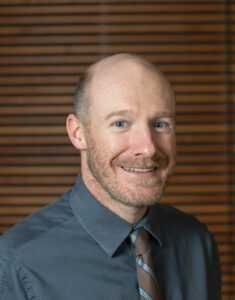
Prof. Vandenbroucke is also a WIPAC investigator and experimental particle astrophysicist. He joined the department in 2013. His main research focus is in multi-messenger astrophysics, including neutrino astronomy, gamma-ray astronomy, and cosmic rays. He is a member of the IceCube collaboration and the Cherenkov Telescope Array Observatory consortium and is an affiliate member of the Fermi LAT and VERITAS collaborations.
Vandenbroucke was previously promoted to associate professor with tenure in 2019. He was named a Vilas Associate from 2023-2025, and was a co-recipient of UW2020 awards in 2018 and 2020. He also leads the Distributed Electronic Cosmic-Ray Observatory (DECO), a citizen science project that enables users around the world to detect cosmic rays and other energetic particles with their cell phones and tablets.
“Justin Vandenbroucke is an outstanding experimentalist who, at the same time, develops creative and challenging data analysis projects that have led to scientific results published in highly cited papers,” Black says. “He does this in two different fields, gamma-ray and neutrino astrophysics, and is a leader in both.”
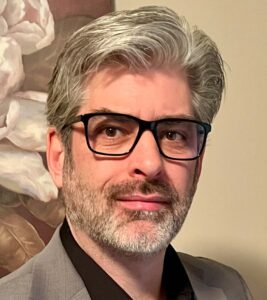
Prof. Hooper, PhD’03 was named the director of WIPAC and joined the physics faculty as a full professor in 2024. He is a theoretical particle astrophysicist whose research focuses on the interface between particle physics and cosmology. His work has spanned the areas of dark matter, high-energy neutrino astronomy, gamma-ray astronomy and cosmic-rays. He is the author of several books and co- hosts the physics podcast “Why This Universe?” breaking down some of some of the biggest ideas in physics into easily digestible chunks.
“Dan Hooper is a singular figure in his field, a stand-out leader in terms of scientific impact whose ideas cast a wide influence on the study of high energy theory, dark matter phenomenology, collider physics, astroparticle physics, and the direct experimental and observational search for dark matter,” Black says.
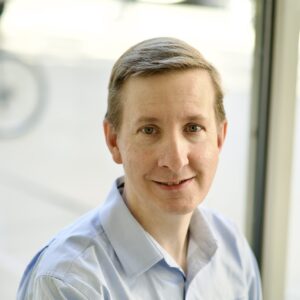
Prof. Plourde joined the department as a full professor in 2024 from Syracuse University. He is an experimental condensed matter physicist who studies superconducting quantum circuits. He is currently on a half-time leave at UW–Madison and works with Qolab, a quantum computing startup company based in Madison. Plourde was elected a Fellow of the American Physical Society in 2024 in the Division of Quantum Information, and in 2023 was elevated to Fellow of the Institute of Electrical and Electronics Engineers.
“Britton Plourde is internationally recognized for his contributions in the field of low-temperature physics and superconducting quantum circuits,” Black says. “He has made significant contributions in the field of superconducting quantum computing and is best known in the community for his works on superconducting qubits, left-handed and quantum metamaterials, and, more recently, for studies of decoherence sources and suppression of errors in superconducting quantum circuits.”
Natasha Kassulke and Alisa King-Klemperer contributed to this story
This post is modified from the original
The Office of the Vice Chancellor for Research (OVCR) hosts the Research Forward initiative to stimulate and support highly innovative and groundbreaking research at the University of Wisconsin–Madison. The initiative is supported by the Wisconsin Alumni Research Foundation (WARF) and will provide funding for 1–2 years, depending on the needs and scope of the project.
Research Forward seeks to support collaborative, multidisciplinary, multi-investigator research projects that are high-risk, high-impact, and transformative. It seeks to fund research projects that have the potential to fundamentally transform a field of study as well as projects that require significant development prior to the submission of applications for external funding. Collaborative research proposals are welcome from within any of the four divisions (Arts & Humanities, Biological Sciences, Physical Sciences, Social Sciences), as are cross-divisional collaborations.
Nine projects were chosen for funding in Round 5 of Research Forward (2025), including one from Physics:
Artificial intelligence is rapidly expanding across all fields of science, particularly in physics. The 2024 Nobel Prize in Physics was awarded for groundbreaking advancements in artificial intelligence that have led to significant discoveries in various physics applications. This project uses a specific type of AI, generative AI, to achieve breakthroughs in diverse particle physics research applications.
Analyzing and understanding the results of high-energy particle interactions using traditional methods requires immense computing resources. Even a single particle collision can involve billions of calculations. This research will enable substantial shortcuts in calculating the outcomes of particle interactions for fundamental physics and astrophysics.
The collaborative research between physicists and computer scientists will significantly improve data use, enabling discoveries that would otherwise be impossible. Medical physics applications, such as radiation therapy, are also envisioned.
PRINCIPAL INVESTIGATOR
Albrecht Karle, professor of physics
CO-PRINCIPAL INVESTIGATORS
Yong Jae, associate professor of computer science
Lu Lu, assistant professor of physics
CO-INVESTIGATOR
Benedikt Riedel, computing manager for WIPAC
This story is modified from the original
Ten University Staff members — including physics instrument maker Bill Foster — have been honored with 2025 University Staff Recognition Awards for their contributions to the University of Wisconsin–Madison. The recipients have been recognized by colleagues for teamwork, dedication to excellence, problem-solving abilities and innovative approach to their jobs.
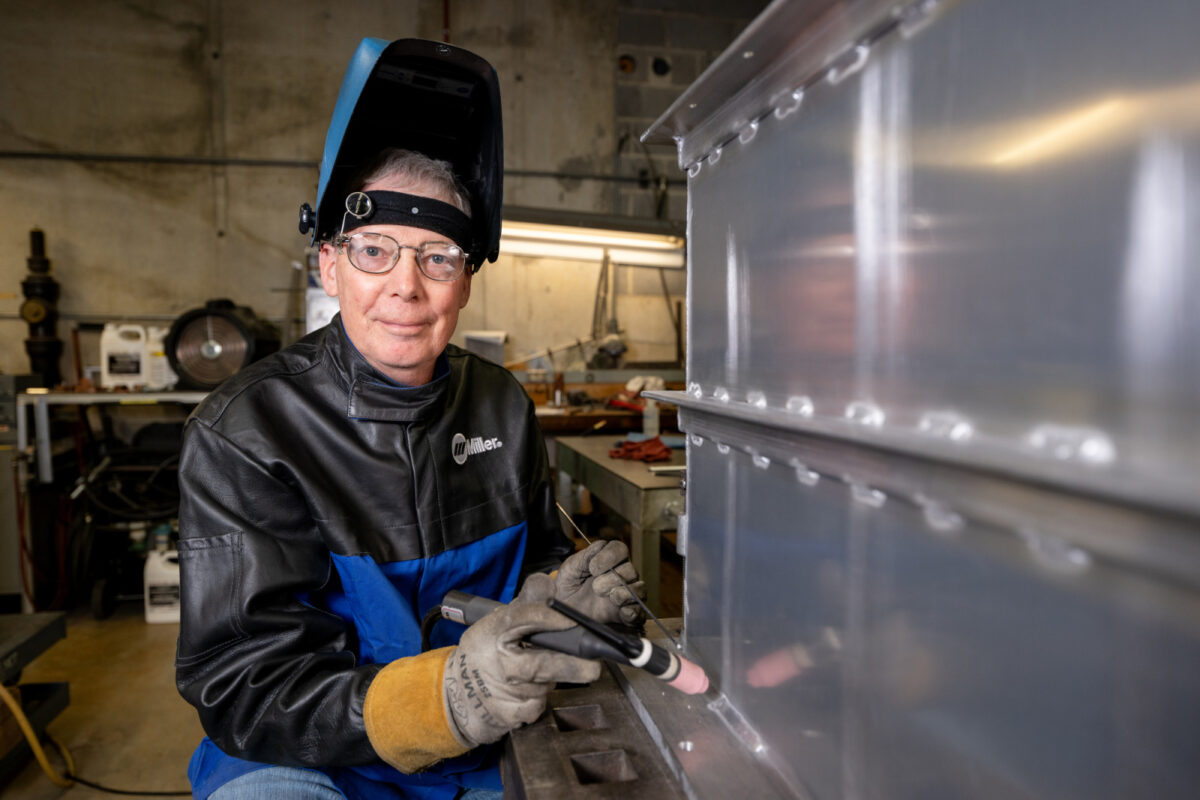
Foster is in his 36th year as an accomplished instrument maker and welder at the Physics Instrument Shop in Chamberlin Hall. He has not only fabricated scientific research equipment, but he has also contributed to many other research departments across the university and beyond. Very particular and detailed in his work, Foster takes the time to thoroughly research projects. Foster is also regarded as a master welder, particularly known for his vacuum and Ultra High Vacuum welding abilities. He’s worked on projects that include vacuum chambers, telescope chambers for testing tissue samples, a plant watering system that went aboard the space shuttle and the South African telescope project.
 Read the full article at: