Velocity gradients key to explaining large-scale magnetic field structure

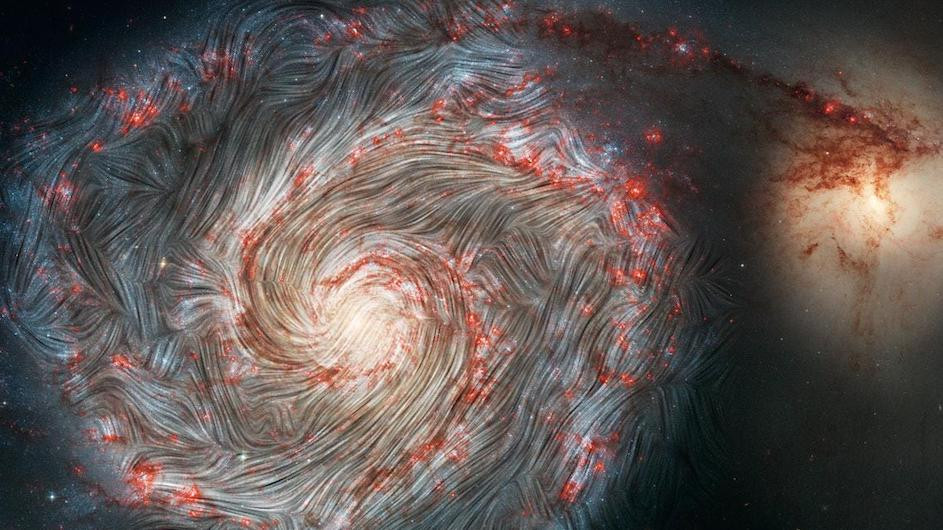
a whirled, wispy, spiral galaxy has white magnetic field lines overlaid on the image, showing that the magnetic field structure is organized in large, long structures over the entirety of the galaxy

All celestial bodies — planets, suns, even entire galaxies — produce magnetic fields, affecting such cosmic processes as the solar wind, high-energy particle transport, and galaxy formation. Small-scale magnetic fields are generally turbulent and chaotic, yet large-scale fields are organized, a phenomenon that plasma astrophysicists have tried explaining for decades, unsuccessfully. 

In a paper published January 21 in Nature, a team led by scientists at the University of Wisconsin–Madison have run complex numerical simulations of plasma flows that, while leading to turbulence, also develop structured flows due to the formation of large-scale jets. From their simulations, the team has identified a new mechanism to describe the generation of magnetic fields that can be broadly applied, and has implications ranging from space weather to multimessenger astrophysics.

profile photo of Bindesh Tripathi
Bindesh Tripathi

“Magnetic fields across the cosmos are large-scale and ordered, but our understanding of how these fields are generated is that they come from some kind of turbulent motion,” says the study’s lead author Bindesh Tripathi, a former UW–Madison physics graduate student and current postdoctoral researcher at Columbia University. “Given that turbulence is known to be a destructive agent, the question remains, how does it create a constructive, large-scale field?” 

Before working on three-dimensional (3D) magnetic fields, Tripathi investigated systems with hydrodynamic flows and two-dimensional (2D) magnetic fields. After staring at the movies and images of 3D magnetic turbulence, he noticed similarities in the shapes of large-scale flows and large-scale magnetic field structures. But it wasn’t as simple as applying fluid dynamic theory to magnetic field generation: the former may be solved as a 2D problem, whereas the latter must be solved in 3D, making it a much more complex, difficult-to-solve problem.

Tripathi and his colleagues decided to tackle the problem with two key changes from previous research. 

The first difference was the input: a constantly replenished velocity gradient. A cyclist hitting a curb head-on, say, experiences a velocity gradient: the wheels stop, but momentum can cause the cyclist to fly over the handlebars. Velocity gradients exist throughout the universe; for example, within different layers of the sun or when two neutron stars merge. The team reasoned that this gradient is likely important to include while studying 3D magnetic fields. 

Second, they ran perhaps the most complex simulation to date of magnetic fields in the presence of an unstable velocity gradient — 137 billion grid points in 3D space. Altogether, they ran around 90 simulations, generating 0.25 petabytes of data and using nearly 100 million CPU hours on the Anvil supercomputer at Purdue University.

Ordered magnetic fields spontaneously emerge out of chaotic, tangled fields. This finding is consistent with astrophysical observations. Streamlines of magnetic fields are 3D-rendered and are colored red–blue by the x-component of the field. Streamlines of the electric current density are shown in green; color represents magnitude. Poloidal fields are displayed on the (y,z)-plane, after averaging them over the azimuthal (x) direction. Credit: Tripathi et al.

“We start our simulations with a flow that has a velocity gradient, then we add some tiny perturbations, like moving one fluid particle infinitesimally, we let that perturbation propagate over the system and grow, and then analyze the data over time,” Tripathi says. “Initially, these perturbations lead to turbulent flows and magnetic fields in small-scale structures, then, over time, they emerge into larger, ordered structures.” 

When Tripathi ran the same simulations where the initial velocity gradient had decayed over time, the simulation only produced the chaotic, small-scale patterns. “So that’s really the main key: to have a steady, large-scale gradient in velocity,” he emphasizes. 

Adds Paul Terry, physics professor at UW–Madison and senior author of the study: “Magnetic field generation via dynamos has been extensively studied for 70 years, with the frustrating result that the generated fields almost always end up at small scales and highly disordered, unlike observations. This work, therefore, potentially resolves a long-standing issue.”

Though the theory cannot be tested in the distant universe, a lab-based experiment does support the team’s findings: in 2012, colleagues at the Wisconsin Plasma Physics Laboratory were trying to better understand the nature of the magnetic field generation process in a laboratory experiment, but their data did not fit any of the previous models. Tripathi and colleagues’ new theory of magnetic field generation more closely matches the experimental data and helps to resolve the confounding findings.

“This work has the potential to explain the magnetic dynamics relevant in, for example, neutron star mergers and black hole formation, with direct applications to multimessenger astronomy,” Tripathi says. “It may also help better understand stellar magnetic fields and predict gas ejections from the sun toward the earth.”

Top image: The magnetic fields in large-scale structures are organized despite local areas of turbulence. The magnetic field in the Whirlpool Galaxy (M51), captured by NASA’s flying Stratospheric Observatory for Infrared Astronomy (SOFIA) observatory superimposed on a Hubble telescope picture of the galaxy. The image shows infrared images of grains of dust in the M51 galaxy. Their magnetic orientation largely follows the spiral shape of the galaxy, but it is also being pulled in the direction of the neighboring galaxy at the right of the frame. (Credit: NASA, SOFIA, HAWC+, Alejandro S. Borlaff; JPL-Caltech, ESA, Hubble)


This work was supported by the National Science Foundation (2409206) and U.S. Department of Energy (DE-SC0022257) through the DOE/NSF Partnership in Basic Plasma Science and Engineering. Anvil at Purdue University was used through allocation TG-PHY130027 from the Advanced Cyberinfrastructure Coordination Ecosystem: Services & Support (ACCESS) program, which is supported by National Science Foundation (2138259, 2138286, 2138307, 2137603 and 2138296).
 

UW–Madison, industry partners run quantum algorithm on neutral atom quantum computer for the first time

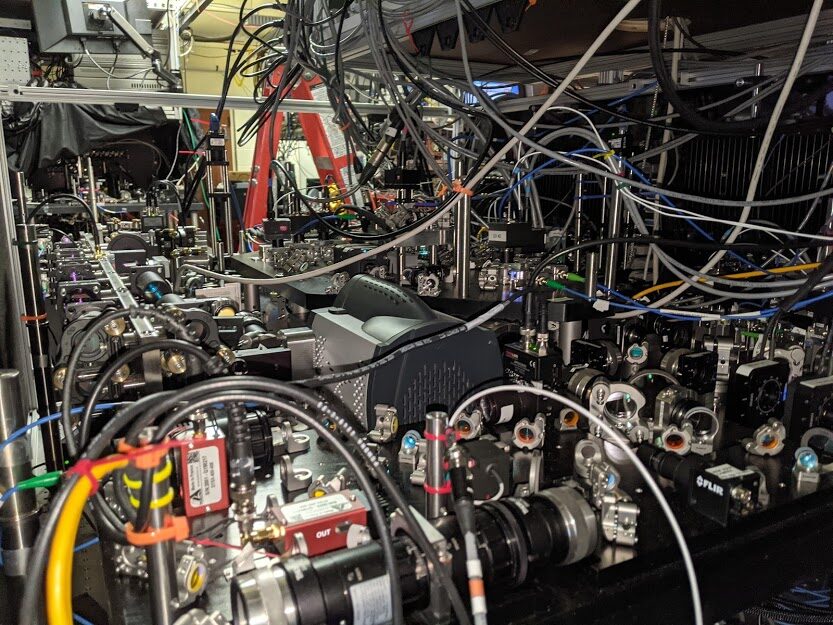
a quantum computing lab with lots and lots of wires and a main hardware piece in the center

A university-industry collaboration has successfully run a quantum algorithm on a type of quantum computer known as a cold atom quantum computer for the first time. The achievement by the team of scientists from the University of Wisconsin­–Madison, ColdQuanta and Riverlane brings quantum computing one step closer to being used in real-world applications. The work out of Mark Saffman’s group was published in Nature on April 20.

Read the joint press release

Read the press release tipsheet 

New 3D integrated semiconductor qubit saves space without sacrificing performance

Small but mighty, semiconducting qubits are a promising area of research on the road to a fully functional quantum computer. Less than one square micron, thousands of these qubits could fit into the space taken up by one of the current industry-leading superconducting qubit platforms, such as IBM’s or Google’s.

For a quantum computer on the order of tens or hundreds of qubits, that size difference is insignificant. But to get to the millions or billions of qubits needed to use these computers to model quantum physical processes or fold a protein in a matter of minutes, the tiny size of the semiconducting qubits could become a huge advantage.

Except, says Nathan Holman, who graduated from UW–Madison physics professor Mark Eriksson’s group with a PhD in 2020 and is now a scientist with HRL Laboratories, “All those qubits need to be wired up. But the qubits are so small, so how do we get the lines in there?”

In a new study published in NPJ Quantum Information on September 9, Holman and colleagues applied flip chip bonding to 3D integrate superconducting resonators with semiconducting qubits for the first time, freeing up space for the control wires in the process. They then showed that the new chip performs as well as non-integrated ones, meaning that they solved one problem without introducing another.

If quantum computers are to have any chance of outperforming their classical counterparts, their individual qubit units need to be scalable so that millions of qubits can work together. They also need an error correction scheme such as the surface code, which requires a 2D qubit grid and is the current best-proposed scheme.

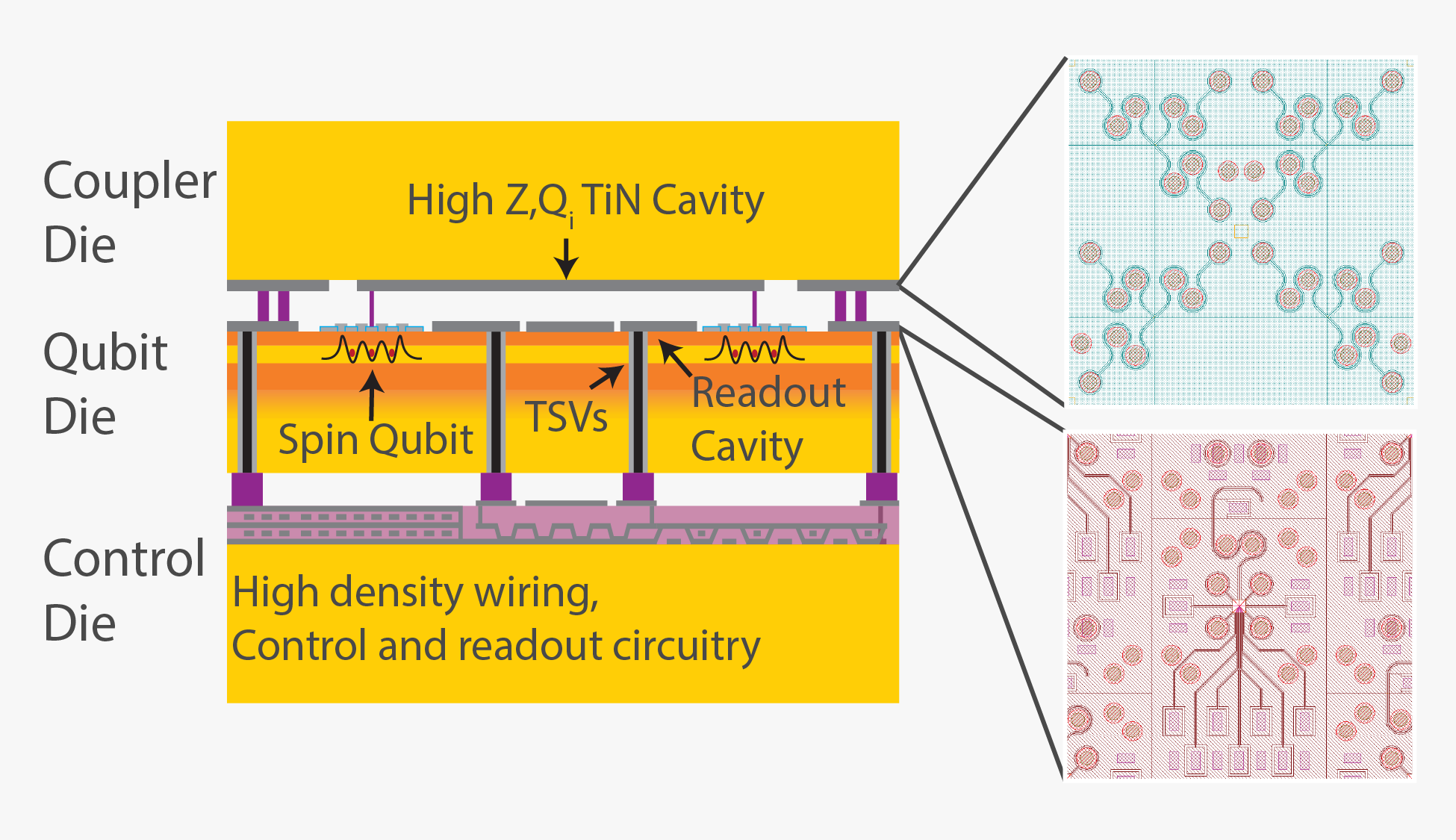
a three-chip sandwich showing the device architecture.
Proposed approach: the 3D integrated device consists of a superconducting die (top layer) and a semiconducting qubit die (middle layer) brought together though a technique known as flip chip integration. The bottom layer, proposed but not studied experimentally in this work, will serve to enable wiring and readout electronics. This study is the first time that semiconducting qubits (middle layer) and superconducting resonators (top layer) have been integrated in this way, and it frees up space for the wiring needed to control the qubits. | Credit: Holman et al., in NPJ Quantum Information

To attain any 2D tiled structure with current semiconducting devices, it quickly gets to the point where 100% of available surface area is covered by wires — and at that point, it is physically impossible to expand the device’s capacity by adding more qubits.

To try to alleviate the space issue, the researchers applied a 3D integration method developed by their colleagues at MIT. Essentially, the process takes two silicon dies, attaches pillars of the soft metal indium placed onto one, aligns the two dies, and then presses them together. The result is that the wires come in from the top instead of from the side.

“The 3D integration helps you get some of the wiring in in a denser way than you could with the traditional method,” Holman says. “This particular approach has never been done with semiconductor qubits, and I think the big reason why it hadn’t is that it’s just a huge fabrication challenge.”

profile photo of Mark Eriksson
Mark Eriksson
profile photo of Nathan Holman
Nathan Holman

In the second part of their study, the researchers needed to confirm that their new design was functional — and that it didn’t add disadvantages that would negate the spacing success.

The device itself has a cavity with a well-defined resonant frequency, which means that when they probe it with microwave photons at that frequency, the photons transmit through the cavity and are registered by a detector. The qubit itself is coupled to the cavity, which allows the researchers to determine if it is functioning or not: a functioning qubit changes the resonant frequency, and the number of photons detected goes down.

They probed their 3D integrated devices with the microwave photons, and when they expected their qubits to be working, they saw the expected signal. In other words, the new design did not negatively affect device performance.

“Even though there’s all this added complexity, the devices didn’t perform any worse than devices that are easier to make,” Holman says. “I think this work makes it conceivable to go to the next step with this technology, whereas before it was very tricky to imagine past a certain number of qubits.”

Holman emphasizes that this work does not solve all the design and functionality issues currently hampering the success of fully functional quantum computers.

“Even with all the resources and large industry teams working on this problem, it is non-trivial,” Holman says. “It’s exciting, but it’s a long-haul excitement. This work is one more piece of the puzzle.”

The article reports that this work was sponsored in part by the Army Research Office (ARO) under Grant Number W911NF-17-1-0274 (at UW­–Madison) and by the Assistant Secretary of Defense for Research & Engineering under Air Force Contract No. FA8721-05-C-0002 (at MIT Lincoln Laboratory).