HAWC detection of an ultra-high-energy gamma-ray bubble around a microquasar

This story is adapted from the HAWC Collaboration press release. Microquasars—compact regions surrounding a black hole with a mass several times that of its companion star—have long been recognized as powerful particle accelerators within our galaxy. The enormous jets spewing out of microquasars are thought to play an important role in the production of galactic cosmic rays, although [...]

Read the full article at: https://wipac.wisc.edu/hawc-detection-of-an-ultra-high-energy-gamma-ray-bubble-around-a-microquasar/

Baha Balantekin wins 2025 APS Bethe Prize

Profile photo of Baha Balantekin
Baha Balantekin

Congrats to Prof. Baha Balantekin on winning the American Physical Society’s 2025 Hans A. Bethe prize!

The Bethe prize is awarded to recognize outstanding work in theory, experiment or observation in the areas of astrophysics, nuclear physics, nuclear astrophysics, or closely related fields. Balantekin won “for seminal contributions to neutrino physics and astrophysics — especially the neutrino flavor transformation problem — both for solar neutrinos and the nonlinear supernova environment.”

Balantekin works at the intersection of particle physics, nuclear physics, and astrophysics. For much of his career, he has studied theoretical aspects of neutrino transport originating in the Sun, supernovae, or neutron star mergers.

“The concepts (I brought to the field) were marrying neutrino physics with many-body physics,” Balantekin says. “Of course, incorporating many-body aspects is common in condensed matter and nuclear physics, but it’s not as common in environments studied in astrophysics.”

Several fundamental astrophysical processes produce neutrinos as byproducts, and scientists have been studying neutrino origins and patterns for decades. Detecting the Sun’s neutrinos can reveal insights into its nuclear reactions, for example, and detecting neutrinos from core collapse supernovae can reveal insights into the early universe.

Balantekin’s early research was on the theory of neutrino transport from the Sun. He has also been studying core collapse supernovae, the result of a star running out of nuclear fuel. During collapse, a very hot star cools very quickly, emitting neutrinos on the order of 10^58.

“A number of that magnitude means you can no longer ignore the neutrino-neutrino interactions,” Balantekin says. “And then it becomes a very interesting many-body problem, where you have two-body interactions between neutrinos, and the propagation, and then it becomes a very complex problem.”

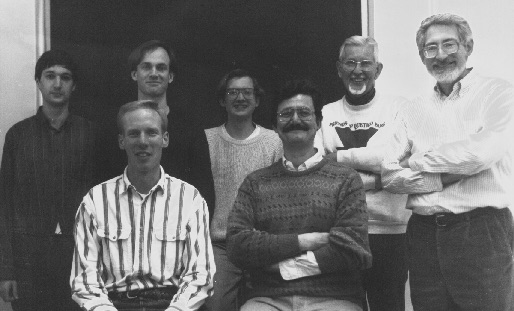
black and white group photo from 1995. There are 7 men featured
Balantekin and department collaborators in 1995. Balantekin is seated, right. Seated next to him is former PhD student Alan DeWeerd. Standing row, L-R: Franco Ruggeri, John Beacom, Jonathan Fetter, late physics professor Kirk McVoy, and William Friedman.

To describe this problem, has more recently begun using techniques from quantum information science to study entanglement of neutrinos with each other and to look at the signatures of such interactions and how they might contribute to heavy element formation.

The Bethe Prize was awarded solely to Balantekin, but he says he would not have won it without his collaborators over the years.

“You don’t do work in a vacuum,” Balantekin says. “I’ve worked with a lot of very talented young people. I would like to acknowledge first not only my graduate students at Wisconsin, but also the Fellows who came from the N3AS Physics Frontier Center we have. And the people I collaborate with around the world. We also have colleagues here in the department like Sue Coppersmith and Mark Saffman who contributed many ideas.”

The Bethe prize consists of $10,000 and a certificate citing the contributions made by the recipient. It is presented annually.

Entangled neutrinos may lead to heavier element formation

Elements are the building blocks of every chemical in the universe, but how and where the different elements formed is not entirely understood. A new paper in The Astrophysical Journal by University of Wisconsin–Madison physics professor Baha Balantekin and colleagues with the Network for Neutrinos, Nuclear Astrophysics, and Symmetries (N3AS) Physics Frontier Center, shows how entangled neutrinos could be required for the formation of elements above approximately atomic number 140 via neutron capture in an intermediate-rate process, or i-process.

Profile photo of Baha Balantekin
Baha Balantekin

Why it’s important

“Where the chemical elements are made is not clear, and we do not know all the possible ways they can be made,” Balantekin says. “We believe that some are made in supernovae explosions or neutron star mergers, and many of these objects are governed by the laws of quantum mechanics, so then you can use the stars to explore aspects of quantum mechanics.”

What is already known?

  • Immediately after the Big Bang, lighter elements like hydrogen and helium were abundant. Heavier elements, up to iron (atomic number 26) continued to form through nuclear fusion in the centers of hot stars.
  • Above iron, fusion is no longer energetically favorable, and nuclear synthesis occurs via neutron capture, where neutrons glom onto atomic nuclei. At high enough concentrations, neutrons can convert into protons, increasing the atomic number of the element by one.
  • This conversion is dependent on neutrinos and antineutrinos. Neutron capture has been found to occur slowly (s-process, over years) and rapidly (r-process, within minutes); an intermediate timescale, or i-process has been proposed but little evidence exists to support it. Rapid or intermediate neutron capture can only take place in catastrophic events where a huge amount of energy is released, such as supernova collapse.
  • “When a supernova collapse occurs, you start with a big star, which is gravitationally bound, and that binding has energy,” Balantekin says. “When it collapses, that energy has to be released, and it turns out that energy is released in neutrinos.”
  • The laws of quantum mechanics state that those neutrinos can become entangled because they interact in the collapsing supernova. Entanglement is when any two or more particles interacted and then “remember” the others, no matter how far apart they might be.

A quick summary of the research

  • “One question we can ask is if these neutrinos are entangled with each other or not,” Balantekin says. “This paper shows that if the neutrinos are entangled, then there is an enhanced new process of element production, the i-process.”
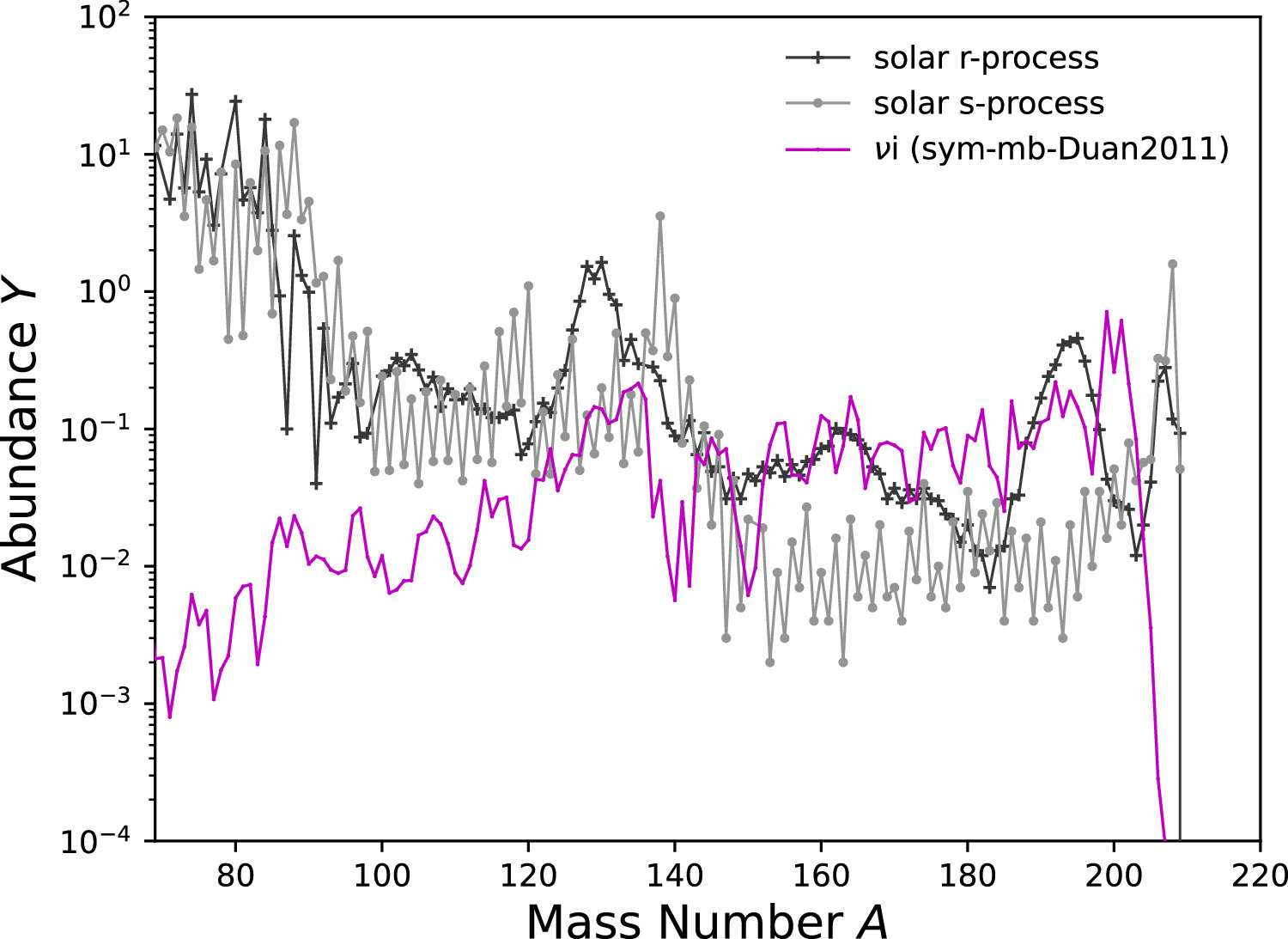
a plot of mass number A (atomic number) on the x-axis and abundance as a log scale on the y-axis. a purple line shows the i-process abundance, black line shows r-process, and grey line shows s-process. Above atomic number 140 or so, there is a visible enhancement of the purple line over the other two lines (below 140 the black and grey lines are much higher abundance values than the purple line)
The abundance pattern based on calculations in this paper (ν i-process pattern; purple line), compared with the solar system s-process (gray line) and r-process (black line) abundance data (Sneden et al. 2008). The ν i abundance for A = 143 is scaled to the solar r-process data for pattern comparison. | Source: The Astrophysical Journal

The experimental and simulated evidence

  • The researchers used two known facts to set up their calculations: well-established rates of neutron capture, and catalogs of the atomic spectra of stars, which astronomers have collected over decades to identify the abundance of different elements. They also knew that a supernova collapse produces on the order of 10^58 neutrinos, a number that is far too large to use in any standard calculations.
  • Instead, they made simulations of up to eight neutrinos and calculated the abundance of elements that would be created via neutron capture if the neutrinos were entangled, or were not entangled.
  • “We have a system of, say, three neutrinos and three antineutrinos together in a region where there are protons and neutrons and see if that changes anything about element formation,” Balantekin says. “We calculate the abundances of elements that are produced in the star, and you see that the entangled or not entangled cases give you different abundances.”
  • The simulations showed that elements with atomic number greater than 140 are likely to be enhanced by i-process neutron capture — but only if the neutrinos are entangled.

Caveats and future work

  • Balantekin points out that these simulations are just “hints” based on astronomical observations. Astrophysics research requires using the cosmos as a lab, and it is difficult to conduct true experimental tests on earth.
  • “There’s something called the standard model of particle physics, which determines the interaction of particles. The neutrino-neutrino interaction is one aspect of the standard model which has not been tested in the lab, it can only be tested in astrophysical extremes,” Balantekin says. “But other aspects of the standard model have been tested in the lab, so one believes that it should all work.”
  • The researchers are currently using more astrophysical data of element abundance in extreme environments to see if those abundances continue to be explained by entangled neutrinos.

This research is supported in part by the National Science Foundation grants Nos. PHY-1630782 and PHY-2020275 (Network for Neutrinos, Nuclear Astrophysics and Symmetries). Balantekin is supported in part by the U.S. Department of Energy, Office of Science, Office of High Energy Physics, under Award No. DE-SC0019465 and in part by the National Science Foundation Grant PHY-2108339 at the University of Wisconsin-Madison. 

The paper’s co-authors include Michael Cervia, Amol Patwardhan, Rebecca Surman, and Xilu Wang, all current or former members of N3AS.

Ellen Zweibel named Hilldale Professor

profile photo of Ellen Zweibel
Ellen Zweibel, W. L. Kraushaar and Hilldale professor of astronomy and physics (Photo by Althea Dotzour / UW–Madison)

Five members of the University of Wisconsin–Madison faculty, including astronomy and physics professor Ellen Zweibel, have received Hilldale Professorships.

Hilldale Professorships are given to faculty members who excel in scholarly activity, have records of outstanding research or creative work, and show promise of continued productivity. Recipients receive a salary increase in addition to funding that may be used for research support and teaching release. Appointments are for five years with the possibility of renewal until the individual leaves the university or retires.

Zweibel’s work in theoretical astrophysicist specializes in plasma astrophysics and focuses on evolution of astrophysical magnetic fields, interstellar astrophysics, star formation, cosmic rays and stellar physics.


Ke Fang named Sloan Fellow

This story is adapted from one published by University Communications

profile photo of Ke Fang
Ke Fang

Ke Fang, assistant professor of Physics and WIPAC investigator, is among 126 scientists across the United States and Canada selected as Sloan Research Fellows.

The fellowships, awarded annually since 1955, honor exceptional scientists whose creativity, innovation and research accomplishments make them stand out as future leaders in their fields.

Using data from the Ice Cube Observatory and Fermi Large Area Telescope along with numerical simulations, Fang studies the origin of subatomic particles — like neutrinos — that reach Earth from across the universe.

“Sloan Research Fellowships are extraordinarily competitive awards involving the nominations of the most inventive and impactful early-career scientists across the U.S. and Canada,” says Adam F. Falk, president of the Alfred P. Sloan Foundation. “We look forward to seeing how fellows take leading roles shaping the research agenda within their respective fields.”

Founded in 1934, the Sloan Foundation is a not-for-profit institution dedicated to improving the welfare of all through the advancement of scientific knowledge.

Sloan Fellows are chosen in seven fields — chemistry, computer science, Earth system science, economics, mathematics, neuroscience and physics — based on nomination and consideration by fellow scientists. The 2024 cohort comes from 53 institutions and a field that included more than 1,000 nominees. Winners receive a two-year, $75,000 fellowship that can be used flexibly to advance their research.

Among current and former Sloan Fellows, 57 have won a Nobel Prize, 71 have been awarded the National Medal of Science, 17 have won the Fields Medal in mathematics and 23 have won the John Bates Clark Medal in economics.

Xiangyao Yu, assistant professor of computer sciences at UW–Madison, was also named a Sloan Fellow.


The largest magnetic fields in galaxy clusters have been revealed for the first time

By Alex Lazarian, Yue Hu, and Ka Wai Ho

Galaxy clusters, immense assemblies of galaxies, gas, and elusive dark matter, form the cornerstone of our Universe’s grandest structure — the cosmic web. These clusters are not just gravitational anchors, but dynamic realms profoundly influenced by magnetism. The magnetic fields within these clusters are pivotal, shaping the evolution of these cosmic giants. They orchestrate the flow of matter and energy, directing accretion and thermal flows, and are vital in accelerating and confining high-energy charged particles/cosmic rays.

However, mapping the magnetic fields on the scale of galaxy clusters posed a formidable challenge. The vast distances and complex interactions with magnetized and turbulent plasmas diminish the polarization signal, a traditionally used informant of magnetic fields. Here, the groundbreaking technique — synchrotron intensity gradients (SIG) — developed by a team of UW–Madison astronomers and physicists led by astronomy professor Alexandre Lazarian, marks a turning point. They shifted the focus from polarization to the spatial variations in synchrotron intensity. This innovative approach peels back layers of cosmic mystery, offering a new way to observe and comprehend the all-important magnetic tapestry on scale of millions of light years.

A landmark study published in Nature Communications has employed the SIG technique to unveil the enigmatic magnetic fields within five colossal galaxy clusters, including the monumental El Gordo cluster, observed with the Very Large Array (VLA) and MeerKAT telescope. This colossal cluster, formed 6.5 billion years ago, represents a significant portion of cosmic history, dating back to nearly half the current age of the universe. The findings in El Gordo, characterized by the largest magnetic fields observed, provide crucial insights into the structure and evolution of galaxy clusters.

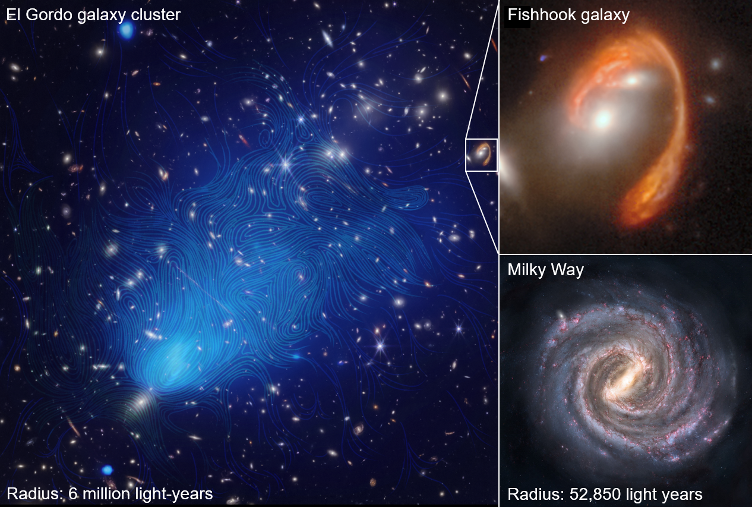
a 3-panel picture. The left half is a blue swirly image titled "El Gordo galaxy cluster" and labeled "radius: 6M light years." A tiny square inset of this left picture is enlarged in the top right, titled "fishhook galaxy", which is a hook-shaped orange swirl of gas-like substance. the bottom right panel is the Milky Way for comparison, with a radius of 52,850 light years
Left: Image of the El Gordo cluster observed Chandra X-ray Observatory and ground-based optical telescopes (credits: NASA/ESA/CSA). Magnetic field visualized by streamlines are superimposed on the image. Right: images of the Fishhook galaxy (top) and Milky Way (bottom).

The research is a fruitful collaboration between the UW–Madison team and their Italian colleagues, including Gianfranco Brunetti, Annalisa Bonafede, and Chiara Stuardi from the Instituto do Radioastronomia (Bologna, Italy) and the University of Bologna. Brunetti, a renowned expert in the high-energy physics of galaxy clusters, is enthusiastic about the potential that the SIG technique holds for exploring magnetic field structures on even larger scales, such as the Megahalos recently discovered by him and his colleagues.

Echoing this excitement is the study’s lead researcher, physics graduate student Yue Hu.

“This research marks a significant milestone in astrophysics,” Hu says. “Utilizing the SIG method, we’ve observed and begun to comprehend the nature of magnetic fields in galaxy clusters for the first time. This breakthrough heralds new possibilities in our quest to unravel the mysteries of the universe.”

This study lays the groundwork for future explorations. With the SIG method’s proven effectiveness, scientists are optimistic about its application to even larger cosmic structures that have been detected recently with the Square Kilometre Array (SKA), promising deeper insights into the mysteries of the Universe magnetism and its effects on the evolution of the Universe Large Scale Structure.

Earth-sized planet discovered in ‘our solar backyard’

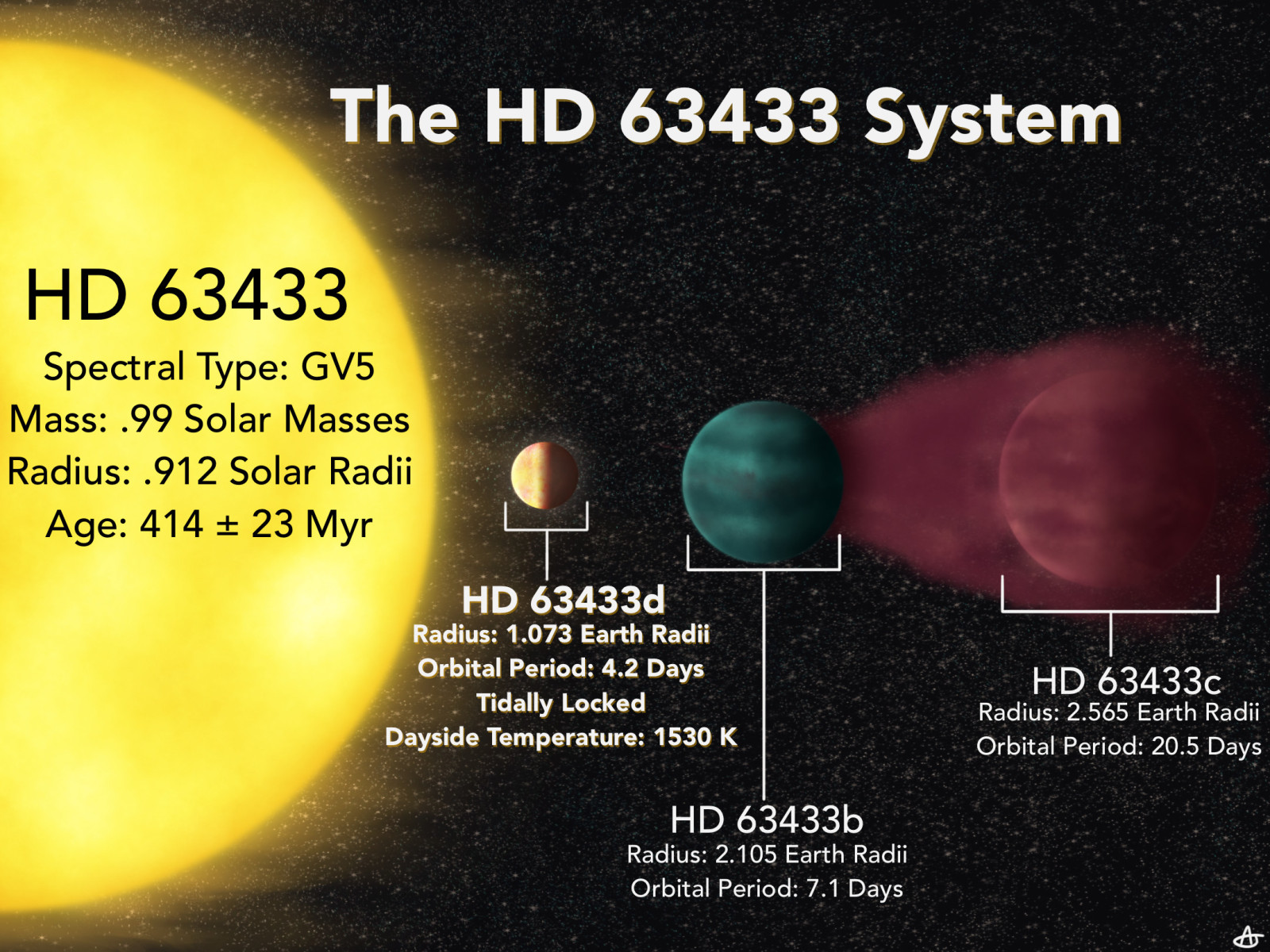
A team of astronomers have discovered a planet closer and younger than any other Earth-sized world yet identified. It’s a remarkably hot world whose proximity to our own planet and to a star like our sun mark it as a unique opportunity to study how planets evolve.

The new planet was described in a new study published this week by The Astronomical JournalMelinda Soares-Furtado, a NASA Hubble Fellow at the University of Wisconsin–Madison who will begin work as an astronomy and physics professor at the university in the fall, and recent UW–Madison graduate Benjamin Capistrant, now a graduate student at the University of Florida, co-led the study with co-authors from around the world.

“It’s a useful planet because it may be like an early Earth,” says Soares-Furtado.

Read the full story

graphic shows a sun, HD 63433, and three planets near it, represented in yellow, green, and red. Each planet lists its Earth-radii value and orbital period
Young, hot, Earth-sized planet HD 63433d sits close to its star in the constellation Ursa Major, while two neighboring, mini-Neptune-sized planets — identified in 2020 — orbit farther out. Illustration: Alyssa Jankowski

Physics PhD student Stephen McKay named ALMA ambassador

profile photo of Stephen McKay
Stephen McKay

Congrats to physics graduate student Stephen McKay on being named an ALMA ambassador!

ALMA, or the Atacama Large Millimeter/submillimeter Array, is the largest radio telescope in the world. It can detect light radiated by clouds of dust grains in some of the earliest and most distant galaxies in the Universe. Researchers can submit proposals to ALMA that direct data collection to observe astronomical targets at a wide range of wavelengths, in order to accomplish many cutting-edge science goals. However, ALMA receives many more proposals than there is time to operate the telescope.

That’s where McKay’s ambassadorship comes in.

“Lots of groups at UW–Madison and other places will propose to get data from these telescope arrays,” McKay says. “In February, I’ll attend a training (through the ambassador program) where they will teach me tips and tricks for writing proposals. Then in early spring, I’ll run a proposal workshop here for anyone who wants to learn how to strengthen a proposal.”

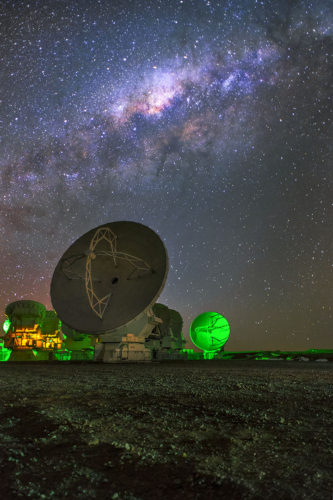
a series of dish antenna telescopes is gently illuminated under the night sky with the milky way galaxy visible above
In the Chajnantor Plateau, amazing picture of the antennas under the Milkyway. Credit: Sergio Otarola- ALMA (ESO/NAOJ/NRAO)

McKay is no stranger to proposing and using ALMA data. A third-year graduate student in astronomy professor Amy Barger’s research group, he expects nearly all his publications will be based on ALMA data. His research focuses on old, distant galaxies and measuring and inferring physical properties about them: How massive are they? What is their rate of star formation? What processes trigger the rapid star-formation in these systems?

“The galaxies that I mainly study are faint or hard to detect in optical wavelengths or even near-infrared wavelengths. Until about maybe 25 years ago, we didn’t know a lot of these galaxies existed because they just weren’t visible in the typical telescope images we had,” McKay says. “The portion of the observed electromagnetic spectrum where these galaxies are brightest ranges from 500 microns to nearly one millimeter, which overlaps heavily with ALMA’s spectral coverage.”

Two years ago, McKay attended an ALMA workshop to learn more about how ALMA and similar radio arrays operate. With this ALMA ambassadorship, he will now help run the workshops and offer advice on crafting stronger proposals. The ALMA Ambassador Program is run through the National Radio Astronomy Observatory’s North American ALMA Science Center (NAASC). It provides training and an up to $10,000 research grant to early-career researchers interested in expanding their ALMA/interferometry expertise and sharing that knowledge with their home institutions.

“This program is helpful for me because I will learn more in terms of how to actually do my own research, but then I can also pass along what I learn with the rest of the astronomical community,” McKay says.

Welcome, Professor Vladimir Zhdankin!

profile photo of Vladimir Zhdankin
Vladimir Zhdankin (credit: Flatiron Institute)

Theoretical plasma astrophysicist Vladimir Zhdankin ‘11, PhD ’15, returns to UW–Madison as an assistant professor of physics on January 1, 2024. As a student, Zhdankin worked with Prof. Stas Boldyrev on solar wind turbulence and basic magnetohydrodynamic turbulence, which are relevant for near-Earth types of space plasmas. After graduating, Zhdankin began studying plasma astrophysics of more extreme environments. He first completed a postdoc at CU-Boulder, then a NASA Einstein Fellowship at Princeton University. He joins the department from the Flatiron Institute in New York, where he is currently a Flatiron Research Fellow.

Please give an overview of your research. 

These days, most of my interest is in the field of plasma astrophysics — the application of plasma physics to astrophysical problems. Much of the matter in the universe is in a plasma state, such as stars, the matter around black holes, and the interstellar medium in the galaxy. I’m interested in understanding the plasma processes in those types of systems. My focus is particularly on really high energy systems, like plasmas around black holes or neutron stars, which are dense objects where you could get extreme plasmas where relativistic effects are important. The particles are traveling at very close to the speed of light, and there’s natural particle acceleration occurring in these systems. They also radiate intensely, you could see them from halfway across the universe. There’s a need to know the basic plasma physics in these conditions if you want to interpret observations of those systems. A lot of my work involves doing plasma simulations of turbulence in these extreme parameter regimes.

What are one or two research projects you’ll focus on the most first?

One of them is on making reduced models of plasmas by using non-equilibrium statistical mechanical ideas. Statistical mechanics is one of the core subjects of physics, but it doesn’t really seem to apply to plasmas very often. This is because a lot of plasmas are in this regime that’s called collisionless plasma, where they are knocked out of thermal equilibrium, and then they always exist in a non-thermal state. That’s not what standard statistical mechanics is applicable to. This is one of the problems that I’m studying, whether there is some theoretical framework to study these non-equilibrium plasmas, to understand basic things like: what does it mean for entropy to be produced in these types of plasmas? The important application of this work is to explain how are particles accelerated to really high energies in plasmas. The particle acceleration process is important for explaining cosmic rays which are bombarding the Earth, and then also explaining the highest energy radiation which we see from those systems.

Another thing I’m thinking about these days is plasmas near black holes. In the center of the Milky Way, for example, there’s a supermassive black hole called Sagittarius A*, which was recently imaged a year or two ago by the Event Horizon Telescope. It’s a very famous picture. What you see is the shape of the black hole and then all the plasma in the vicinity, which is in the accretion disk. I’m trying to understand the properties of that turbulent plasma and how to model the type of radiation coming out of the system. And then also whether we should expect neutrinos to be coming out, because you would need to get very high energy protons in order to produce neutrinos. And it’s still an open question of whether or not that happens in these systems.

What attracted you to UW–Madison?

It’s just a perfect match in many ways. It really feels like a place where I’m confident that I could succeed and accomplish my goals, be an effective mentor, and build a successful group. It has all the resources I need, it has the community I need as a plasma physicist to interact with. I think it has a lot to offer to me and likewise, I have a lot to offer to the department there. I’m also really looking forward to the farmers’ market and cheese and things like that. You know, just the culture there.

What is your favorite element and/or elementary particle?

I like the muon. It is just a heavy version of the electron, I don’t remember, something like 100 times more massive or so. It’s funny that such particles exist and this is like the simplest example of one of those fundamental particles which we aren’t really familiar with, it’s just…out there. You could imagine situations where you just replace electron with a muon and then you get slightly different physics out of it.

What hobbies and interests do you have?

They change all the time. But some things I’ve always done: I like running, skiing, bouldering indoors, disk golf, racquet sports, and hiking. (Cross country or downhill skiing?) It’s honestly hard to choose which one I prefer more. In Wisconsin, definitely cross country. If I’m in real mountains, the Alps or the Rockies, then downhill is just an amazing experience.

Federal physics advisory panel — including Profs. Bose and Cranmer — announces particle physics recommendations

Earlier this year, physics professors Tulika Bose and Kyle Cranmer were selected to serve on the Particle Physics Project Prioritization Panel, or P5, a group of High Energy Physics experts that advises the Department of Energy Office of Science and the National Science Foundation’s Division of Physics on high energy and particle physics matters.

P5 announced their recommendations in a draft report published Dec. 7 — and UW–Madison physicists are featured in many of the projects.

One recommendation is to move forward with a planned expansion of the IceCube Neutrino Observatory, an international scientific collaboration operated by the UW–Madison at the South Pole. Other recommendations include support for a separate neutrino experiment based in Illinois (the Deep Underground Neutrino Experiment, or DUNE); continuing investment in the Large Hadron Collider in Switzerland and the Rubin Observatory in Chile; and expanding involvement in the Cherenkov Telescope Array (CTA), a ground-based very-high-energy gamma ray observatory. UW–Madison physicists have leading roles in all of these research efforts.

Additional recommendations include the development of a next generation of ground-based telescopes to observe the cosmic microwave background and a direct dark matter detector experiment, among others.

Read the full story