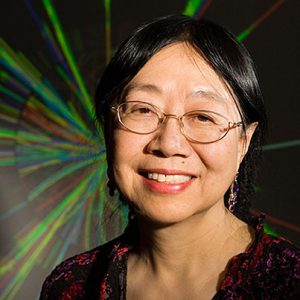
Congratulations to Prof. Wu on her retirement!

profile photo of Sau Lan Wu
Sau Lan Wu | Photo: Jeff Miller, UW–Madison

Congrats to UW–Madison physics Prof. Sau Lan Wu, who announced her retirement effective January 1, 2026. One of the first two women on the physics faculty when she joined as an assistant professor in 1977, her nearly 50-year career stands as one of the most consequential in modern experimental particle physics.

“Sau Lan is truly remarkable and irreplaceable,” says UW–Madison experimental particle physicist and department chair Kevin Black. “If I accomplish even one-third of what she has in her career, I will consider myself incredibly successful.”

Rising from humble beginnings in Hong Kong to becoming a central figure in high energy physics, Wu’s path began at Vassar College, where she graduated summa cum laude in 1963. She then earned her MA and PhD from Harvard, part of the first cohort of women ever awarded graduate degrees directly from the university. After a postdoctoral fellowship and research appointment at MIT, she joined UW–Madison as an assistant professor in 1977, was promoted to associate professor in 1980, and to full professor in 1983. She earned the UW–Madison titles of Enrico Fermi Professor, Hilldale Professor, and Vilas Professor.

From her earliest days in the field, Wu gravitated toward the biggest scientific frontiers. She played key roles in three landmark particle discoveries: the charm quark in 1974 as part of Samuel Ting’s MIT/Brookhaven team; the gluon in 1979 through her pioneering work identifying three-jet events at DESY; and the Higgs boson in 2012, where her ATLAS group helped lead analyses of the H→γγ and H→ZZ*→4ℓ decay channels. Each discovery reshaped the Standard Model, and collectively they earned her a reputation as one of particle physics’ most influential experimentalists.
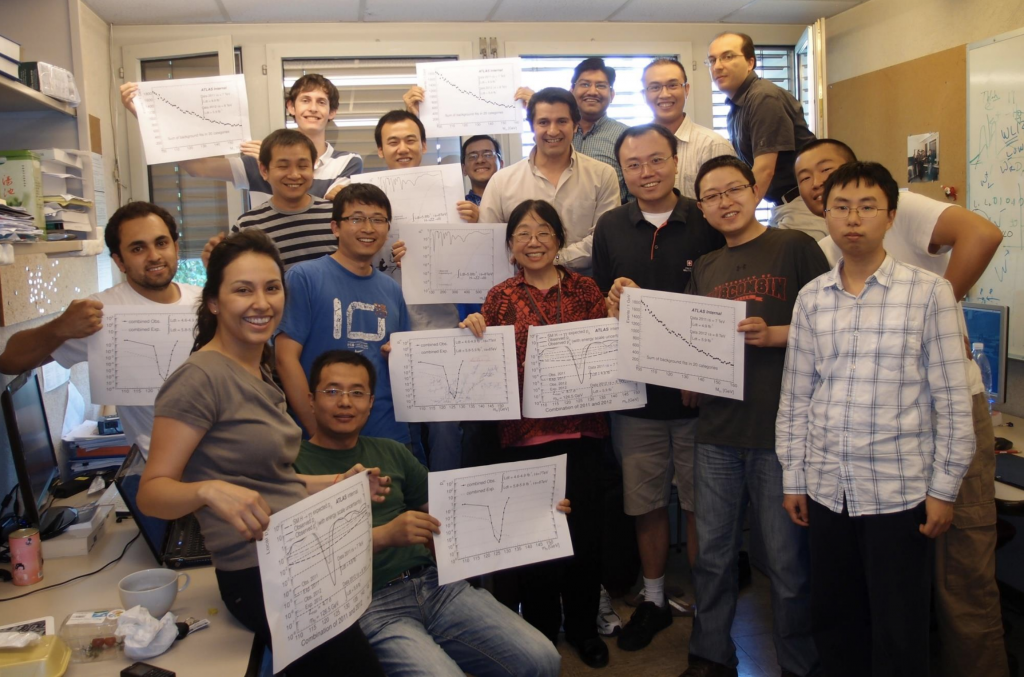
a group of very happy scientists pose for a shot, all holding a printout of the same graph
The UW–Madison ATLAS group at CERN at the time of the Higgs discovery all celebrated with printouts of the data confirming 5sigma. | Provided by Sau Lan Wu

Wu is a Fellow of the American Physical Society and the American Academy of Arts & Sciences, a recipient of the European Physical Society Prize, and shared the 2025 Breakthrough Prize in Fundamental Physics with the LHC collaboration. In 2022, the International Astronomical Union named a minor planet, Saulanwu, in her honor.

Through all these achievements, Wu remained devoted to guiding the next generation of experimental physics. 65 doctoral students completed their PhDs in her group, on major experiments from PETRA to LEP, BaBar, and the LHC. Of her former students and postdocs, 40 now hold faculty positions worldwide, and 18 are permanent staff scientists at major laboratories. Many others have gone on to high-impact roles in national science policy and the technology sector.

Says Steve Ritz, distinguished professor of physics at the University of California Santa Cruz and the Santa Cruz Institute for Particle Physics and a former student with Wu:

“Sau Lan pointed the way toward the most interesting questions, and she made sure we had what we needed for success. We always knew that we could try new approaches to problems and that she had our backs if we hit a bump in the road. She also made sure we didn’t just bury ourselves in our own work: there seemed to be a constant flow of great physicists visiting the group, and Sau Lan introduced us to each one. We were encouraged to attend their seminars and we were invited to lunch and dinner discussions. I now understand that Sau Lan was helping us develop our own sense of belonging in the field, while also pushing us to reach our full potential.”

John Conway, distinguished professor in the Department of Physics and Astronomy at UC Davis and former postdoc in Wu’s group, adds:

“I worked with Sau Lan as a postdoc on the ALEPH experiment at CERN for over five years. It was a fantastic time — her group was super lively and carrying out a lot of different work on the experiment, and which was then brand new. Sau Lan instilled in me the hunger for discovery that I have carried through the rest of my career, and demonstrated what it meant to be truly dedicated to this work. She was an inspiring leader and had genuine concern for the lives and careers of everyone who worked for her. I’ve tried to pay that forward in my own career.”
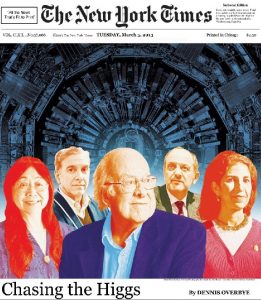
a screenshot of a newspaper front page, with an artistically-rendered photo of 5 key scientists involved in the Higgs discovery
Sau Lan Wu and other Higgs scientists were featured on the cover of the New York Times for a story about the chase for the Higgs boson.

Even in the later stages of her career, Wu remained at the forefront of innovation. She championed the integration of artificial intelligence and machine learning into experimental physics, leading ATLAS’s first event-level anomaly detection study and advancing GNN-based tracking, GAN-based simulation, and early quantum machine learning applications for high energy physics. These efforts have helped prepare the field for the data-intensive future of the HighLuminosity‑ LHC beginning later this decade.

Wu has been featured on the front page of The New York Times, profiled in Quanta and Wired, invited to write for Scientific American, and highlighted in seven books celebrating scientific trailblazers and women in STEM, many aimed at sharing the excitement of discovery with children. The UW–Madison alumni magazine, On Wisconsin, featured her in a lengthy profile in 2019. She has delivered Vassar’s 150th Commencement Address, appeared on the cover of the AIP History Newsletter, and continued to be a sought-after speaker, including keynotes at SLAC in 2024 commemorating the 50th anniversary of the J/ψ discovery.

“Sau Lan is a legend in the field of experimental particle physics,” says Sridhara Dasu, an experimental particle physics professor at UW–Madison. “Her experiences will be inspiring for generations to come.”
 

Double the Higgs, Double the Mystery! The hunt for a new, heavy particle decaying to a pair of Higgs Bosons

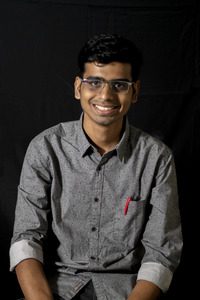
This story, written by physics grad student Ganesh Parida, was originally published by the CMS collaboration

CMS scientists are on the hunt for a new, heavy particle that decays into a pair of Higgs bosons. Using the final state with two bottom quarks and two tau leptons, the search sets the most stringent limits to date in the mass range 1.4–4.5 TeV.

Ganesh Parida

The CMS experiment is searching for signs of new, heavy particles that could decay into pairs of Higgs bosons –  we call this an HH signature. These signatures are particularly exciting because they can give us clues about the stability of our universe and open a window to physics beyond our current understanding of fundamental particles and their interactions, the standard model.

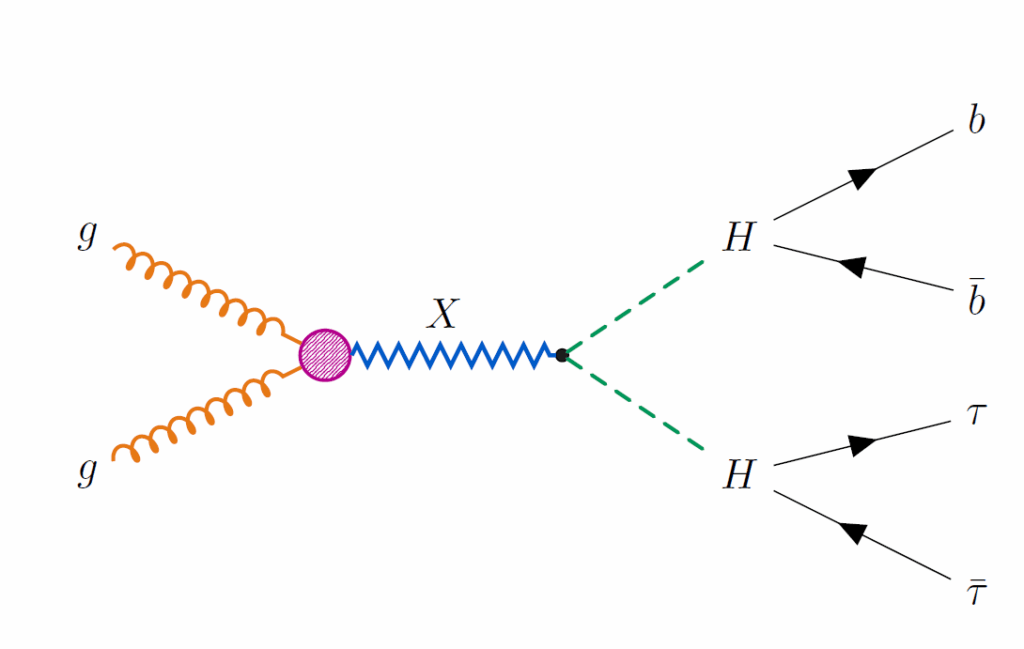
In this search, we focus on a final state where one Higgs boson decays to two bottom quarks (H→bb) and the other decays to two tau leptons (H→ττ). This final state offers a promising balance: it has a relatively large probability of occurring, while also allowing us to separate signal events from background processes. Performing such a search is far from straightforward. If a new heavy particle were produced at the LHC, it would impart a large momentum, a “boost”, to its daughter Higgs bosons. The boost causes the decay products of each Higgs boson to be collimated and overlap in the detector, making their reconstruction quite challenging.


a diagram shows two small 'g' with orange squiggly lines converging on a pink circle. A blue squiggly line emerges, then splits into two dashed lined that lead to H's, with both subsequently splitting to two beta or tau symbols for top and bottom quark and tau particles
Diagram showing a new physics process explored in this search. Two protons collide and produce a new heavy particle X, which then decays into two standard model Higgs bosons , which in turn give two bottom quarks and two tau leptons in the final state. | Credit: CMS Collaboration

To meet this challenge, CMS uses advanced reconstruction and machine-learning techniques. For the H→bb decay, the bottom quarks form collimated sprays of particles, called jets, which overlap to a large extent. To identify them, a graph neural network, called ParticleNet, is trained to recognize the pattern of the two bottom quark jets inside a single, large jet.

Reconstructing the H→ττ is a two-step process: first, we untangle and reconstruct the two really close taus, and then we use a convolutional neural network, called Boosted DeepTau to figure out the characteristics of these reconstructed taus and tell them apart from background jets. Because tau leptons also produce invisible neutrinos, we apply a likelihood-based method to obtain the four-momentum of the parent Higgs boson.

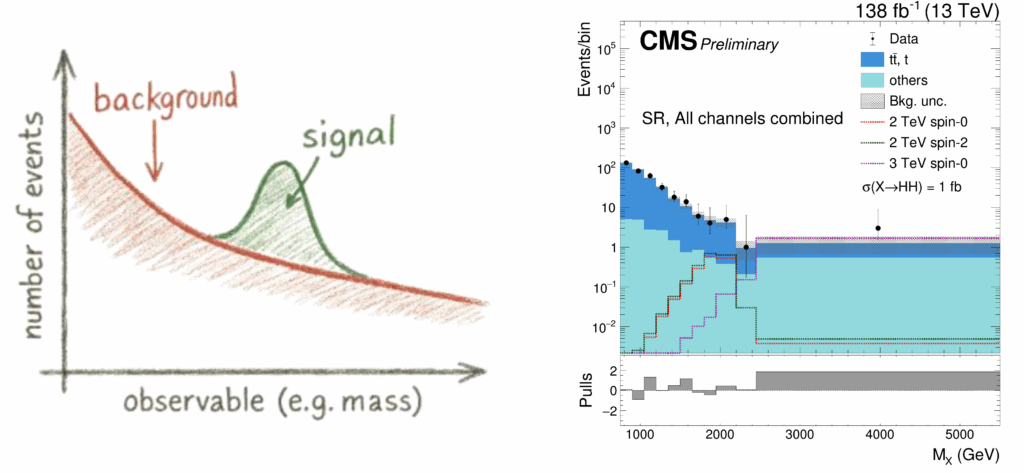
Once both Higgs bosons are reconstructed, we can combine them to measure the mass of the system. If a new heavy particle exists, it would appear as a peak, or “bump,” on top of the smoothly falling background distribution. This strategy is often referred to as a “bump hunt” – a classic tool in the search for new particles at colliders.

graph on left is observable (x-axis) vs number of events. it's a hand-drawn-ish cartoon with a clear signal bump in the middle. Right is Mass of the higgs vs events.
Left: The sketch illustrates how we perform a “bump hunt.” Background processes fall smoothly with increasing mass, while a new particle would create a visible peak on top of this distribution. Right: We reconstruct the mass of Higgs boson pairs from collision data and compare it to standard model background predictions (shown in color). The black points show the recorded data, while the dashed lines illustrate how new heavy particles could appear. The data follow the standard model expectation, and CMS does not observe a significant excess. | Source: CMS Collaboration

After analyzing data from the full LHC Run 2 (2016–2018), CMS did not observe any significant deviation from the standard model prediction. While this means that no new particle was discovered in this final state yet, the analysis sets the most stringent upper limits to date on the possible production of heavy particles decaying into Higgs boson pairs in the bbττ final state in the mass range of 1.4 TeV to 4.5 TeV.

“The results may not yet show evidence of new physics, but they are paving the way,” says Ganesh Parida, a PhD student at the University of Wisconsin–Madison, who carried out this analysis together with Camilla Galloni and Deborah Pinna, both scientists at the University of Wisconsin–Madison and members of CMS. “It has been both exciting and rewarding to learn, develop, and apply sophisticated techniques to probe these challenging boosted regimes.”

The biggest challenge here is the sheer number of events we can collect for these difficult “boosted” scenarios. That is why the ongoing Run 3 and the upcoming High-Luminosity runs of the LHC are so important – they will give us the biggest datasets ever for a potential discovery!

UW–Madison scientists part of team awarded Breakthrough Prize in Physics

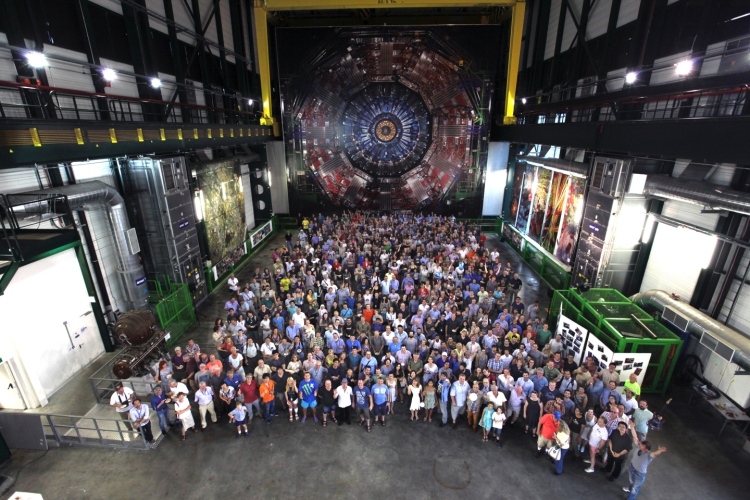
hundreds if not thousands of people stand in front of the CMS detector

A team of 13,508 scientists, including over 100 from the University of Wisconsin–Madison, won the 2025 Breakthrough Prize in Fundamental Physics, the Breakthrough Prize Foundation announced April 5. The Prize recognized work conducted at CERN’s Large Hadron Collider (LHC) between 2015 and 2024.

The Breakthrough Prize was created to celebrate the wonders of our scientific age. The $3 million prize will be donated to the CERN & Society Foundation, which offers financial support to doctoral students to conduct research at CERN.

Four LHC projects were awarded, including ATLAS and CMS, both of which UW–Madison scientists work on. ATLAS and CMS jointly announced the discovery of the Higgs boson in 2012, and its discovery opened up many new avenues of research. In the years since, LHC researchers have worked towards a better understanding of this important particle because it interacts with all matter and gives other particles their mass. Both teams are actively engaged in analyzing LHC data in search of exciting and new physics.

“The LHC experiments have produced more than 3000 combined papers covering studies of electroweak physics and the Higgs boson, searches for dark matter, understanding quantum chromodynamics, and studying the symmetries of fundamental physics,” says CMS researcher Kevin Black, chair of the UW–Madison department of physics. “This work represents the combined contributions of many thousands of physicists, engineers, and computer scientists, and has taken decades to come to fruition. We are all very excited to be recognized with this award.”

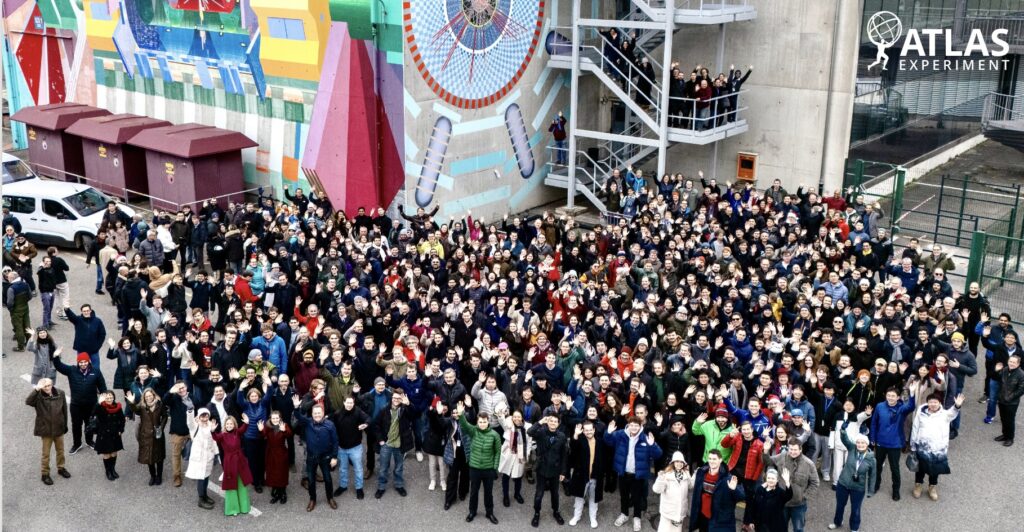
thousands of people stand as a group in front of some vaguely science-y looking (and very large!) equipment
Over 13,000 LHC researchers were awarded the 2025 Breakthrough Prize, including a subset of the ATLAS team seen here. | Source: CERN

ATLAS and CMS have generally the same research goals, but different technical ways of addressing them. Both detectors probe the aftermath of particle collisions at the LHC and use the detectors’ high-precision measurements to address questions about the Standard Model of particle physics, the building blocks of matter and dark matter, exotic particles, extra dimensions, supersymmetry, and more.

The ATLAS team at UW–Madison has taken a leadership role in both physics analyses and computing. They have spearheaded precision measurements of the Higgs boson’s properties and conducted extensive searches for new physics, including Dark Matter, achieving major sensitivity gains through advanced AI and machine learning techniques. In addition to leading developments in computing infrastructure, the team has played a crucial role in the High-Level Trigger system and simulation efforts using generative AI, further enhancing the experiment’s capabilities.

The CMS team at UW–Madison has played and continues to play key roles in trigger electronics systems, which are ways of sorting through the tens of millions of megabytes of data produced each second by a collider experiment and retaining the most meaningful events. They also manage a large computing cluster at UW-Madison, contribute to the building and operating of muon detectors, make key contributions to CMS trigger and computing operations, and develop physics analysis techniques including AI/ML. The CMS group efforts are well recognized in the recently published compendium of results, dubbed, the Stairway to Heaven.

CMS and ATLAS research at UW–Madison is largely supported by the U.S. Department of Energy, with additional support from the National Science Foundation.

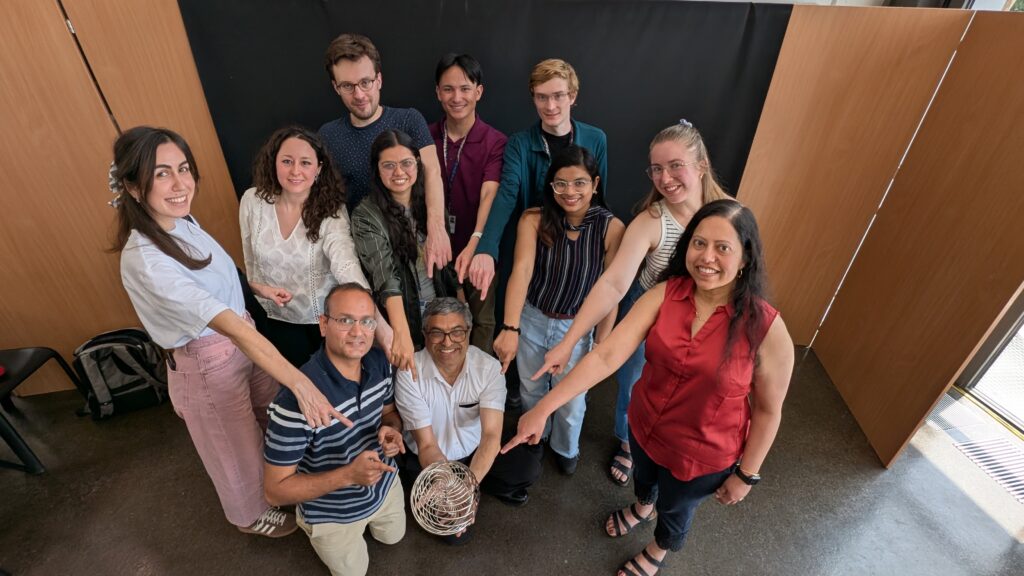
a group of people pose with a trophy-like object
A group of CMS researchers at UW–Madison pose with the Breakthrough Prize

The following people had a UW–Madison affiliation during the time noted by the Prize:

Current Professors

Kevin Black, Tulika Bose, Kyle Cranmer, Sridhara Dasu, Matthew Herndon, Sau Lan Wu

Current PhD Physicists

Pieter Everaerts, Matthew Feickert, Camilla Galloni, Alexander Held, Wasikul Islam, Charis Koraka, Abdollah Mohammadi, Ajit Mohapatra, Laurent Pétré, Deborah Pinna, Jay Sandesara, Alexandre Savin, Varun Sharma, Werner Wiedenmann

Current Graduate Students

Anagha Aravind, Alkaid Cheng, He He, Abhishikth Mallampalli, Susmita Mondal, Ganesh Parida, Minh Tuan Pham, Dylan Teague, Abigail Warden

Current Engineering Staff

Shaojun Sun

Current Emeriti

Sunanda Banerjee (Senior Scientist), Richard Loveless (Distinguished Senior Scientist),  Wesley H. Smith (Professor)

Alumni

Michalis Bachtis (Ph.D. 2012), Swagato Banerjee (Postdoc 2015), Austin Belknap (Ph.D. 2015), James Buchanan (Ph.D. 2019), Cecile Caillol (Postdoc), Duncan Carlsmith (Professor), Maria Cepeda (Postdoc), Jay Chan (Ph.D. 2023), Stephane Cooperstein (B.S. 2014), Isabelle De Bruyn (Scientist), Senka Djuric (Postdoc), Laura Dodd (Ph.D. 2018), Keegan Downham (B.S. 2020), Evan Friis (Postdoc), Bhawna Gomber (Postdoc), Lindsey Gray (Ph.D. 2012), Monika Grothe (Scientist), Wen Guan (Engineer with PhD 2022), Andrew Straiton Hard (Ph.D. 2018), Yang Heng (Ph.D. 2019), Usama Hussain (Ph.D. 2020), Haoshuang Ji (Ph.D. 2019), Xiangyang Ju (Ph.D. 2018), Laser Seymour Kaplan (Ph.D. 2019), Lashkar Kashif (Postdoc 2019), Pamela Klabbers (Scientist), Evan Koenig (BS 2018, Intern), Amanda Kaitlyn Kruse (Ph.D. 2015), Armando Lanaro (Senior Scientist), Jessica Leonard (Ph.D. 2011), Aaron Levine (Ph.D. 2016), Andrew Loeliger (Ph.D. 2022), Kenneth Long (Ph.D. 2019), Jithin Madhusudanan Sreekala (Ph.D. 2022) Yao Ming (Ph.D. 2018), Isobel Ojalvo (Ph.D. 2014, Postdoc), Lauren Melissa Osojnak (Ph.D. 2020), Tom Perry (Ph.D. 2016), Elois Petruska (BS, 2021), Yan Qian (Undergraduate Student 2023), Tyler Ruggles (Ph.D. 2018, Postdoc), Tapas Sarangi (Scientist), Victor Shang (Ph.D. 2024), Manuel Silva (Ph.D. 2019), Nick Smith (Ph.D. 2018), Amy Tee (Postdoc, 2023), Stephen Trembath-Reichert (M.S. 2020),  Ho-Fung Tsoi (Ph.D. 2024), Devin Taylor (Ph.D. 2017), Wren Vetens (Ph.D. 2024), Alex Zeng Wang (Ph.D. 2023), Fuquan Wang (Ph.D. 2019), Nate Woods (Ph.D. 2017), Hongtao Yang (Ph.D. 2016), Fangzhou Zhang (Ph.D. 2018), Rui Zhang (Postdoc, 2025), Chen Zhou (Postdoc 2021)

HAWC detection of an ultra-high-energy gamma-ray bubble around a microquasar

This story is adapted from the HAWC Collaboration press release. Microquasars—compact regions surrounding a black hole with a mass several times that of its companion star—have long been recognized as powerful particle accelerators within our galaxy. The enormous jets spewing out of microquasars are thought to play an important role in the production of galactic cosmic rays, although [...]

Read the full article at: https://wipac.wisc.edu/hawc-detection-of-an-ultra-high-energy-gamma-ray-bubble-around-a-microquasar/

New NOvA results add to mystery of neutrinos

The international NOvA collaboration presented new results at the Neutrino 2024 conference in Milan, Italy, on June 17. The collaboration doubled their neutrino data since their previous release four years ago, including adding a new low-energy sample of electron neutrinos. The new results are consistent with previous NOvA results, but with improved precision. The data favor the “normal” ordering of neutrino masses more strongly than before, but ambiguity remains around the neutrino’s oscillation properties.

At UW–Madison, the NOvA collaboration includes physics professor Brian Rebel, postdoc Adam Lister, former postdoc Tom Carroll, and grad student Anna Cooleybeck.

The latest NOvA data provide a very precise measurement of the bigger splitting between the squared neutrino masses and slightly favor the normal mass ordering. That precision on the mass splitting means that, when coupled with data from other experiments performed at nuclear reactors, the data favor the normal ordering at almost 7:1 odds. This suggests that neutrinos adhere to the normal ordering, but physicists have not met the high threshold of certainty required to declare a discovery.

Read the full story, originally published by Fermilab

Entangled neutrinos may lead to heavier element formation

Elements are the building blocks of every chemical in the universe, but how and where the different elements formed is not entirely understood. A new paper in The Astrophysical Journal by University of Wisconsin–Madison physics professor Baha Balantekin and colleagues with the Network for Neutrinos, Nuclear Astrophysics, and Symmetries (N3AS) Physics Frontier Center, shows how entangled neutrinos could be required for the formation of elements above approximately atomic number 140 via neutron capture in an intermediate-rate process, or i-process.

Profile photo of Baha Balantekin
Baha Balantekin

Why it’s important

“Where the chemical elements are made is not clear, and we do not know all the possible ways they can be made,” Balantekin says. “We believe that some are made in supernovae explosions or neutron star mergers, and many of these objects are governed by the laws of quantum mechanics, so then you can use the stars to explore aspects of quantum mechanics.”

What is already known?

  • Immediately after the Big Bang, lighter elements like hydrogen and helium were abundant. Heavier elements, up to iron (atomic number 26) continued to form through nuclear fusion in the centers of hot stars.
  • Above iron, fusion is no longer energetically favorable, and nuclear synthesis occurs via neutron capture, where neutrons glom onto atomic nuclei. At high enough concentrations, neutrons can convert into protons, increasing the atomic number of the element by one.
  • This conversion is dependent on neutrinos and antineutrinos. Neutron capture has been found to occur slowly (s-process, over years) and rapidly (r-process, within minutes); an intermediate timescale, or i-process has been proposed but little evidence exists to support it. Rapid or intermediate neutron capture can only take place in catastrophic events where a huge amount of energy is released, such as supernova collapse.
  • “When a supernova collapse occurs, you start with a big star, which is gravitationally bound, and that binding has energy,” Balantekin says. “When it collapses, that energy has to be released, and it turns out that energy is released in neutrinos.”
  • The laws of quantum mechanics state that those neutrinos can become entangled because they interact in the collapsing supernova. Entanglement is when any two or more particles interacted and then “remember” the others, no matter how far apart they might be.

A quick summary of the research

  • “One question we can ask is if these neutrinos are entangled with each other or not,” Balantekin says. “This paper shows that if the neutrinos are entangled, then there is an enhanced new process of element production, the i-process.”
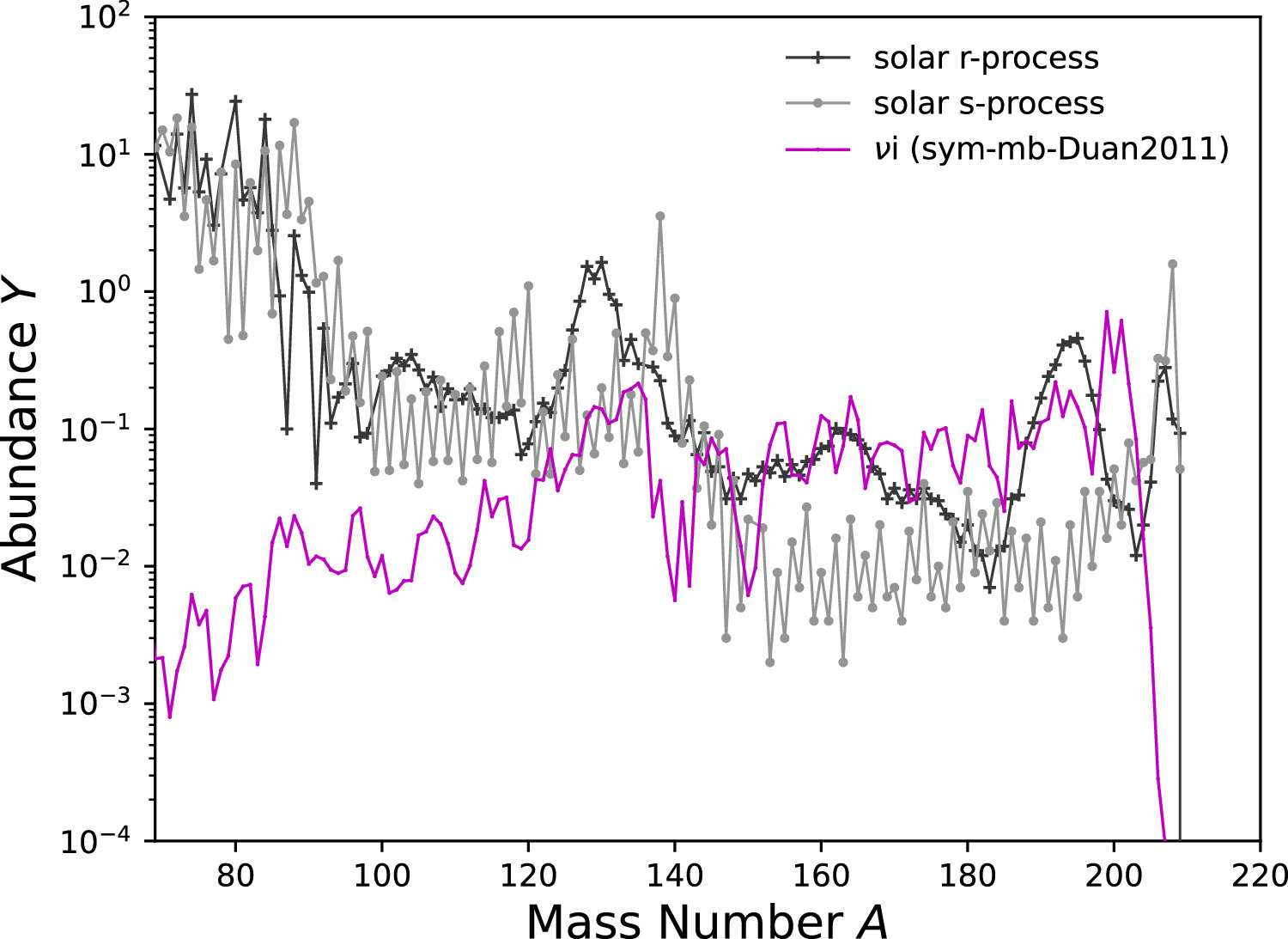
a plot of mass number A (atomic number) on the x-axis and abundance as a log scale on the y-axis. a purple line shows the i-process abundance, black line shows r-process, and grey line shows s-process. Above atomic number 140 or so, there is a visible enhancement of the purple line over the other two lines (below 140 the black and grey lines are much higher abundance values than the purple line)
The abundance pattern based on calculations in this paper (ν i-process pattern; purple line), compared with the solar system s-process (gray line) and r-process (black line) abundance data (Sneden et al. 2008). The ν i abundance for A = 143 is scaled to the solar r-process data for pattern comparison. | Source: The Astrophysical Journal

The experimental and simulated evidence

  • The researchers used two known facts to set up their calculations: well-established rates of neutron capture, and catalogs of the atomic spectra of stars, which astronomers have collected over decades to identify the abundance of different elements. They also knew that a supernova collapse produces on the order of 10^58 neutrinos, a number that is far too large to use in any standard calculations.
  • Instead, they made simulations of up to eight neutrinos and calculated the abundance of elements that would be created via neutron capture if the neutrinos were entangled, or were not entangled.
  • “We have a system of, say, three neutrinos and three antineutrinos together in a region where there are protons and neutrons and see if that changes anything about element formation,” Balantekin says. “We calculate the abundances of elements that are produced in the star, and you see that the entangled or not entangled cases give you different abundances.”
  • The simulations showed that elements with atomic number greater than 140 are likely to be enhanced by i-process neutron capture — but only if the neutrinos are entangled.

Caveats and future work

  • Balantekin points out that these simulations are just “hints” based on astronomical observations. Astrophysics research requires using the cosmos as a lab, and it is difficult to conduct true experimental tests on earth.
  • “There’s something called the standard model of particle physics, which determines the interaction of particles. The neutrino-neutrino interaction is one aspect of the standard model which has not been tested in the lab, it can only be tested in astrophysical extremes,” Balantekin says. “But other aspects of the standard model have been tested in the lab, so one believes that it should all work.”
  • The researchers are currently using more astrophysical data of element abundance in extreme environments to see if those abundances continue to be explained by entangled neutrinos.

This research is supported in part by the National Science Foundation grants Nos. PHY-1630782 and PHY-2020275 (Network for Neutrinos, Nuclear Astrophysics and Symmetries). Balantekin is supported in part by the U.S. Department of Energy, Office of Science, Office of High Energy Physics, under Award No. DE-SC0019465 and in part by the National Science Foundation Grant PHY-2108339 at the University of Wisconsin-Madison. 

The paper’s co-authors include Michael Cervia, Amol Patwardhan, Rebecca Surman, and Xilu Wang, all current or former members of N3AS.

Ke Fang named inaugural recipient of the Bernice Durand Faculty Fellowship

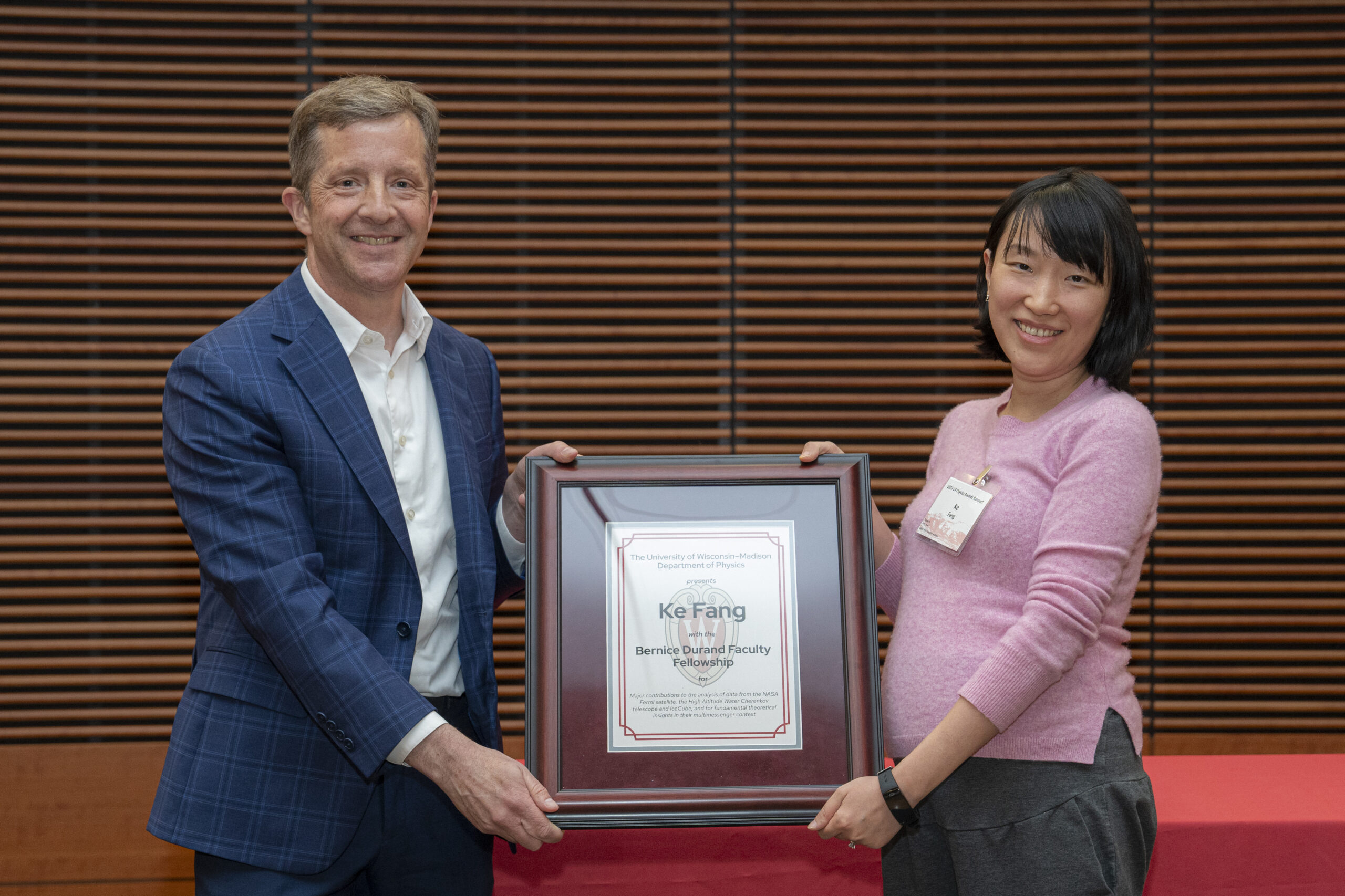
The Department of Physics is pleased to announce that Ke Fang, assistant professor of physics and WIPAC investigator, has received the inaugural Bernice Durand Faculty Fellowship. This fellowship, given in honor of late Professor Emerit of Physics Bernice Durand, recognizes Fang’s major contributions to the analysis of data from the NASA Fermi satellite, the High Altitude Water Cherenkov (HAWC) telescope and IceCube, and for fundamental theoretical insights in their multimessenger context. Fang is a Sloan Fellow, has been awarded an NSF CAREER award, and is the spokesperson for the HAWC experiment.

a man and a woman smile while both holding a framed award certificate
Department Chair and professor Mark Eriksson (left) presents assistant professor Ke Fang with the Bernice Durand Faculty Fellowship at the department awards banquet in May 2024.

Durand was one of the first two women professors in the UW–Madison Department of Physics. While at UW–Madison, Durand was a theoretical physicist who specialized in particle theory and mathematical physics. Her research was on symmetry relations in algebra and physics, plus the phenomenology of high-energy interactions at large particle accelerators.

As the first Associate Vice Chancellor for Diversity & Climate, Professor Durand provided leadership to ensure that faculty, staff, and student diversity issues including race, ethnicity, gender, sexual preference, and classroom and general campus workplace climate issues be addressed, and that search committees for non-classified staff be trained in broadening the pool of applicants and eliminating implicit bias. Durand co-directed a grant from the Alfred P. Sloan Foundation to the UW System designed to create more equity, flexibility and career options for faculty and academic staff. She was also a member of the leadership team of the Women in Science and Engineering Leadership Institute sponsored by the National Science Foundation to increase the participation and status of women in science.

A recipient of the Chancellor’s Award for Outstanding Teaching, Professor Durand taught courses at all levels, from modern physics for non-scientists (“Physics for Poets”) to a specialized course she developed for advanced graduate students in the use of topology and algebra in quantum field theory. In the mid 1990s, she used technological and pedagogical techniques in her teaching, such as broadcasting her modern physics for non-scientists course on public television with web-based coursework, and pioneering one of two early versions of MOOCs (massive open online courses) on campus.

Durand passed away in 2022.

The Bernice Durand Faculty Fellowship was conceived by our Board of Visitors, who spearheaded the ultimately-successful fundraising effort, with support from Professor Emerit Randy Durand for this fellowship honoring his wife.

Two physics students win presentation awards at APS April Meeting

Elias Mettner and Nadia Talbi, both conducting research in high energy physics at UW–Madison, won undergraduate presenter awards at the American Physical Society’s April Meeting.

The meeting, held in Sacramento April 3-6, included seven undergraduate oral presentation sessions with six to eight students in each session. The top two students from each session earned “Top Presenter” awards. Mettner and Talbi were the only two UW–Madison students who gave oral presentations, and both won awards.

profile photo of Elias Mettner
Elias Mettner

Mettner is a physics major working with scientist Abdollah Mohammadi. His talk was titled “Pair Production and Hadron Photoproduction Backgrounds at the Cool Copper Collider.”

The Cool Copper Collider is a proposed electron-positron collider that will help scientists to explore the Higgs boson even further. The electron-positron beam will have some natural decay that converts into particles and is recorded by the detector. Mettner’s research asks how this beam background will impact the detector.

“The detector will record this background, and it could take the place of the data we want or make it harder to reconstruct data,” Mettner says. “It’s important to make sure that the backgrounds that will come into the detector using this new design will not cause any issues, otherwise the benefits of this collider design cannot be put to their maximum use.”

Mettner had been interested in physics from a young age and comes from a family of teachers who encouraged him to explore his academic interests. Upon entering UW–Madison, he jumped at the chance to conduct research in particle physics. He joined the UW CMS Collaboration in his freshman year through the Undergraduate Research Scholars program and began his project with the Cool Copper Collider soon after. He was also awarded the Sophomore Research Fellowship for his junior year and the Hilldale Research Fellowship for his upcoming senior year.

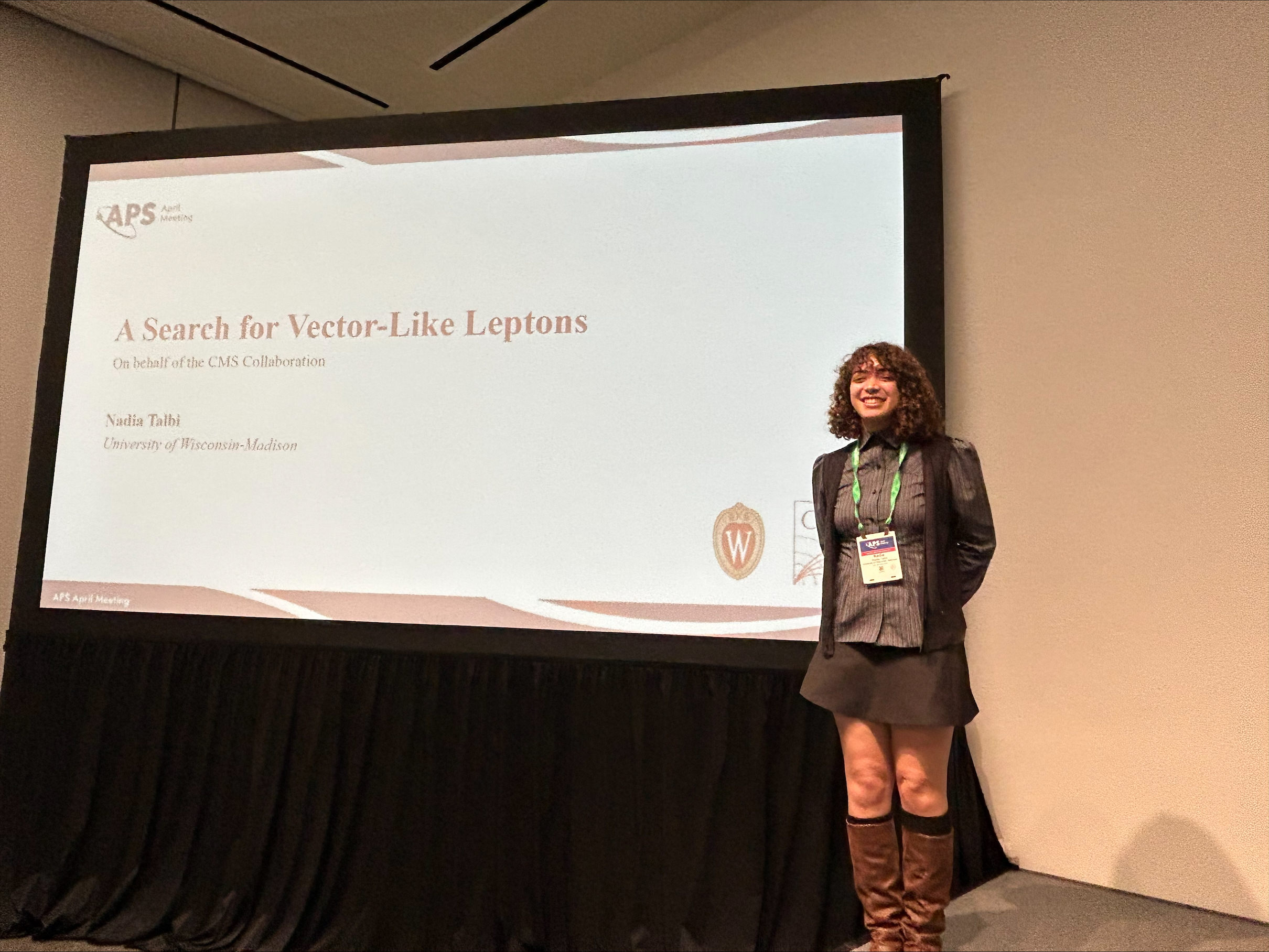
a woman stands in front of a screen with a powerpoint presentation title slide showing
Nadia Talbi presents at APS April Meeting

Talbi is an astronomy-physics major working in physics professor Tulika Bose’s group and mentored by postdoc Charis Koraka. Her talk, “A Search for Vector-Like Leptons: Compact Analysis,” covered work she has done through a Thaxton Fellowship.

“Bosons are force particles, and basically every boson except for the Higgs — the photon, the gluon — is a vector boson. Leptons are electrons, muons, neutrinos, stuff like that,” Talbi explains. “Vector-like leptons are a hypothetical particle, we don’t know whether or not they exist.”

Talbi was drawn to astronomy because she has long had an interest in the fundamental nature of the universe. As a child, she read an article on Dark Matter and, later, a friend gave her a book on the Standard Model. She was hooked. When she applied for the Thaxton Fellowship, a departmental program that was started to provide more equitable access to undergraduate research in physics, she discussed her interest in particle physics and the research at CERN, which landed her in Bose’s group.

“So before I even had any formal education in physics, where things can be very black and white, I’ve had the opportunity to understand the beautiful things within the field,” Talbi says. “Studying physics, I think, gives you some of the most fundamental understanding of our existence.”

Both Metter and Talbi say that attending conference was overall a very worthwhile experience — even if they both had to take an E+M exam remotely before presenting. (“It was a good bonding experience,” Talbi says.)

“The conference was a lot of fun, and worth it to go and make some connections and experience a bunch of really interesting research from people all in different stages of their careers,” Mettner says.

Adds Talbi: “There were so many undergraduates there, I met so many, I made a lot of friends. It felt like there was a community.”

Both students were also invited to present their award-winning talks to the Physics Board of Visitors spring meeting.