Research, teaching and public engagement in Physics at UW–Madison
Year: 2026
UW-Madison research on planetary engulfment is featured in the New York Times
Posted on
Two recent publications led by UW-Madison astrophysicists were featured in a July 9 New York Times article on planetary engulfment, the process by which a star consumes an orbiting companion. Both center on TOI-5882, an evolved subgiant star hosting a massive brown dwarf (22 Jupiter masses) on a tight, 7-day orbit, and together they reconstruct both the chemical fingerprint and the physical fate of that doomed companion.
The first paper (Kotten et al. 2026) shows that TOI-5882 carries an unusually strong lithium signature, best explained by the star having engulfed a super-Earth to Neptune-mass planet. The second (Narayan et al. 2026) develops a new, self-consistent framework for how tides drain orbital energy and angular momentum from the companion, demonstrating that internal gravity waves accelerate the brown dwarf’s inspiral far faster than classical models predict.
The work was led by two former UW-Madison undergraduates: Brooke Kotten, a former astronomy and physics major who is now an NSF Graduate Research Fellow at the University of Michigan, and Ritvik Sai Narayan, an astronomy major now heading to MIT this fall. Both students were mentored by Professor Soares-Furtado (Depts of Physics and Astronomy), who directed Brooke’s project and co-mentored Ritvik’s alongside Professor Rich Townsend. Townsend (Dept of Astronomy), who holds a Physics affiliation, played a key role in developing the computational model the team built to understand the fate of the brown dwarf. That two undergraduates drove research at this level speaks to the mentorship and research opportunities UW-Madison offers.
This project is closely aligned with the goals of WiCOR (Wisconsin Center for Origins Research; Physics and Astronomy are both department members). When a star consumes a planet, traces of the planet’s chemical makeup are left behind in the stellar atmosphere, allowing us to reconstruct its bulk composition. This matters for the search for life because a planet’s ability to support life depends largely on its interior chemistry. That chemistry determines whether the planet can form a rocky surface, maintain a protective magnetic field, and create an atmosphere. That interior chemistry is normally hidden beneath clouds and surface layers. Engulfment is one of the only ways to probe far beneath a planet’s atmosphere and determine the bulk composition of its interior. Stars like TOI-5882 provide a rare window into the ingredients that determine whether worlds like these could ever support life.
Matt Otten receives an NSF CAREER award!
Posted on
Congrats to Matthew Otten, Assistant Professor of Physics, for being selected for an NSF CAREER award. The 5-year award will support Otten and his group’s research on achieving practical quantum advantage for electronic structure on early-fault-tolerant-quantum (EFTQ) devices.
Such devices, with approximately 100 logical qubits capable of approximately one million gates are expected to appear within this decade, yet a compelling demonstration of quantum advantage for a problem of practical interest in electronic structure is still elusive. This project tackles that challenge with CANOE, the Classically Assisted Non-Orthogonal Eigensolver, a hybrid wavefunction framework that variationally combines a state-of-the-art classical expansion with additional quantum states stored on a quantum processor. Preliminary results demonstrate that such a wavefunction ansatz has powerful expressivity, but there are several bottlenecks that need to be addressed.
“To move CANOE from theory to a practical demonstration on quantum hardware, we will develop robust, classical generalized eigensolvers; utilize shot-frugal measurement methods; develop adaptive techniques for co-selection of classical and quantum states; and rigorously benchmark against state-of-the-art classical HPC ground state energy solvers.” Otten says. “This work will develop and distribute open-access software products that will provide unique capabilities for utilizing EFTQ devices and for simulating electronic structure at unprecedented accuracy. Fundamental advancements in the various techniques utilized will create a more nuanced understanding of the role of classical and quantum information in electronic structure.”
In addition to an innovative research component, this project strongly aligns with the broad NSF goals of growing participation in the QISE workforce and building a STEM-literate citizenry. It will train a new group of quantum-ready computational scientists through an integrated pipeline that couples research, education, and open dissemination. Graduate and advanced undergraduate students will learn EFTQ through modules embedded into a new course, Quantum Algorithms and Error Correction, and gain industry-aligned experience via internships through existing partnerships.
“Our current plan is to utilize our new methods annually during the Wisconsin Summer School on Quantum Science and stream it to Chicago Quantum Exchange member institutions.”, Otten says. “This will deliver hands-on quantum-programming labs.” All algorithms and data will be released under permissive licenses in a dedicated repository and contributed to leading quantum and resource-estimation toolchains, ensuring that researchers without hardware access can reproduce and extend the work. These activities will broaden participation in quantum information science, accelerate technology transfer to industry, and create durable community infrastructure for utility-scale quantum chemistry on EFTQ devices. The downstream societal benefits of improved understanding of strongly-correlated systems can have impacts on nitrogen fixation, battery chemistry, and corrosion materials.
The Faculty Early Career Development (CAREER) Program is an NSF-wide activity that offers the Foundation’s most prestigious awards in support of early-career faculty who have the potential to serve as academic role models in research and education and to lead advances in the mission of their department or organization. Activities pursued by early-career faculty should build a firm foundation for a lifetime of leadership in integrating education and research.
NSF-DOE Vera C. Rubin Observatory begins the Legacy Survey of Space and Time (LSST)!
Posted on
The NSF-DOE Vera C. Rubin Observatory has begun the Legacy Survey of Space and Time (LSST); an ultra-wide, ultra-high-definition time-lapse record of our Universe that will revolutionize the way we explore the cosmos.
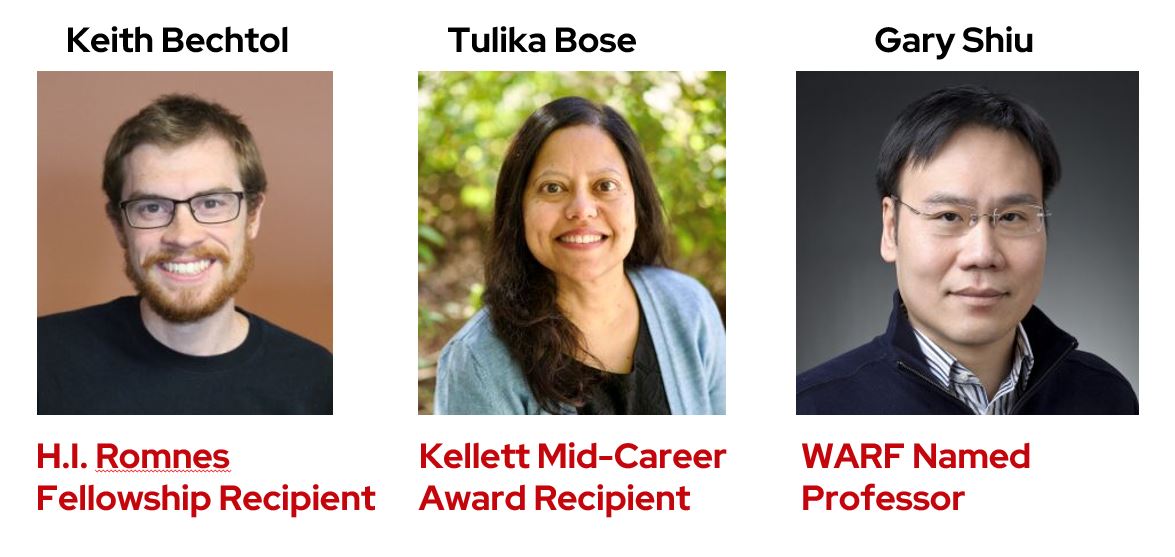
University of Wisconsin–Madison physics professor Keith Bechtol has been part of the international team that built and operates Rubin Observatory since 2016, serving in multiple leadership roles. He served as System Verification and Validation Scientist responsible for orchestrating the on-sky observing campaigns and data analyses to confirm that the as-built Rubin Observatory can achieve its ambitious science goals. In October 2025, Bechtol was appointed to lead the Early Operations Optimization campaign, coordinating efforts to tune up the observatory to reliably perform at the high level needed for 10 years of sustained LSST observing.
“Starting tonight, Rubin Observatory will repeatedly scan the sky on nearly every clear night for the next decade. We aim to acquire more than 2 million individual images using the largest camera ever built and produce the greatest cosmic movie ever made,” Bechtol says. “Delivering consistently sharp image quality across the enormous field of view throughout the night, night-after-night, while rapidly scanning the sky requires many components working together with incredible precision.”
Bechtol is also Deputy Spokesperson for the LSST Dark Energy Science Collaboration, the international science collaboration formed to perform cosmological analyses of LSST data. “We are all looking forward to seeing what we can learn about dark matter and dark energy from LSST data. The discovery potential is enormous and there could be surprises.”
UW–Madison PhD students Miranda Gorsuch, Julian Beas-Gonzalez, and Kayleigh Excell have also been contributing to the scientific validation of early data from Rubin Observatory.
For more information, read the official release here.
What teeth enamel tells us about ancient human diets
Detailed molecular picture of tooth enamel reveals adaptions to diets, Gilbert and colleagues find
Posted on
Hominin dentitions have changed in relation to dietary changes over the past 10 million years. Compared with the earliest hominins, modern humans have less robust jaws, smaller posterior teeth and thinner enamel. At the nanoscale (10 nm), modern humans have more misoriented enamel than the earliest hominins, as reported here in magenta.
From chewing to chomping to grinding, teeth suffer from a lifetime of repeated mechanical stress. It makes sense, then, that enamel is one of the hardest natural materials. University of Wisconsin–Madison physics professor Pupa Gilbert and colleagues previously showed that the hydroxyapatite nanocrystals that make up enamel are arranged perfectly parallel to one another, like hairs in a ponytail, but their crystal lattices are not co-oriented — a structure that contributes to the biomaterial’s resistance to fracture, also known as toughness.
In a new study published on June 3 in the journal Nature, Gilbert and her colleagues developed a technique to quantitively measure enamel nanocrystal orientation angles across human and non-human primate enamel from different epochs, finding a strong correlation between how tough food is and the misorientation angle. The results help explain enamel evolution and have implications for modulating strength in bioinspired materials.
“Our work demonstrates that the misorientation of adjacent nanocrystals in enamel correlates very strongly with the hardness of food that primates eat,” Gilbert says. “Overall, the misorientation angles measured were small, all falling between 1.3 and 7.2 degrees, which makes sense with our earlier work where we found that small misorientation angles between thin, long, morphologically parallel nanocrystals deflect cracks and therefore toughen enamel.”
In all primates, enamel is arranged into 5-micrometer-wide bundles of elongated ~50-nanometer-wide hydroxyapatite nanocrystals. When grown synthetically, hydroxyapatite nanocrystals grow as needles, and they always have the crystalline axis along the long axis of the crystal. In enamel they do not.
Gilbert’s new work uses a new technique she developed, called PELICAN, that displays crystal orientations quantitatively and precisely measures the misorientation of adjacent nanocrystals. This technique allows the researchers to measure the misorientation angle of one nanocrystal relative to eight neighboring crystals, with nine million angles per area. They display the data in false-colored PELICAN maps where different colors represent the range of angles, and they make histograms of the frequency of each misorientation angle.
The researchers first compared enamel structure from non-human primates, including currently living and fossilized species whose diets range from soft fruit to hard seeds and nuts. The data show a clear increase in adjacent nanocrystal misorientation angles as the primates’ food hardness increases — with a nearly six-fold increase from ripe fruit to nutshells, from 1.3 to 7.2 degrees.
Next, they looked at primates in the human lineage, first comparing three species that lived at the same time and in the same region, ~1.6 million years ago in Kenya, but ate no meat, some meat, or mostly meat. They found that the non-meat-eater had lower misorientation angles compared to the meat eaters — 2.1 to 3-3.5 degrees — with no statistical difference between the meat eaters. Their next comparison was between Homosapiens (paleolithic and modern humans) from before (~40,000 years ago) and after (1550 and 700 years ago) the switch to agriculture, where food in general is softer, yet they still saw an increase in crystal misorientation. However, Gilbert’s anthropologist co-author Mackie O’Hara notes that stone grinding introduced stone grit into food, making it harder and abrasive at the microscale. As in non-human primates, a general trend emerges that harder or tougher food is associated with larger misorientation angles of adjacent enamel nanocrystals.
The consumption of meat in hominin diets correlates with an increase in misorientation angle. PELICAN maps of the occlusal enamel region from P. boisei (Pb; no meat; a), H.erectus (He; regular meat consumption; b) and H. habilis (Hh; occasional meat consumption; c).
Lastly, they looked at a modern human sample from 50 years ago, about 200 years after the Industrial Revolution when diets became much softer. Nanocrystal misorientation still went up slightly relative to the two post-agriculture Medieval samples, but the increase was not statistically significant, thus, the Industrial Revolution did not affect enamel nanostructure. Gilbert acknowledges that more research is needed to understand why misorientation angles did not decrease. One idea is that enamel adapts and evolves on a timescale greater than a few hundred years; another is that enamel is but one variable in the overall picture.
“The enamel nanostructure is only one component of a complex set of changes,” Gilbert says. “Our brains grew significantly in the last 2 million years, our jaws shrank in the last 12,000 years, we developed language, and many other changes occurred over human evolution. Even beyond genetic changes, physical characteristics change all the time, for example, crowding of the teeth toward the front of the mouth didn’t happen until after the Industrial Revolution.”
Overall, Gilbert and her team’s work suggests that primates have evolved to protect their teeth with stronger enamel as food becomes tougher. The team has not nailed down the exact misorientation angle at which maximum protection can occur, but the 1.3-7.2 degrees they measured in this study fits nicely within what materials scientists call low-angle grain boundaries, typically lower than 10-15 degrees.
“These results could also be harnessed for the synthesis of new materials that resist fracture with small misorientation of adjacent nanocrystals, such as self-assembling spherulites” Gilbert says.
Adam Distler, Physics and Astronomy alumni wins the prestigious Hertz Fellowship!
Posted on
Adam Distler, a 2024 UW–Madison graduate, has been named one of the 2026 Hertz Fellows.
As the Hertz Foundation describes it: “The Hertz Fellowship provides financial and lifelong professional support for the nation’s most promising doctoral students in the applied sciences, engineering and mathematics. Awarded through a rigorous selection process honed over seven decades, Hertz Fellows receive up to five years of funding and join an influential community dedicated to solving our most pressing challenges.”
Originally from Minnesota, Adam was a physics undergraduate at UW–Madison, where he also completed majors in Astronomy-Physics and Mathematics. He worked with Professor Melinda Soares-Furtado, co-authoring two papers before beginning his doctoral studies at Harvard, and is also completing projects with Professors Juliette Becker and Nicholas Stone.
Could there be more particles like the Higgs boson? For the first time, the CMS experiment has searched for the decay of the Higgs boson into two more Higgs-boson-like particles with unequal masses.
Some theories suggest that the Higgs boson might occasionally decay into particles that have never been seen before and have Higgs-boson-like properties. These new particles are unstable and quickly decay to known Standard Model particles in the CMS detector. While past CMS results have explored scenarios where the Higgs boson decays to such short-lived particles of identical masses, in this study we searched for a new possibility: what if the Higgs boson decays into two different new particles instead of two identical ones?
Calling the new particles ɸ1 and ϕ2 (ϕ2 is the heavier one), we consider cases where one of the ɸ decays to two bottom quarks, and the other decays to two 𝜏 leptons. This final state is favourable, since it has a relatively large probability of occurring and can be used to select interesting signal-like events from our datasets.
If the ϕ2 particle is at least twice as heavy as ϕ1, it could decay into an intermediate state with two ϕ1 before these decay into Standard Model particles. “We call this ‘cascade’ decay,” says Ashling Quinn, a PhD student working on the analysis, “since the extra step makes it resemble a waterfall.” So the decays can look like: H→ ɸ1ϕ2 → 2𝜏2b (non-cascade) or H→ ɸ1ϕ2 → 2𝜏4b (cascade). These are shown in the figure below.
Schematic (Feynman) diagrams depicting cascade (left) and non-cascade (right) decays of the Higgs boson into new Higgs-boson-like particles.
The strategy of this search is to reconstruct the decay of the ɸ1 boson into two 𝜏 leptons and to obtain the ɸ1 mass distribution. The presence of the ɸ1 signal is expected to appear as a peak on top of a flat background distribution.
To enhance the separation between signal and background events, we trained a machine learning model with several kinematic distributions as input. Another PhD student, Anagha Aravind, describes how this works: “Since the ɸ bosons have relatively low mass, their final state will be collimated in a narrow cone. The machine learning model exploits this feature, along with other subtle differences, to classify events as either signal or background.”
No significant excess of events was observed in the mass distribution. Upper limits were extracted on the rates – or “cross section” – of the considered processes for a range of ɸ1, ϕ2 boson masses. These results provide valuable constraints on theoretical models predicting such signatures and help guide future theoretical and experimental efforts.
Upper limits on the rates – or “cross section” – of the considered processes. Mass of the lighter new particle ɸ1 on the x-axis and the heavier ɸ2 on the y-axis.
This was the first search within the CMS Collaboration for Higgs boson decays into two Higgs-boson-like particles with unequal masses. The results pave the way for a promising future: the dominant source of uncertainty was statistical, which means more data from Run 3 and the High-Luminosity LHC will improve the sensitivity. If we think of ourselves as detectives hunting for new particles, more data means more clues to solve the mystery.