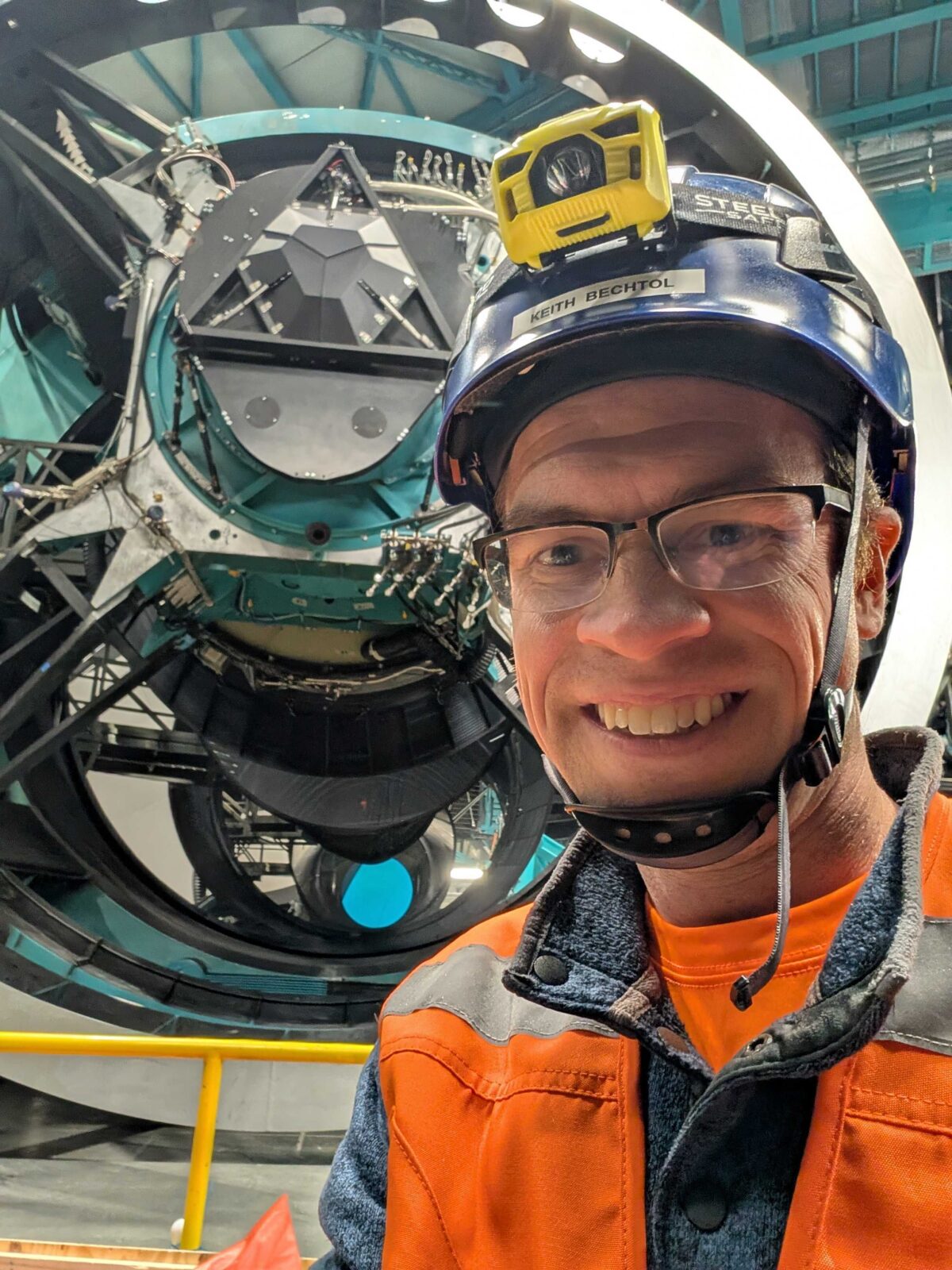
The NSF-DOE Vera C. Rubin Observatory has begun the Legacy Survey of Space and Time (LSST); an ultra-wide, ultra-high-definition time-lapse record of our Universe that will revolutionize the way we explore the cosmos.
University of Wisconsin–Madison physics professor Keith Bechtol has been part of the international team that built and operates Rubin Observatory since 2016, serving in multiple leadership roles. He served as System Verification and Validation Scientist responsible for orchestrating the on-sky observing campaigns and data analyses to confirm that the as-built Rubin Observatory can achieve its ambitious science goals. In October 2025, Bechtol was appointed to lead the Early Operations Optimization campaign, coordinating efforts to tune up the observatory to reliably perform at the high level needed for 10 years of sustained LSST observing.
“Starting tonight, Rubin Observatory will repeatedly scan the sky on nearly every clear night for the next decade. We aim to acquire more than 2 million individual images using the largest camera ever built and produce the greatest cosmic movie ever made,” Bechtol says. “Delivering consistently sharp image quality across the enormous field of view throughout the night, night-after-night, while rapidly scanning the sky requires many components working together with incredible precision.”
Bechtol is also Deputy Spokesperson for the LSST Dark Energy Science Collaboration, the international science collaboration formed to perform cosmological analyses of LSST data. “We are all looking forward to seeing what we can learn about dark matter and dark energy from LSST data. The discovery potential is enormous and there could be surprises.”
UW–Madison PhD students Miranda Gorsuch, Julian Beas-Gonzalez, and Kayleigh Excell have also been contributing to the scientific validation of early data from Rubin Observatory.
For more information, read the official release here.