Balantekin named co-PI on NSF grant to solve cosmic mystery

This story has been modified from one originally published by New York Institute of Technology. 

A team of University of Wisconsin–Madison and New York Institute of Technology physicists has secured a grant from the National Science Foundation (NSF) in an attempt to solve one of science’s greatest mysteries: how the universe formed from stardust.

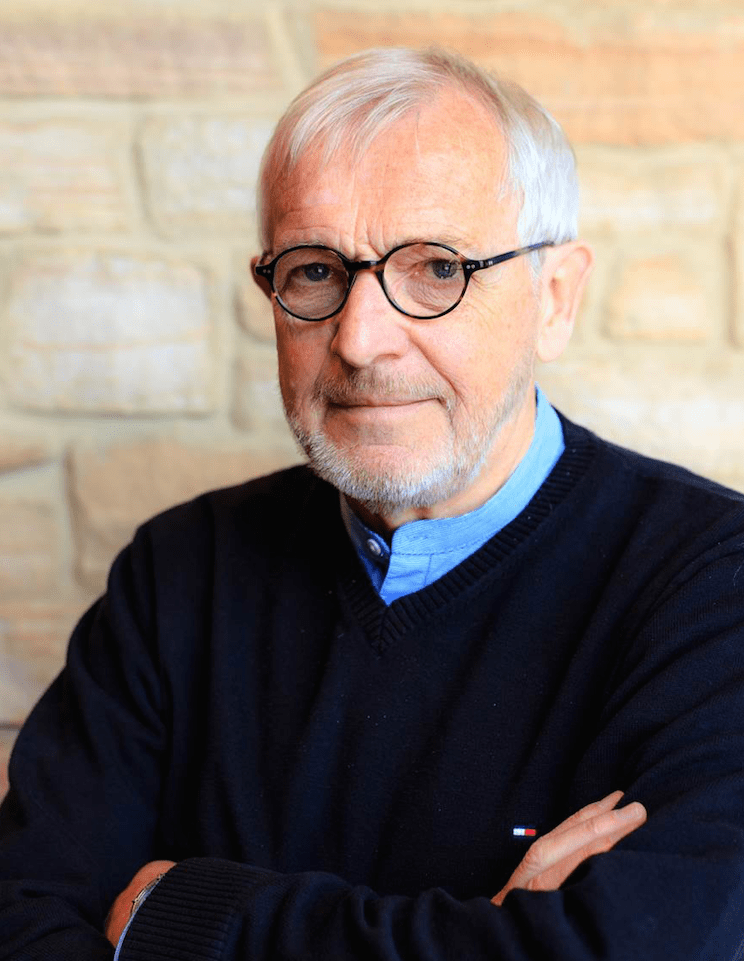
Many of the universe’s elements, including the calcium found in human bones and iron in skyscrapers, originated from ancient stars. However, scientists have long sought to understand the cosmic processes that formed other elements—those with undetermined origins. Now, UW–Madison professor of physics Baha Balantekin and co-principal investigator Eve Armstrong assistant professor of physics at New York Institute of Technology, will perform the first known research project that uses weather prediction techniques to explain these events. Their revolutionary work will be funded by a two-year $299,998 NSF EAGER grant, an award that supports early-stage exploratory projects on untested but potentially transformative ideas that could be considered “high risk/high payoff.”

While the Big Bang created the first and lightest elements (hydrogen and helium), the next and heavier elements (up to iron on the periodic table) formed later inside ancient, massive stars. When these stars exploded, their matter catapulted into space, seeding that space with elements. Eventually, stardust matter from these supernovae formed the sun and planets, and over billions of years, Earth’s matter coalesced into the first life forms. However, the origins of elements heavier than iron, such as gold and copper, remain unknown. While they may have formed during a supernova explosion, current computational techniques render it difficult to comprehensively study the physics of these events. In addition, supernovae are rare, occurring about once every 50 years, and the only existing data is from the last explosion in 1987.

Large information-rich data sets are obtained from increasingly sophisticated experiments and observations on complicated nonlinear systems. The techniques of Statistical Data Assimilation (SDA) have been developed to handle very nonlinear systems with sparsely sampled data. SDA techniques, akin to the path integral methods commonly used in physics, are used in fields ranging from weather prediction to neurobiology. Armstrong and Balantekin will apply the SDA methods to the vast amount of data accumulated so far in neutrino physics and astrophysics.

With simulated data, in preparation for the next supernova event, the team will use data assimilation to predict whether the supernova environment could have given rise to some heavy elements. If successful, these “forecasts” may allow scientists to determine which elements formed from supernova stardust.

This project will provide an opportunity to the Physics graduate students interested in neutrinos to master an interdisciplinary technique with many other applications.

“Physicists have sought for years to understand how, in seconds, giant stars exploded and created the substances that led to our existence. A technique from another scientific field, meteorology, may help to explain an important piece of this puzzle that traditional tools render difficult to access,” says Armstrong.

The NSF is an independent agency of the U.S. government that supports fundamental research and education in all the non-medical fields of science and engineering. Its medical counterpart is the National Institutes of Health. NSF funding accounts for approximately 27 percent of the total federal budget for basic research conducted at U.S. colleges and universities.

This project is funded by NSF EAGER Award ID No. 2139004

The content is solely the responsibility of the authors and does not necessarily represent the official views of the NSF.

The Wonders of Physics ready to hit the road

The Wonders of Physics traveling show is back! After a five-year hiatus, the department is pleased to announce that we have hired a full-time outreach specialist and restarted the program.

profile photo of Haddie McLean
Haddie McLean

Haddie McLean, a former meteorologist with WISC-TV / Channel 3 in Madison, began her new role as the Wonders of Physics outreach coordinator on August 9. After a 21-year TV career, McLean says she was looking for a new challenge — and any job that didn’t require her to wake up at 2am was just a bonus.

“I love talking to people about science. And I love seeing kids’ faces light up when they understand a topic or when they learn something new,” McLean says. “I was able to do a little bit of that in my job in TV. But in this position, I’ll get to do a ton more, and that’s what drew me to it.”

McLean’s primary role with The Wonders of Physics will be to further develop and perform the traveling show. She will also play a lead role in the development and performance of the annual shows in February, as well as participating in science outreach events and connecting with Wisconsin science teachers.

The Wonders of Physics traveling show started in the late 1980s as an offshoot of The Wonders of Physics annual shows, which first ran in 1984. Two graduate students at the time, David Newman and Christopher Watts, approached Prof. Clint Sprott — the creator of The Wonders of Physics — and suggested that they take the show on the road.

Over the years, The Wonders of Physics traveling show has gone from an all-volunteer, graduate student-led effort to one that has employed part- or full-time outreach specialists. Past funding has been provided by NSF and DOE. Now, thanks to the support of generous donors — including a successful Day of the Badger fundraising campaign — the department expects that the traveling show will be run by a full-time staff member for years to come.

“I’d like to make this show accessible to all ages, all walks of life,” McLean says. “I’d like to hit all areas of the state, if possible, and bring the university to the kids that wouldn’t otherwise get a chance to experience all that our campus has to offer.”

McLean is already busy prepping the show and hopes to be in schools by late fall 2021 (if university and school district COVID-19 policies permit it). She expects to have a general show available that is as hands-on and interactive as possible. She also plans to make the show customizable as needed, where she can work with teachers to focus the performance on the specific areas of physics that they are teaching at the time.

“My hope for the traveling show is that it’s fun and engaging, gets kids excited, and helps spark an interest in the next generation of scientists,” McLean says.

Sprott, now an emeritus professor with the department who still stars in the annual shows each February, is enthusiastic that McLean will be involved in those shows and that she is reviving the traveling show.

“After several difficult years, I’m delighted that Haddie McLean has joined us to head the Department’s nearly 40-year tradition of physics outreach and public education for people of all ages throughout Wisconsin and beyond,” Sprott says.

Anyone interested in scheduling The Wonders of Physics traveling show can email wonders@physics.wisc.edu or visit wonders.physics.wisc.edu for more information.

The shows are free of charge, but donations are encouraged.

Related: See the winning entries from The Wonders of Physics 2021 video contest!


Magnetic fields implicated in the mysterious midlife crisis of stars

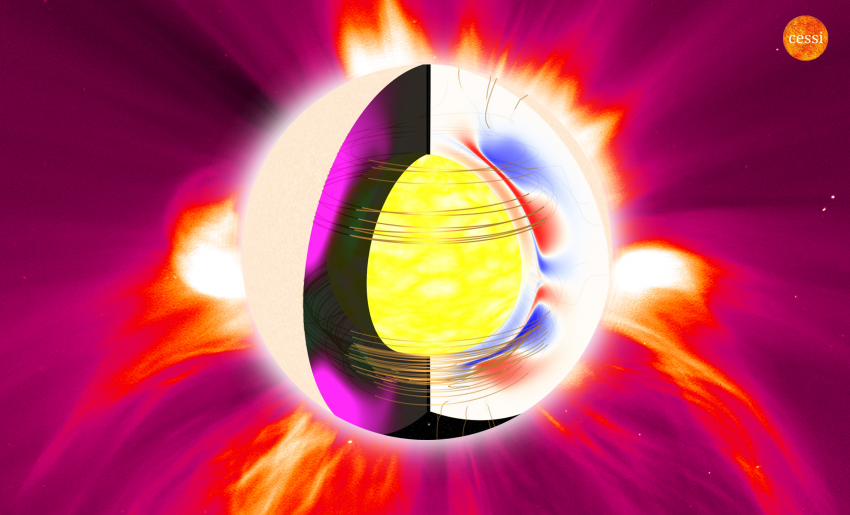
a brightly colored sun with a cutout showing into the core, with lines suggesting the spinning motion
Artist’s impression of the spinning interior of a star, generating the stellar magnetic field. This image combines a dynamo simulation of the Sun’s interior with observations of the Sun’s outer atmosphere, where storms and plasma winds are generated. | Credit:
CESSI / IISER Kolkata / NASA-SVS / ESA / SOHO-LASCO

This post was originally published by the Royal Astronomical Society. UW–Madison physics graduate student Bindesh Tripathi is the lead author of the scientific publication.

Middle-aged stars can experience their own kind of midlife crisis, experiencing dramatic breaks in their activity and rotation rates at about the same age as our Sun, according to new research published today in Monthly Notices of the Royal Astronomical Society: Letters. The study provides a new theoretical underpinning for the unexplained breakdown of established techniques for measuring ages of stars past their middle age, and the transition of solar-like stars to a magnetically inactive future.

Astronomers have long known that stars experience a process known as ‘magnetic braking’: a steady stream of charged particles, known as the solar wind, escapes from the star over time, carrying away small amounts of the star’s angular momentum. This slow drain causes stars like our Sun to gradually slow down their rotation over billions of years.

In turn, the slower rotation leads to altered magnetic fields and less stellar activity – the numbers of sunspots, flares, outbursts, and similar phenomena in the atmospheres of stars, which are intrinsically linked to the strengths of their magnetic fields.

profile photo of Bindesh Tripathy
Bindesh Tripathi

This decrease in activity and rotation rate over time is expected to be smooth and predictable because of the gradual loss of angular momentum. The idea gave birth to the tool known as ‘stellar gyrochronology’, which has been widely used over the past two decades to estimate the age of a star from its rotation period.

However recent observations indicate that this intimate relationship breaks down around middle age. The new work, carried out by Bindesh Tripathi at UW–Madison and the Indian Institute of Science Education and Research (IISER) Kolkata, India, provides a novel explanation for this mysterious ailment. Prof. Dibyendu Nandy, and Prof. Soumitro Banerjee of IISER are co-authors.

Using dynamo models of magnetic field generation in stars, the team show that at about the age of the Sun the magnetic field generation mechanism of stars suddenly becomes sub-critical or less efficient. This allows stars to exist in two distinct activity states – a low activity mode and an active mode. A middle aged star like the Sun can often switch to the low activity mode resulting in drastically reduced angular momentum losses by magnetized stellar winds.

Prof. Nandy comments: “This hypothesis of sub-critical magnetic dynamos of solar-like stars provides a self-consistent, unifying physical basis for a diversity of solar-stellar phenomena, such as why stars beyond their midlife do not spin down as fast as in their youth, the breakdown of stellar gyrochronology relations, and recent findings suggesting that the Sun may be transitioning to a magnetically inactive future.”

The new work provides key insights into the existence of low activity episodes in the recent history of the Sun known as grand minima – when hardly any sunspots are seen. The best known of these is perhaps the Maunder Minimum around 1645 to 1715, when very few sunspots were observed.

The team hope that it will also shed light on recent observations indicating that the Sun is comparatively inactive, with crucial implications for the potential long-term future of our own stellar neighbor.

2021 Homi Bhabha Award given to Francis Halzen

This story was originally published by the IceCube collaboration.

profile photo of Francis Halzen
Francis Halzen | Image: Zig Hampel-Arias, WIPAC.

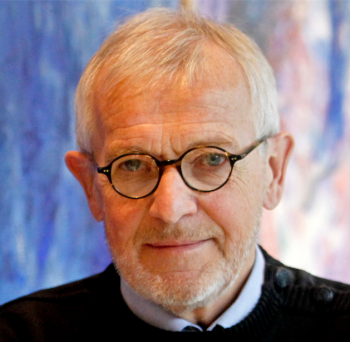
The International Union of Pure and Applied Physics (IUPAP) and the Tata Institute of Fundamental Research (TIFR) in Mumbai, India, have awarded the 2021 Homi Bhabha Medal and Prize to Francis Halzen, the Hilldale and Gregory Breit Distinguished Professor of Physics at the University of Wisconsin–Madison and principal investigator of IceCube, for his “distinguished contributions in the field of high-energy cosmic-ray physics and astroparticle physics over an extended academic career.” Halzen accepted the award at the opening session of the virtual 37th International Cosmic Ray Conference, on July 12, 2021.

The Bhabha Award was established by IUPAP and TIFR in 2010 to honor Dr. Homi Jehangir Bhabha, a cosmic ray physicist well known for the Bhabha-Heitler cascade theory and relativistic positron-electron scattering, also known as Bhabha scattering. Bhabha founded TIFR in 1945 and initiated the nuclear energy program in India in 1951. He initiated experimental programs for the study of cosmic ray particles and their interactions with instruments either carried aloft to the top of the atmosphere with balloons or placed in laboratories at high altitude or deep underground. The Homi Bhabha Medal and Prize consists of a certificate, a medal, a monetary award, and an invitation to visit the TIFR, Mumbai, and the Cosmic Ray Laboratory, Ooty to give public lectures. It is awarded biennially at the International Cosmic Ray Conference.

Born in Belgium, Halzen received his Master’s and PhD degrees from the University of Louvain, Belgium, and has been on the physics faculty at UW–Madison since 1972. The Bhabha Award is just the latest in Halzen’s long and storied career; previous accolades include a 2014 American Ingenuity Award, the 2015 Balzan Prize, a 2018 Bruno Pontecorvo Prize, the 2019 IUPAP Yodh Prize, and the 2021 Bruno Rossi Prize. Halzen is the third IceCube collaborator to win a Bhabha Award after Tom Gaisser in 2015 and Subir Sarkar in 2017.

During his virtual acceptance remarks, Halzen credited his collaborators, saying, “If I made contributions, it is because I ran into incredible collaborators who were leaders in the field, and still are. My ultimate collaborators, of course, I found within the AMANDA collaboration—and now IceCube—who made high-energy neutrinos part of the high-energy cosmic ray spectrum…

“Thanks to everybody, and thanks to IceCube; this prize is shared with all of you.”

Francis Halzen named Vilas Research Professor

Francis Halzen

UW–Madison physics professor Francis Halzen has been named a Vilas Research Professor. Created “for the advancement of learning,” Vilas Research Professorships are granted to faculty with proven research ability and unusual qualifications and promise. The recipients of the award have contributed significantly to the research mission of the university and are recognized both nationally and internationally.

Halzen, the Gregory Breit and Hilldale Professor of Physics, joined the UW­­–Madison faculty in 1972. He has made pioneering contributions to particle physics and neutrino astrophysics, and he continues to be the driving force of the international IceCube Collaboration.

Early in his career, Halzen cofounded the internationally recognized phenomenology research institute in the UW–Madison Department of Physics to promote research at the interface of theory and experiment in particle physics. This institute is recognized for this research and for its leadership in the training of postdocs and graduate students in particle physics phenomenology.

The IceCube Neutrino Observatory is the culmination of an idea first conceived in the 1960s, and one in which Halzen has played an integral role in its design, implementation, and data acquisition and analysis for the past three decades. After initial experiments confirmed that the Antarctic ice was ultratransparent and established the observation of atmospheric neutrinos, IceCube was ready to become a reality. From 2004 to 2011, the South Pole observatory was constructed — the largest project ever assigned to a university and one led by Halzen.

After two years of taking data with the full detector, the IceCube Neutrino Observatory opened a new window onto the universe with its discovery of highly energetic neutrinos of extragalactic origin. This discovery heralded the beginning of the exploration of the universe with neutrino telescopes. The IceCube observation of cosmic neutrinos was named the 2013 Physics World Breakthrough of the Year.

Nationally and internationally renowned for this work, Halzen was awarded a 2014 American Ingenuity Award, a 2015 Balzan Prize, a 2018 Bruno Pontecorvo Prize, a 2019 Yodh Prize, and a 2021 Bruno Rossi Prize.

With the Vilas Research Professorship, Halzen is also recognized for his commitment to education and service in the department, university, and international science communities. He has taught everything from physics for nonscience majors to advanced particle physics and special topics courses at UW–Madison. He has actively participated on several departmental and university committees as well as advisory, review, and funding panels. His input is highly sought by committees and agencies that assess future priorities of particle and astroparticle physics research.

“Francis Halzen has had a prolific, internationally recognized research career, has shown excellence as an educator who is able to effectively communicate cutting-edge science on all levels, and has made tireless and valued contributions in service of the department,” says Sridhara Dasu, Physics Department chair. “He is one of the most creative and influential physicists of the last half century and worthy of the prestigious Vilas Research Professorship.”

Vilas awards are supported by the estate of professor, U.S. senator and UW Regent William F. Vilas (1840-1908). The Vilas Research Professorship provides five years of flexible funding — two-thirds of which is provided by the Office of the Provost through the generosity of the Vilas trustees and one-third provided by the school or college whose dean nominated the winner.

Halzen joins department colleagues Profs. Vernon Barger and Sau Lan Wu as recipients of this prestigious UW–Madison professorship.

Ke Fang receives prestigious Shakti Duggal Award

This article was originally published by WIPAC

Ke Fang, professor at the University of Wisconsin–Madison, has been selected as the recipient of the 2021 Shakti P. Duggal Award presented by the International Union of Pure and Applied Physics (IUPAP).

profile photo of Ke Fang
Ke Fang

The Duggal Award was established after cosmic-ray physicist Shakti Duggal’s untimely death in 1982. In honor of Shakti’s long association with cosmic ray physics and his many contributions to the field during his career, his namesake award is given biennially “to recognize an outstanding young scientist for contributions in any branch of cosmic ray physics.” The first Shakti P. Duggal Award was presented at the 19th International Cosmic Ray Conference at La Jolla in 1985. Previous Duggal Award winners have all achieved recognition and prominence in their careers.

Award winners receive a monetary award and, since 1991, an invitation to visit the Bartol Research Institute of the University of Delaware, where Shakti Duggal worked, to present a colloquium and discuss their work.

Fang’s research focuses on understanding the universe through its energetic messengers, including ultra-high-energy cosmic rays, gamma rays, and high-energy neutrinos. She runs numerical simulations to study theories of astroparticle sources and analyzes data from HAWC, Fermi-LAT, and IceCube. She joined WIPAC and the UW–Madison Physics Department as an assistant professor on January 1, 2021. You can learn more about Fang and her research in this Q&A.

“I am very grateful for this special honor,” said Fang. “As a young researcher, I have received enormous support from my mentors and collaborators, to whom the award truly belongs. I look forward to continuing working on and contributing to cosmic ray physics as a member of the Duggal family.”


Sau Lan Wu featured in AIP History newsletter

A biography of Professor Sau Lan Wu was included as the cover story in a recent issue of the AIP History Newsletter (see pages 14-15). The story covers her early life in Hong Kong, her arrival in the U.S. to attend college at Vassar which she attended on a full scholarship, and into her graduate studies and subsequent research programs at MIT, UW–Madison and CERN. There is also a list of references / further readings. Check out the article to learn more about Prof. Wu’s illustrious career so far!

Physics projects funded in first round of UW’s Research Forward initiative

In its inaugural round of funding, the Office of the Vice Chancellor for Research and Graduate Education’s (OVCRGE) Research Forward initiative selected 11 projects, including two with physics department faculty involvement.

OVCRGE hosts Research Forward to stimulate and support highly innovative and groundbreaking research at the University of Wisconsin–Madison. The initiative is supported by the Wisconsin Alumni Research Foundation (WARF) and will provide funding for 1–2 years, depending on the needs and scope of the project.

The two projects from the department are:

Research Forward seeks to support collaborative, multidisciplinary, multi-investigator research projects that are high-risk, high-impact, and transformative. It seeks to fund research projects that have the potential to fundamentally transform a field of study as well as projects that require significant development prior to the submission of applications for external funding. Collaborative research proposals are welcome from within any of the four divisions (Arts & Humanities, Biological Sciences, Physical Sciences, Social Sciences), as are cross-divisional collaborations.

Correlated errors in quantum computers emphasize need for design changes

Quantum computers could outperform classical computers at many tasks, but only if the errors that are an inevitable part of computational tasks are isolated rather than widespread events.

Now, researchers at the University of Wisconsin–Madison have found evidence that errors are correlated across an entire superconducting quantum computing chip — highlighting a problem that must be acknowledged and addressed in the quest for fault-tolerant quantum computers.

The researchers report their findings in a study published June 16 in the journal Nature, Importantly, their work also points to mitigation strategies.

“I think people have been approaching the problem of error correction in an overly optimistic way, blindly making the assumption that errors are not correlated,” says UW–Madison physics Professor Robert McDermott, senior author of the study. “Our experiments show absolutely that errors are correlated, but as we identify problems and develop a deep physical understanding, we’re going to find ways to work around them.”

Read the full story at https://news.wisc.edu/correlated-errors-in-quantum-computers-emphasize-need-for-design-changes/

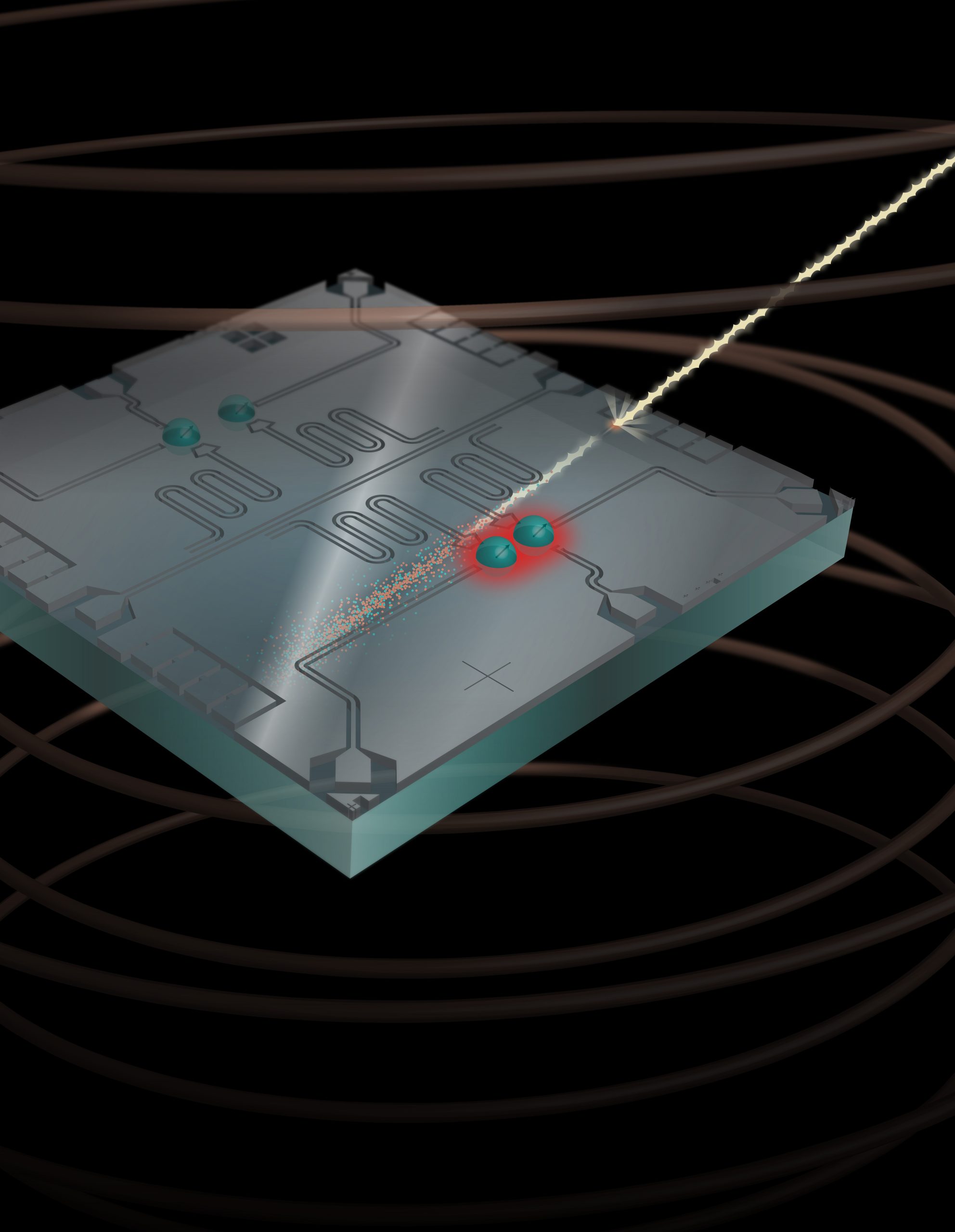
artist rendition of a 4-qubit chip with a dotted-line-like cosmic ray hitting it from out of the image frame, lighting up two neighboring qubits "red" to indicate they are affected by the cosmic ray's energy
In this artistic rendering, a high-energy cosmic ray hits the qubit chip, freeing up charge in the chip substrate that disrupts the state of neighboring qubits. 

CHIME telescope detects more than 500 mysterious fast radio bursts in its first year of operation

This post has been modified from the original post, published by MIT News

To catch sight of a fast radio burst is to be extremely lucky in where and when you point your radio dish. Fast radio bursts, or FRBs, are oddly bright flashes of light, registering in the radio band of the electromagnetic spectrum, that blaze for a few milliseconds before vanishing without a trace.

These brief and mysterious beacons have been spotted in various and distant parts of the universe, as well as in our own galaxy. Their origins are unknown, and their appearance is unpredictable. Since the first was discovered in 2007, radio astronomers have only caught sight of around 140 bursts in their scopes.

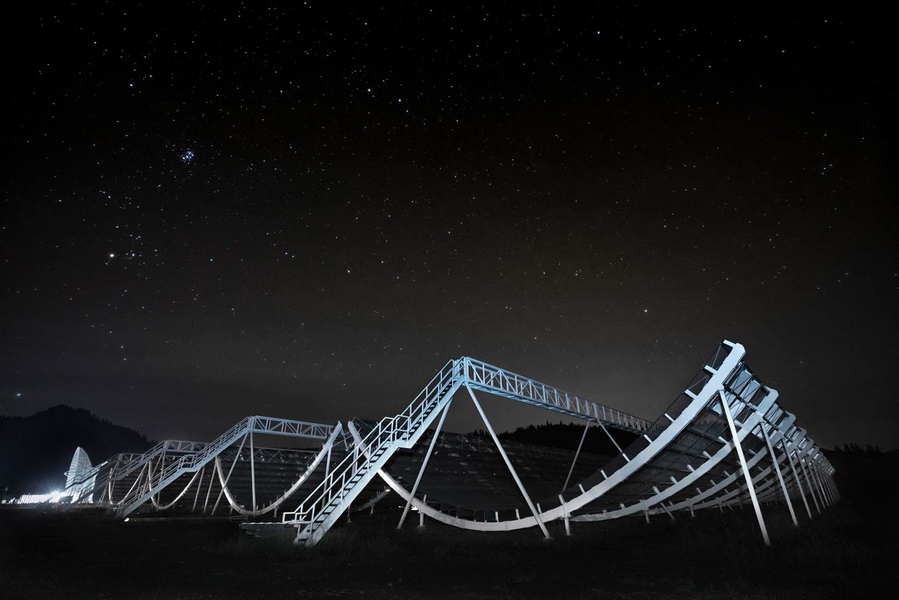
Now, a large stationary radio telescope in British Columbia has nearly quadrupled the number of fast radio bursts discovered to date. The telescope, known as CHIME, for the Canadian Hydrogen Intensity Mapping Experiment, has detected 535 new fast radio bursts during its first year of operation, between 2018 and 2019.

Profile photo of Moritz Münchmeyer
Moritz Münchmeyer

Scientists with the CHIME Collaboration, including researchers at the University of Wisconsin–Madison, have assembled the new signals in the telescope’s first FRB catalog, which they will present this week at the American Astronomical Society Meeting.

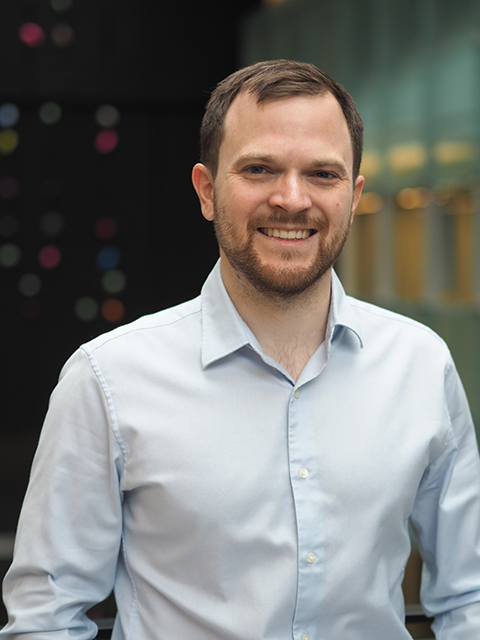
UW–Madison physics professor Moritz Münchmeyer is a member of CHIME-FRB and contributed to the statistical analysis of the new FRB catalog. He joined UW–Madison this spring and a part of his new group is continuing this work, with the goal of using FRBs as a novel probe of the physics of the universe.

“This is only the beginning of FRB research. For the first time we now have enough FRBs to study their statistical distribution. It turns out that FRBs come from all over the universe, from relatively nearby to half way back to the Big Bang,” Münchmeyer says. “They are also quite frequent, about 800 per day if we were to see them all. They are extremely powerful light sources at cosmological distances and thus provide a new window into the physics of the universe.”

For the full story, please visit https://news.mit.edu/2021/chime-telescope-fast-radio-bursts-0609

The large radio telescope CHIME, pictured here, has detected more than 500 mysterious fast radio bursts in its first year of operation, MIT researchers report. | Image Courtesy of CHIME