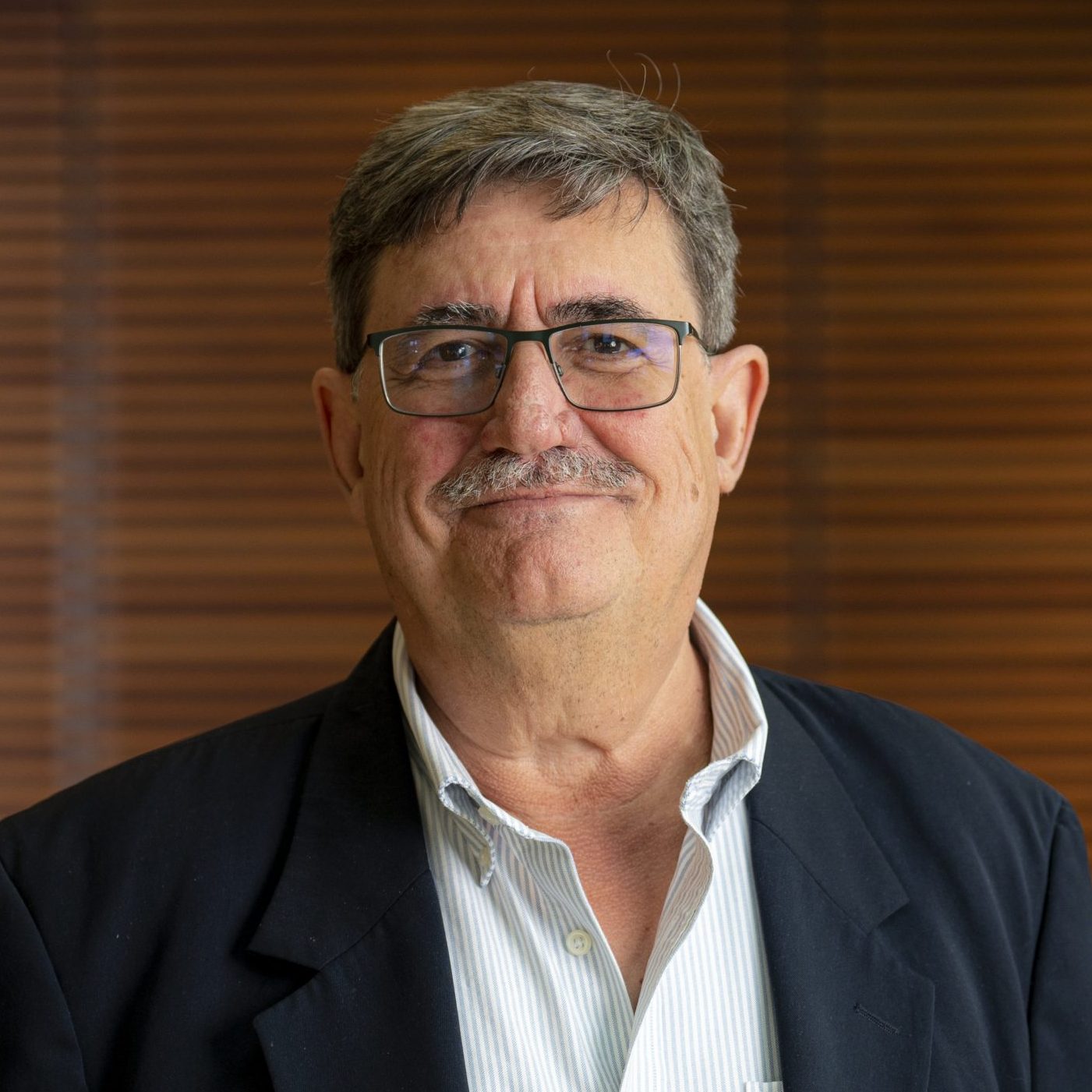
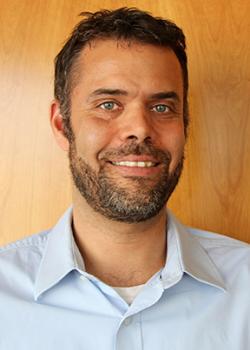
Barger was elected for “seminal work in studying fundamental particles at colliders and leadership in particle phenomenology, where theory meets experiment.”
This year, 502 scientists, engineers and innovators were chosen from the AAAS membership to be AAAS Fellows. The honor, presented annually since 1874, recognizes efforts to advance science and society, with the fellows chosen to reflect the highest standards of scientific integrity and professional ethics.
“As we celebrate the 150th anniversary of the AAAS Fellows, AAAS is proud to recognize the newly elected individuals,” said Sudip S. Parikh, AAAS chief executive officer and executive publisher of the Science family of journals. “This year’s class embodies scientific excellence, fosters trust in science throughout the communities they serve and leads the next generation of scientists while advancing scientific achievements.”
The new class of fellows will be featured in the April issue of the journal Science, and each new fellow will be celebrated at a September event in Washington, D.C.
Physics major Nathan Wagner awarded Goldwater Scholarship
Posted on
This story is modified from one published by University Communications
Physics and mathematics major Nathan Wagner is one of four UW–Madison students named as winners of 2024 Goldwater Scholarships, the premier undergraduate scholarship in mathematics, engineering and the natural sciences in the United States.
The scholarship program honors the late Sen. Barry Goldwater and is designed to foster and encourage outstanding students to pursue research careers.
“I’m so proud of these four immensely talented scholars and all they’ve accomplished,” says Julie Stubbs, director of UW’s Office of Undergraduate Academic Awards. “Their success also reflects well on a campus culture that prioritizes hands-on research experiences for our undergraduates and provides strong mentoring in mathematics, engineering and the natural sciences.”
The other UW–Madison students are juniors Katarina Aranguiz and Scott Chang and sophomore Max Khanov .
A Goldwater Scholarship provides as much as $7,500 each year for up to two years of undergraduate study. A total of 438 Goldwater Scholars were selected this year from a field of 1,353 students nominated by their academic institutions.
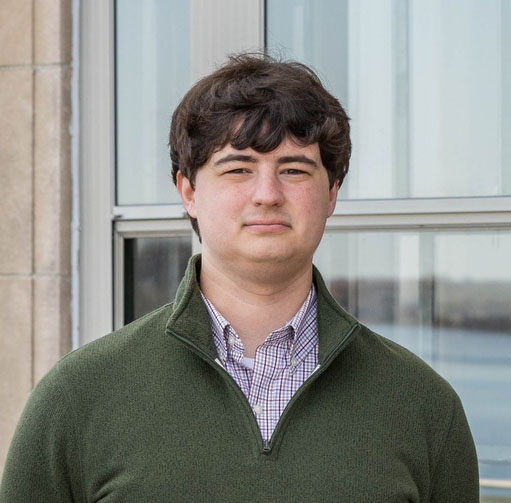
Nathan Wagner (Photo by Taylor Wolfram / UW–Madison)
Sophomore Nathan Wagner of Madison, Wisconsin
Wagner is majoring in physics and mathematics. Wagner began research in Professor Mark Saffman’s quantum computing lab in spring 2021 as a high school junior. His first-author manuscript, “Benchmarking a Neutral-Atom Quantum Computer” was recently accepted for publication in the International Journal of Quantum Information. In Summer 2023, Wagner started research with the Physics Department’s High Energy Physics Group, working alongside Professor Sridhara Dasu and others on future particle colliders design research. Wagner was invited to present his research at the Department of Physics Board of Visitors meeting in fall 2023. This summer, he will complete a research internship at Argonne National Laboratory near Chicago, focusing on computational physics. Wagner plans to pursue a PhD in physics and a career at a U.S. Department of Energy national laboratory researching novel carbon-neutral energy generation, quantum computing and networking, nuclear photonics and computational physics.
About the Goldwater Scholarship
Congress established the Barry Goldwater Scholarship and Excellence in Education Foundation in 1986. Goldwater served in the U.S. Senate for over 30 years and challenged Lyndon B. Johnson for the presidency in 1964. A list of past winners from UW–Madison can be found here.
Three physics students earn 2024 NSF GRFP awards, four students earn honorable mention
Posted on
Congrats to Physics PhD student Joyce Lin and undergraduates Brooke Kotten and Lucy Steffes on being awarded the 2024 NSF GRFP! PhD students Owen Eskandari, Sam Kramer, Tali Oh, and Julia Sheffler were awarded Honorable Mentions.
The National Science Foundation (NSF) recently announced the 2024 awards in its Graduate Research Fellowship Program (GRFP), a prestigious and competitive fellowship that helps support outstanding graduate research across the country.
Of those offered awards, 19 are currently UW–Madison graduate students. Seven current UW–Madison undergraduates were also offered the award for their graduate study. Additionally, 33 UW–Madison students were recognized with honorable mentions from NSF.
UW–Madison strongly encourages senior undergraduates and early-career graduate students to apply to this fellowship.
Sanjib Kumar Agarwalla was recently awarded the 2021-2022 Rajib Goyal Prize in Physical Sciences, which “honors Indian scientists who have made a mark in basic and applied sciences research.” The Goyal Prizes were instituted by the late philanthropist Ram S. Goyal to honor Indian scientists and social activists working towards the service of India. Agarwalla [...]
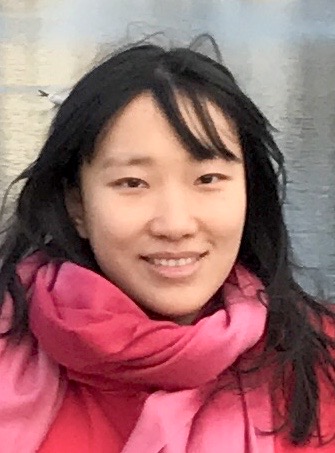
Wasikul Islam, a postdoctoral researcher with Sau Lan Wu’s group
For this award, postdocs write a short article that describes their research for the general public. Interested postdocs apply to submit an article, then receive guidelines and editorial assistance to improve accessibility. Approved articles are posted on the WISL website, and the author receives a $250 award.
Islam’s article, “Navigating Anomalies in the Pursuit of New Physics” shares how particle physicists study the fundamental building blocks of the universe, exploring the complex behaviors of subatomic particles that shape our world.
“As a postdoctoral researcher, my journey is not limited to research alone,” Islam says in the article. “It comes with an important responsibility to share the wonders and experiences of scientific research with diverse communities.”
The dual mission of the Wisconsin Initiative for Science Literacy is to promote literacy in science, mathematics and technology among the general public and to attract future generations to careers in research, teaching and public service. WISL is directed by Professor Bassam Z. Shakhashiri of the University of Wisconsin-Madison Chemistry Department. Programs draw on the concepts developed by Dr. Shakhashiri during many years of innovative work in science education.
Haddie McLean earns Bassam Z. Shakhashiri Public Science Engagement Award
Posted on
This post is adapted from one originally published by the Office of the Vice Chancellor for Research
Haddie McLean
Haddie McLean, who is inspiring the next generation of scientists with The Wonders of Physics, has received the Bassam Z. Shakhashiri Public Science Engagement Award.
The award, in its second year, recognizes a UW–Madison faculty and academic staff member (one awarded to each category) who has shown excellence in engaging the public in their work in STEAM (Science, Technology, Engineering, Arts and Math). Botany professor Simon Gilroy won in the faculty category.
McLean is a UW–Madison alumna with a Bachelor of Science in Atmospheric and Oceanic Sciences. She spent over 20 years working as a meteorologist at WISC-TV in Madison, where she honed her science communication skills in front of the camera every day and earned the trust of the public. She joined the Department of Physics in August 2021 as an Outreach Specialist to present The Wonders of Physics traveling show to schools and community groups around the state.
In October 2023, she was promoted to Outreach Program Manager. In her new role, McLean oversees all aspects of The Wonders of Physics outreach program, including the large annual show on campus every February, the traveling show, and securing funding to train undergraduates in the best practices of science communication to broad audiences and expand the program.
McLean’s nominator explains, “Importantly, she shares the science behind the demos — it’s not magic, it’s physics! One of the biggest improvements Haddie has made to The Wonders of Physics is the incorporation of leave-behind kits. These kits, developed with a colleague who is a former high school physics teacher, provide inquiry-based activities related to the show, which help reinforce concepts and allow for more active learning.”
McLean is constantly developing new demos and builds most of them herself with inexpensive items, proving that science outreach doesn’t have to be pricey to be effective. She also collaborates with department outreach staff to create new exhibits for the Ingersoll Physics Museum.
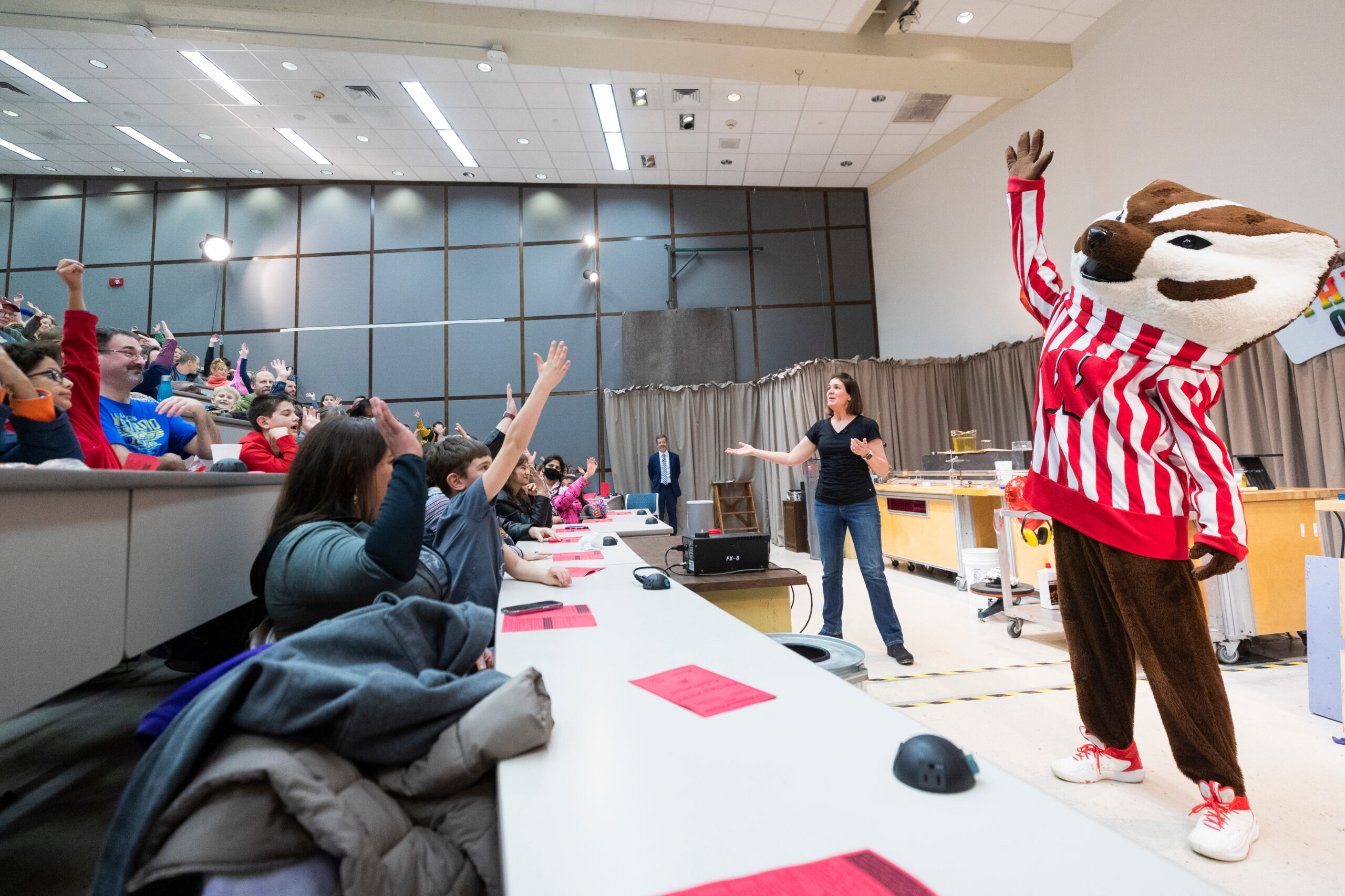
Haddie McLean and Bucky Badger hype up the crowd during the 40th year of The Wonders of Physics. (Photo by Taylor Wolfram / UW–Madison)
For the glass-themed 2022 WiSciFest, McLean created a “walking on broken glass” demo for a live performance on State Street. She broke and tumbled dozens of glass bottles, then filled a plastic tub with them. She first showed that the glass was sharp enough to pop a balloon, then she stepped into the tub. In a glass walk, the weight of your body is spread out over lots of pieces, which have the freedom to move. When you step on a single sliver of glass, your weight is concentrated over that one sharp point.
The audience for the Wonders of Physics shows is, as McLean says, “from pre-K to grey.” She adjusts the contents of her shows for any age and any level of familiarity with physics. She does this by relating physics to real-life concepts, showing her audience how they use physics every day and making sure that everyone knows they, too, can be a scientist if they observe and ask questions.
In addition to performance-based shows, Haddie has partnered with 4-H, UW Extension and many statewide partners to reach under-resourced communities across the state. In two years, she has visited over one-third of Wisconsin counties.
She is a strong partner of the PEOPLE program, developing summer courses for PEOPLE Summer University and traveling to Milwaukee public schools that serve PEOPLE students.
“By meeting students where they are,” her nominator says, “Haddie shows anyone that they, too, can be a physicist.”
The award is named for Bassam Z. Shakhashiri, emeritus professor of chemistry and the William T. Evjue Distinguished Chair for the Wisconsin Idea, in honor of his “Science is Fun” philosophy and long-term commitment to science education and public engagement. Shakhashiri joined the UW faculty in September of 1970 and retired in September 2021.
“Science and society have what is essentially a social contract that enables great intellectual achievements but comes with mutual expectations of benefiting the human condition and protecting our Planet,” says Shakhashiri.
The Bassam Z. Shakhashiri Public Science Engagement Award is supported by the Wisconsin Alumni Research Foundation, the Morgridge Institute for Research and UW–Madison’s Office of the Vice Chancellor for Research.
Baha Balantekin named “Outstanding Referee” of the Physical Reviews journals
Congrats to Prof. Baha Balantekin on being named a 2024 Outstanding Referee of the Physical Reviews journals!
The highly selective Outstanding Referee program annually recognizes about 150 of the roughly 91,600 currently active referees. Like Fellowship in the APS, this is a lifetime award.
In this year, 2024, 156 Outstanding Referees were selected. APS Editors select the honorees based on the quality, number, and timeliness of their reports, without regard for membership in the APS, country of origin, or field of research. Referees are rewarded for their work carried out since 1978, the earliest year for which we have accurate data on referee reports returned. The decisions are difficult and there are many excellent referees who are still to be recognized.
The Outstanding Referee program was instituted in 2008 to recognize scientists who have been exceptionally helpful in assessing manuscripts for publication in the APS journals. By means of the program, APS expresses its appreciation to all referees, whose efforts in peer review not only keep the standards of the journals at a high level, but in many cases also help authors to improve the quality and readability of their articles – even those that are not published by APS.
Other current UW–Madison physics department members who are recipients of this honor include Mark Friesen (2023), Lisa Everett (2021), Deniz Yavuz (2013), and Thad Walker (2009).
Tiancheng Song awarded Lee Osheroff Richardson Science Prize
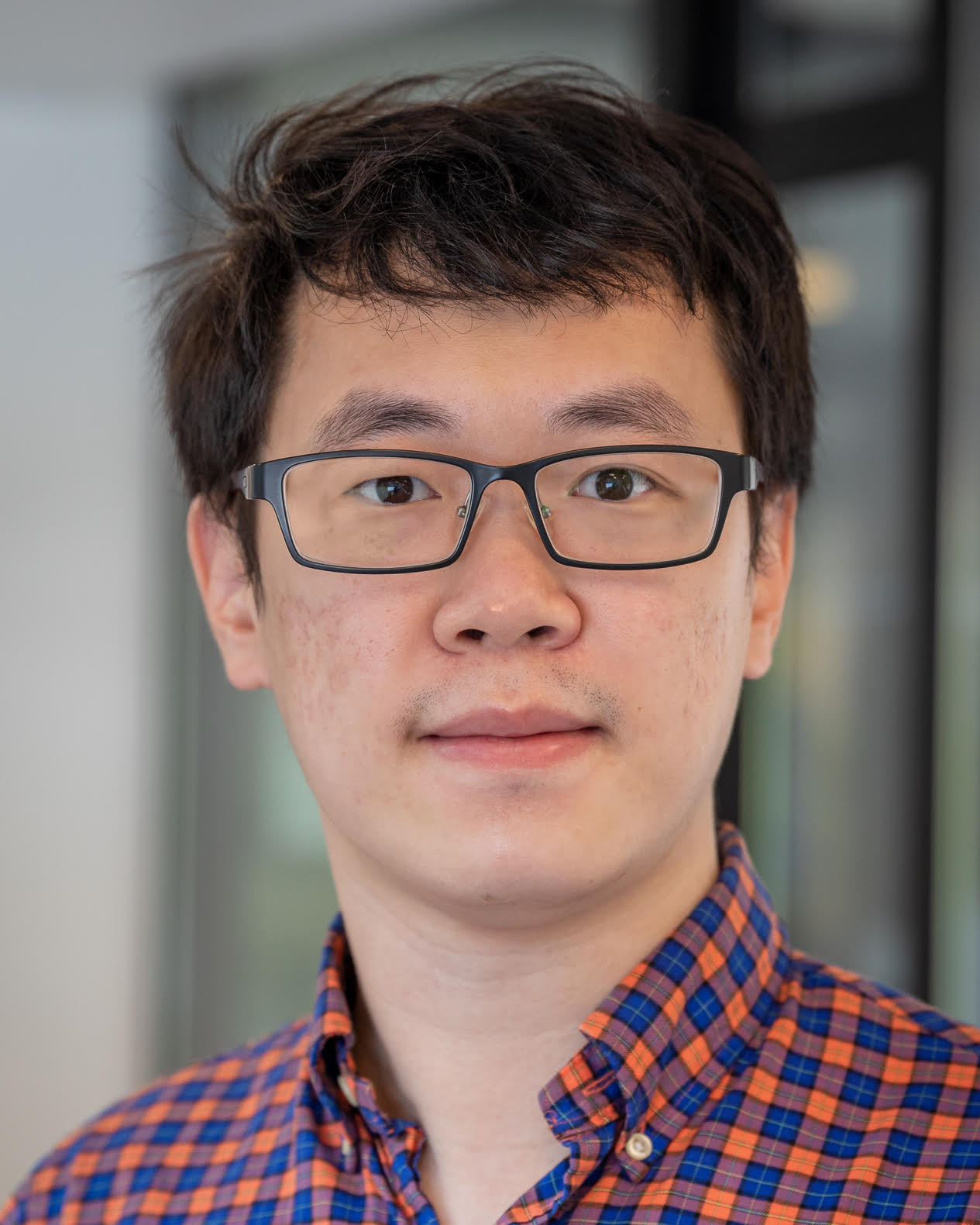
Oxford Instruments announced Feb 15 that Tiancheng Song, who will join the UW–Madison physics department as an assistant professor in May, has been awarded the 2024 Lee Osheroff Richardson Science Prize. He is currently an experimental physicist and Dicke Fellow at Princeton University.
Dr. Song is recognized for his efforts in developing and employing various measurement techniques at low temperatures and in magnetic fields to study 2D superconductivity and magnetism in van der Waals heterostructures. His works have uncovered a series of emergent quantum phenomena in 2D superconducting and magnetic systems.
The Lee Osheroff Richardson Science Prize promotes and recognises the novel work of young scientists working in the fields of low temperatures and/or high magnetic fields or surface science in North and South America.
“I am thrilled to be the recipient of the prestigious Lee Osheroff Richardson Science Prize this year! I feel this is a special honour because I am joining the ranks of remarkable scientists who have been awarded this prize for their famous experiments and achievements,” commented Dr. Song.
Tiancheng Song is currently a Dicke Fellow in the Department of Physics at Princeton University. Working with Prof. Sanfeng Wu, Dr. Song recently developed a new technique to investigate 2D superconductivity, strongly correlated phases and the associated unconventional quantum phase transition.
In his work at Princeton, Dr. Song successfully measured superconducting quantum fluctuations of monolayer WTe2 based on the vortex Nernst effect. The result led to the discovery of a new type of quantum critical point beyond the conventional Ginzburg-Landau theory and demonstrated a new sensitive probe to 2D superconductivity and superconducting phase transitions.
Dr. Song’s results have been well recognized by the community with his work being cited over 4,000 times. Dr. Song’s original contributions are demonstrated by the faculty offers he has subsequently received; he will join the University of Wisconsin–Madison as an assistant professor in May 2024.
As part of the prize, Dr. Song will receive $8000 as well as support to attend the APS March Meeting in Minneapolis where he will be presented his award.
The 2024 LOR Science Prize selection committee is chaired by Professor Laura Greene, NHMFL and FSU and includes: Professor Hae-Young Kee, Toronto University; Professor Collin Broholm, Johns Hopkins University; Professor Paula Giraldo-Gallo, University of the Andes; and Dr Xiaomeng Liu, Princeton (2023 winner).
About the LOR Science Prize
Oxford Instruments is aware that there is a critical and often difficult stage for many scientists between completing a PhD and gaining a permanent research position. The company is pleased to help individuals producing innovative work by offering financial assistance and suitably promoting their research work, through sponsoring the LOR Science Prize for North and South America for the past 19 years. The Prize is named in honour of Professors David M. Lee, Douglas D. Osheroff and Robert C. Richardson, joint recipients of The Nobel Prize in Physics 1996 for their discovery of ‘superfluidity in helium-3’.
The previous winners of the LOR Science Prize are Dr Xiaomeng Liu, Dr James Nakamura, Dr Matthew Yankowitz, Dr Sheng Ran, Dr Paula Giraldo-Gallo, Dr Kate Ross, Dr Brad Ramshaw, Dr Mohamad Hamidian, Dr Cory Dean, Dr Chiara Tarantini, Dr Lu Li, Dr Kenneth Burch, Dr Jing Xia, Dr Vivien Zapf, Dr Eunseong Kim, Dr Suchitra Sebastian, Dr Jason Petta, and Dr Christian Lupien.
Ke Fang named Sloan Fellow
Posted on
This story is adapted from one published by University Communications
Ke Fang
Ke Fang, assistant professor of Physics and WIPAC investigator, is among 126 scientists across the United States and Canada selected as Sloan Research Fellows.
The fellowships, awarded annually since 1955, honor exceptional scientists whose creativity, innovation and research accomplishments make them stand out as future leaders in their fields.
Using data from the Ice Cube Observatory and Fermi Large Area Telescope along with numerical simulations, Fang studies the origin of subatomic particles — like neutrinos — that reach Earth from across the universe.
“Sloan Research Fellowships are extraordinarily competitive awards involving the nominations of the most inventive and impactful early-career scientists across the U.S. and Canada,” says Adam F. Falk, president of the Alfred P. Sloan Foundation. “We look forward to seeing how fellows take leading roles shaping the research agenda within their respective fields.”
Founded in 1934, the Sloan Foundation is a not-for-profit institution dedicated to improving the welfare of all through the advancement of scientific knowledge.
Sloan Fellows are chosen in seven fields — chemistry, computer science, Earth system science, economics, mathematics, neuroscience and physics — based on nomination and consideration by fellow scientists. The 2024 cohort comes from 53 institutions and a field that included more than 1,000 nominees. Winners receive a two-year, $75,000 fellowship that can be used flexibly to advance their research.
Among current and former Sloan Fellows, 57 have won a Nobel Prize, 71 have been awarded the National Medal of Science, 17 have won the Fields Medal in mathematics and 23 have won the John Bates Clark Medal in economics.
Xiangyao Yu, assistant professor of computer sciences at UW–Madison, was also named a Sloan Fellow.
Navigating new tech: Kael Hanson earns Draper Technology Innovation Fund award
Posted on
Kael Hanson
Celestial navigation — charting a course through a combination of identifying star positions in the sky and knowing the time — has existed for centuries and is considerably low-res compared to modern GPS systems. So why did physics professor Kael Hanson recently receive a Draper Technology Innovation Fund (TIF) award for an invention that is based off of it?
“The pain that we’re trying to address with this technology is vulnerabilities in GPS,” Hanson says. “Everyone uses GPS, but if it drops out or gets jammed, that could be a problem, especially for the military or commercial industries like aviation or shipping that rely on it to be working and accurate 100% of the time.”
GPS is vulnerable because the satellites’ weak signals can be easily drowned out by stronger signals. Its function is susceptible to both natural (e.g. strong solar flares) and man-made (e.g. jamming or intentional signal spoofing) incidents.
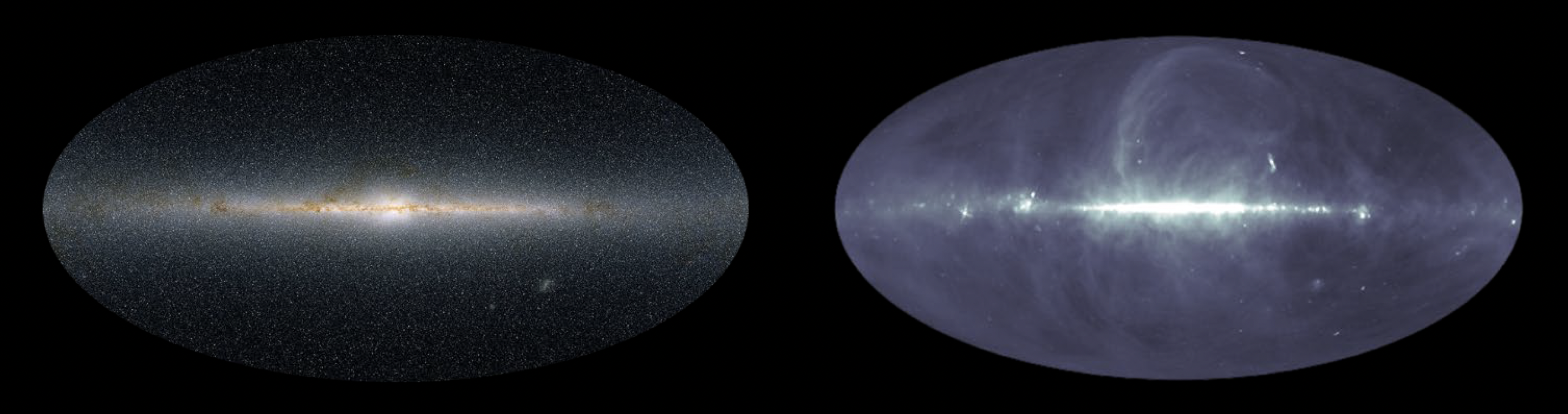
Distant stars and galaxies, however, remain unaffected by whatever is happening on or near earth, so they are useful visual points of reference — unless the current conditions include daylight, clouds, or fog. Hanson’s invention, known as GRADIANT, reverts to the same concept as celestial navigation, but with a modern twist to avoid any visibility issues.
“Charged particles spinning around in the magnetic fields of our galaxy give off synchrotron radiation at radio frequencies. This technology images the sky in radio frequencies,” Hanson says. “And by doing that, basically you can see through clouds. Our technology is reliably good in all scenarios.”
Radio astronomers have been cataloging radio data for decades, and the signals remain mostly static throughout time. The invention would detect radio frequencies at the user’s location, be computationally compared to the wealth of catalogued data, and then tell the user where they are.
Hanson is not exactly sure where he came up with this idea, but he thinks it came to him when he was at the South Pole 10-15 years ago working on the Askaryan Radio Array (ARA), a radio detector installed below the ice (it is co-deployed with IceCube, which is operated by WIPAC, of which Hanson was director from 2014-2022).
These two images of the sky are looking at the same sky but at different wavelengths. The left is optical, what you would see if you looked up on a clear night. The right is at radio frequencies. There are still plenty of objects that can be used to determine position, but the right image would be seen under a thick, overcast sky. Credit: Navigationis
“One of the background signals was the sun, and I thought ‘Oh, we can actually image the sun a couple hundred meters under the ice. Boy, wouldn’t that be interesting if you could somehow use this technology to try to figure out where you are based on where the sun is?’” Hanson says. “But then I just stuffed it away in my brain and didn’t really think about it (until recently).”
In 2021, Hanson started a company, Navigationis, to pursue his modern celestial navigation idea. This past summer, he submitted a disclosure for GRADIANT to WARF, for which a patent has now been filed. Then, he applied for and was awarded the Draper TIF funding.
Draper TIF provides a mechanism to support additional research necessary to bring new concepts and inventions to the patent and licensing stage. A main goal of the program is the eventual introduction of new products and processes into the marketplace for the public good. It is open to UW–Madison faculty and academic staff. The program is administered in partnership between Discovery to Product and the Wisconsin Alumni Research Foundation.
Hanson’s award provides $50,000, which he will use to try to make the technology more licensable.
“In order to really get this thing to the commercial state, it will take millions of dollars, it will take some additional investment,” Hanson says. “With this Draper TIF, we’re going to put together a prototype that actually proves in real hardware the working concept that’s in the patent. My hope is that I’ll have something I can point to, and venture capitalists will be that much more interested in making an investment, or the Department of Defense would be interested in supporting this work.”