Research, teaching and outreach in Physics at UW–Madison
saperdue@wisc.edu
Introducing the Physics Ph.D. Class of 2021
Posted on
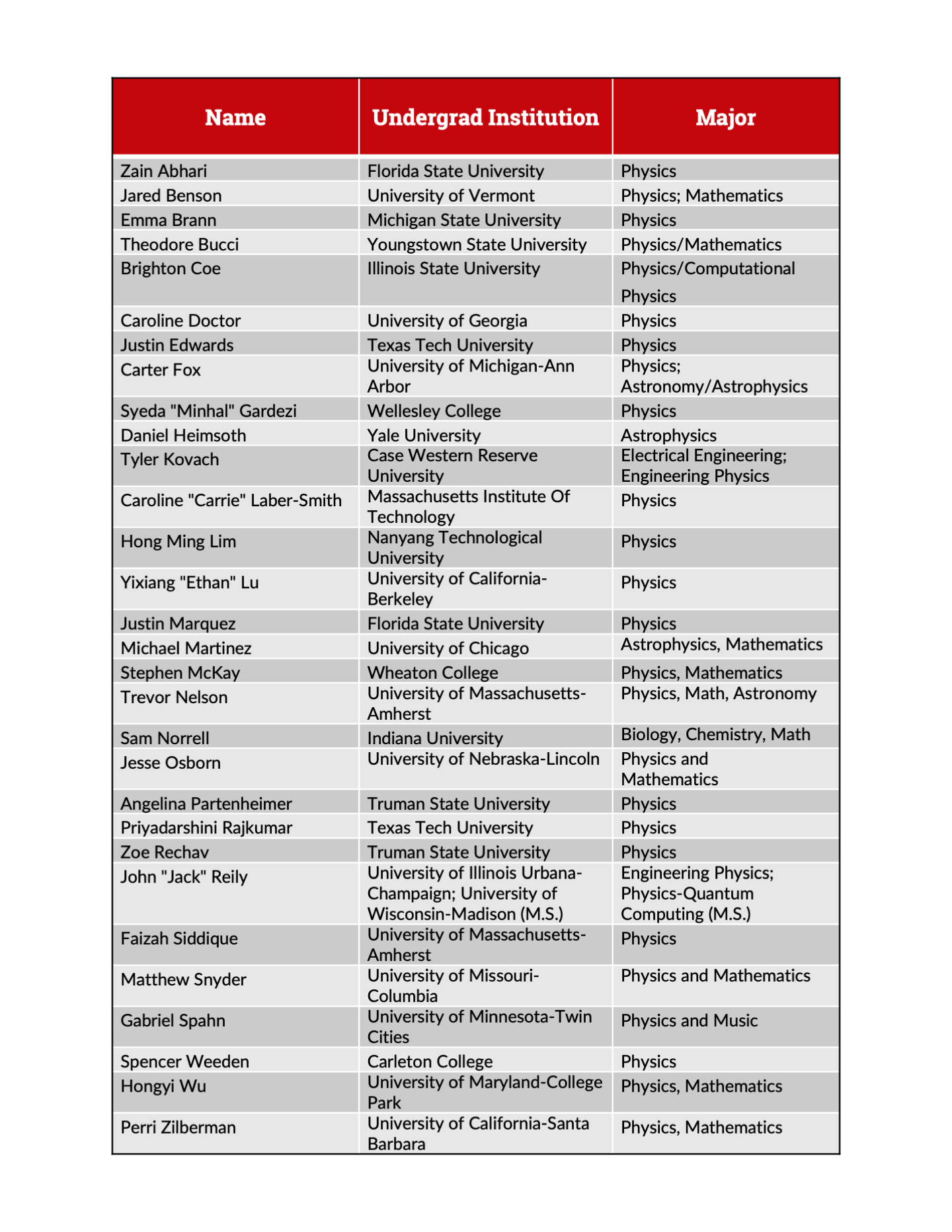
After record-breaking application numbers and the most unique recruiting season yet, the Department of Physics is pleased to introduce the 30 students of the incoming Ph.D. class of 2021!
“This year’s incoming Ph.D. class is a remarkably strong and diverse cohort who have overcome truly historic obstacles to join us,” says Ph.D. admissions committee chair, Prof. Shimon Kolkowitz. “I couldn’t be more excited to welcome them to our department and to witness the great work they will accomplish in their time here.”
602 students applied for one of 91 admissions spots, the most applications the department has received in at least the past decade (based on available graduate school data).
Some highlights of the incoming class include:
Students coming from 18 U.S. states and three other countries (China, India, and Malaysia)
22 expressing a preference for experiment, with the rest expressing a preference for theory only, or either/undecided
Eight women
Three Advanced Opportunity Fellowship (AOF) eligible students
Two students who were named 2021 NSF Graduate Research Fellows
This year’s incoming class is also the first to ever participate in “Virtual Visit Days,” thanks to the COVID-19 pandemic. Though perhaps not as exciting as visiting campus in person, admitted students could still meet with faculty to discuss research opportunities, participate in discussions and virtual games nightswith current students, and watch videos — many newly-created just for these visits — about the University, the city of Madison, and research in our department.
“Thank you to all the prospective students for their engagement and enthusiasm throughout the admissions and virtual visit process,” says Michelle Holland, graduate program coordinator.“We are beyond thrilled to welcome the Class of 2021 to the Physics Ph.D. Program at UW–Madison as we find our ‘new normal’ in being together on campus this fall.”
The department would like to send a huge round of applause to everyone who participated in recruitment this year, especially current graduate students on the recruitment committee: Trevor Oxholm, Abigail Shearrow, Kunal Sanwalka, Susmita Mondal, Winnie Wang. We also thank graduate program coordinators Michelle Holland and Jackson Kennedy for organizing and running the virtual visit days, Dan Bradley for once again providing IT solutions to help the admissions process and visit days run smoothly, and Sarah Perdue for website development and video production.
The department also thanks the Ph.D. admissions committee for their thorough evaluation of the applicants. In addition to Kolkowitz, the committee members are Profs. Keith Bechtol, Stas Boldyrev, Victor Brar, Mark Eriksson, Ke Fang, and Jeff Parker.
One student accepted our admissions offer but has deferred to 2022.
Gage Siebert named 2021 Goldwater Scholar
Posted on
Gage Siebert
Three University of Wisconsin–Madison students, including junior Physics and Math major Gage Siebert, have been named 2021 winners of the Barry Goldwater Scholarship, considered the country’s preeminent undergraduate scholarship in the natural sciences, mathematics and engineering.
As a freshman, Siebert studied the origins of life in Professor David Baum’s lab at the Wisconsin Institute for Discovery. Siebert then interned at the Arecibo Observatory in Puerto Rico, studying the radio emission from several of the millisecond pulsars used in the search for gravitational waves. He later presented this work at a meeting of the American Astronomical Society. For the past two years, Siebert has worked in Professor Peter Timbie’s observational cosmology lab on the Tianlai Array, a radio astronomy experiment built to map hydrogen. He plans to pursue a Ph.D. in physics.
More than 1,250 students were nominated this year from 438 academic institutions; 410 were named Goldwater Scholars. The scholarship program honors the late Sen. Barry Goldwater and was designed to develop highly qualified scientists, engineers and mathematicians. The scholarships were first awarded in 1989. Each scholar will receive up to $7,500 for their senior year of undergraduate study.
CMS Group publishes new study on Lepton flavor in Higgs boson decays
Posted on
Neutrinos mix and transform from one flavor to the other. So do quarks. However, electron and its heavier cousins, the muon and the tau, seem to conserve their flavor identity. This accidental conservation of charged lepton flavor must have a profound reason, or low-levels of violation of that conservation principle should occur at high energy scales. However, evidence for any charged lepton flavor violation remains elusive.
The CMS group recently published a new study on Lepton flavor in Higgs boson decays. At UW–Madison, the effort was led by Sridhara Dasu and postdoctoral researcher Varun Sharma, building off of work done by former postdoctoral researcher Maria Cepeda and former graduate student Aaron Levine.
The international CMS collaboration recently published a news story about this new study. Please read the full story here.
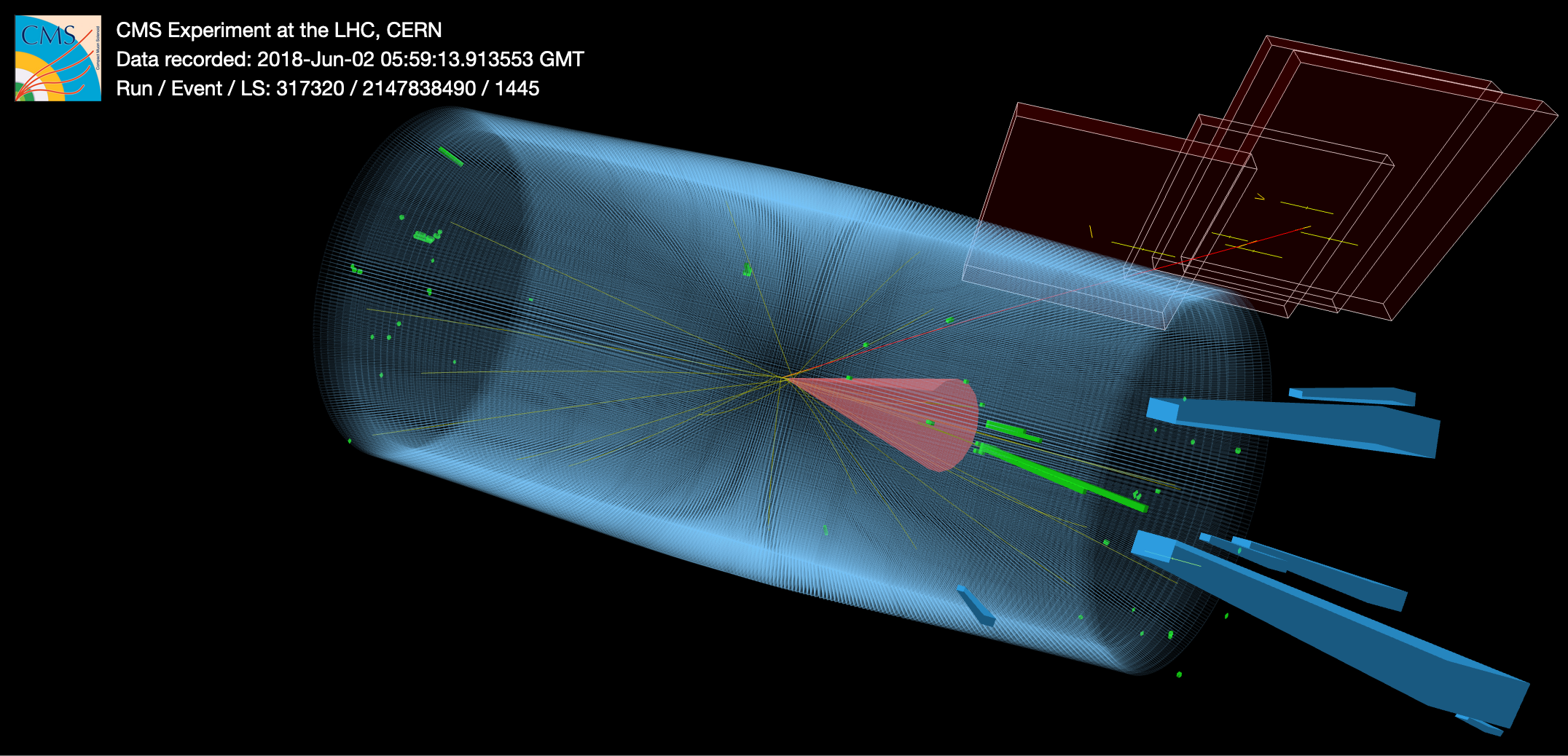
An event similar to the lepton flavor violating decay of the Higgs boson, produced with the gluon fusion production mechanism. The red track corresponds to a muon, while the red cone along with its corresponding calorimeter deposits is the tau lepton. | CMS Collaboration
This new award category recognizes graduate students in L&S who provided exceptional continuity of instruction support to their department or delivered exceptional student experience in a remote instructional setting during the COVID-19 pandemic.
Bonner was nominated for his work as a TA in Physics 109, Physics in the Arts, by one of the course’s instructors, Prof. Pupa Gilbert. Physics 109 is a quantitative-reasoning course offered to non-science majors, typically serving more than 200 students.
“The students are terrified of physics, and are not quantitative thinkers, thus it is especially important for Physics in the Arts TAs to be kind, friendly, and not intimidating,” Gilbert says. “Gage excels at all these challenges, and teaches masterfully. He is kind, intelligent, knowledgeable, and always in a good mood, making everyone feel comfortable and not intimidated.”
Gilbert nominated Bonner for the Continuation of Study award because of how effectively he adapted to the changes forced by the COVID-19 pandemic. For example, because in-person labs were no longer an option, Gilbert selected online labs, and asked the TAs to develop a series of interactive questions associated with each online experiment to help the students learn by doing. Bonner excelled at developing these questions. She also noted how well he interacts with students through the online Zoom lectures, helping to keep conversations going and being knowledgable, kind and effective with online instruction.
Based on course and TA evaluations, the students agree with Gilbert. Said one student in an evaluation:
“Gage has been a really awesome TA. He makes labs run so smoothly, responds to questions quickly and effectively, and reminds us [of] vital information. He was also super helpful in lectures. Letting the teachers know if there was a technical issue or question. He also made a really friendly and comfortable learning environment even with the restraints of BBC collaborate ultra.”
UW–Madison employs over 2,100 teaching assistants (TAs) across a wide range of disciplines. Their contributions to the classroom, lab, and field are essential to the university’s educational mission. To recognize the excellence of TAs across campus, the Graduate School supports the College of Letters & Science (L&S) in administering these awards.
Bonner has been a graduate student and TA in the department since Fall 2016.
New nondestructive optical technique reveals the structure of mother-of-pearl
Posted on
Most people know mother-of-pearl, an iridescent biomineral also called nacre, from buttons, jewelry, instrument inlays and other decorative flourishes. Scientists, too, have admired and marveled at nacre for decades, not only for its beauty and optical properties but because of its exceptional toughness.
“It’s one of the most-studied natural biominerals,” says Pupa Gilbert, a University of Wisconsin–Madison physics professor who has studied nacre for more than a decade. “It may not look like much — just a shiny, decorative material. But it can be 3,000 times more resistant to fracture than aragonite, the mineral from which it’s made. It has piqued the interest of materials scientists because making materials better than the sum of their parts is extremely attractive.”
Now, a new, nondestructive optical technique will unlock even more knowledge about nacre, and in the process could lead to a new understanding of climate history. Gilbert, UW–Madison electrical engineering professor Mikhail Kats — who is also an affiliate professor of physics — their students, and collaborators described the technique, called hyperspectral interference tomography, today in the journal Proceedings of the National Academy of Sciences.
Highest-energy Cosmic Rays Detected in Star Clusters
Posted on
For decades, researchers assumed the cosmic rays that regularly bombard Earth from the far reaches of the galaxy are born when stars go supernova — when they grow too massive to support the fusion occurring at their cores and explode.
Those gigantic explosions do indeed propel atomic particles at the speed of light great distances. However, new research suggests even supernovae — capable of devouring entire solar systems — are not strong enough to imbue particles with the sustained energies needed to reach petaelectronvolts (PeVs), the amount of kinetic energy attained by very high-energy cosmic rays.
And yet cosmic rays have been observed striking Earth’s atmosphere at exactly those velocities, their passage marked, for example, by the detection tanks at the High-Altitude Water Cherenkov (HAWC) observatory near Puebla, Mexico. Instead of supernovae, the researchers — including UW–Madison’s Ke Fang — posit that star clusters like the Cygnus Cocoon serve as PeVatrons — PeV accelerators — capable of moving particles across the galaxy at such high energy rates.
Their paradigm-shifting research provides compelling evidence for star forming regions to be PeVatrons and is published in two recent papers in Nature Astronomy and Astrophysical Journal Letters.
IceCube detection of a high-energy particle proves 60-year-old theory
Posted on
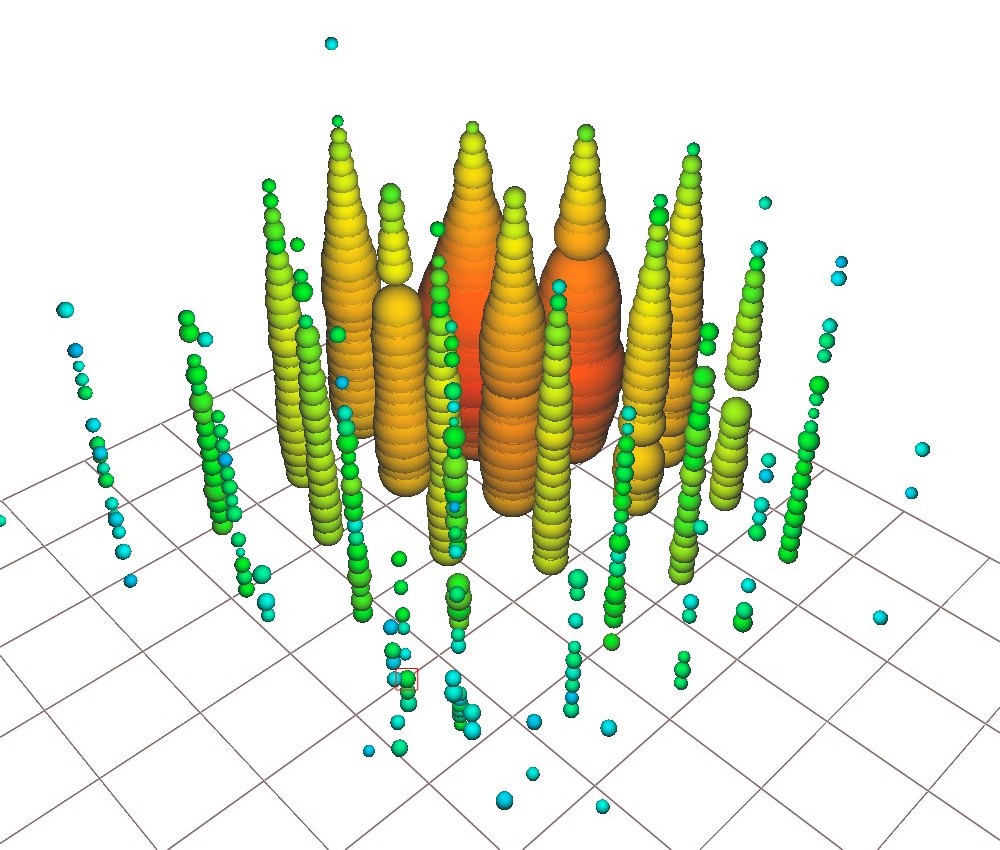
On Dec. 8, 2016, a high-energy particle hurtled to Earth from outer space at close to the speed of light. The particle, an electron antineutrino, smashed into an electron deep inside the ice sheet at the South Pole. This collision produced a particle that quickly decayed into a shower of secondary particles, triggering the sensors of the IceCube Neutrino Observatory, a massive telescope buried in the Antarctic glacier.
IceCube had seen a Glashow resonance event, a phenomenon predicted by Nobel laureate physicist Sheldon Glashow in 1960. With this detection, scientists provided another confirmation of the Standard Model of particle physics. It also further demonstrated the ability of IceCube, which detects nearly massless particles called neutrinos using thousands of sensors embedded in the Antarctic ice, to do fundamental physics. The result was published March 10 in Nature.
Congratulations to Professor Sue Coppersmith on her retirement!
Posted on
With the best of wishes — and some sadness — the Department of Physics says “Happy Retirement” to Professor Sue Coppersmith. Her last day at UW–Madison was February 14.
Coppersmith, the Robert E. Fassnacht Professor of Physics, joined the department in 2001. Prior to coming to UW–Madison, she earned her Ph.D. from Cornell University, conducting her thesis work at Bell Labs. She completed a postdoc at Brookhaven National Lab, then worked at Bell Labs for eight years before joining the faculty at the University of Chicago.
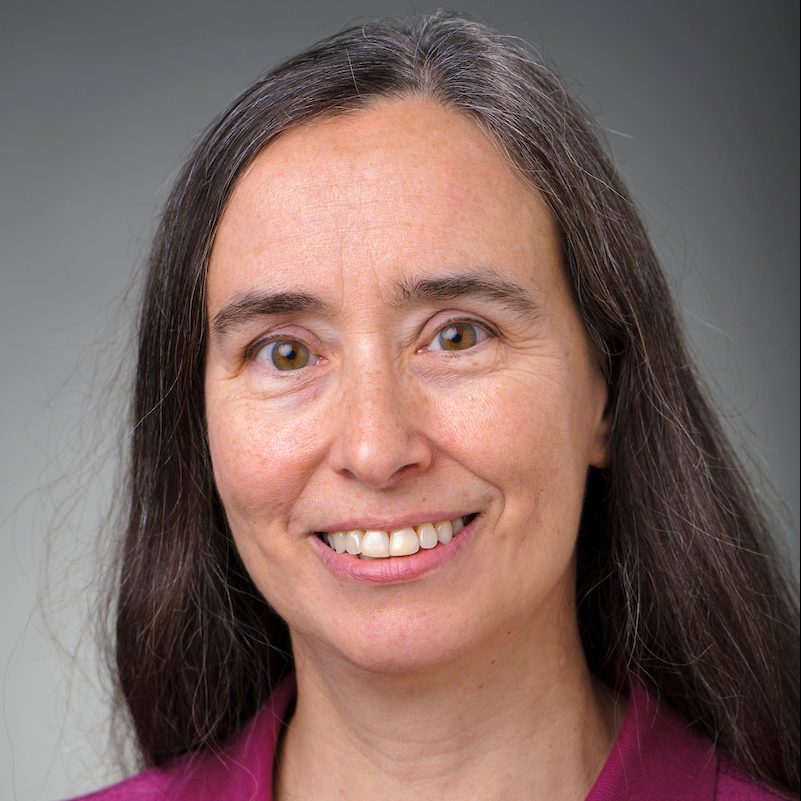
Sue Coppersmith
During her tenure here, she served as Department Chair for one three-year term, and earned recognition as a Fellow of the National Academy of Sciences, the American Academy of Arts and Sciences, the American Association for the Advancement of Science, and the American Physical Society.
Scientific Achievements
At UChicago, Coppersmith’s research focused on soft matter physics and non-linear dynamics, work that she continued at UW–Madison, primarily with Prof. Pupa Gilbert. But her research program largely shifted over the years into quantum computing, an area that was just getting started when she started in Madison..
“At the time, I would tell people what we were doing, and of course nothing was working yet, and people would say, ‘Well, that’s all crap, isn’t it?’” Coppersmith recalls. “So, it was really fun to go from a time where there was nothing working, to now we have qubits, and being a part of the effort and feeling like I was helping.”
Coppersmith describes herself as a theorist who went into the lab every day to better understand the experimental side of quantum computing, And, she says, UW–Madison stands out as one of the universities where theory and experiment are so closely tied together. Here, she frequently collaborated with Prof. Mark Eriksson and Distinguished Scientist Mark Friesen.
“She just comes up with a lot of ideas, and what matters most is how many of them are home runs. She had an unusually large number,” Eriksson says. “She came up with the idea for a brand new qubit, the quantum dot hybrid qubit, and we’re still working on it to this day in my lab. And other people around the world have picked it up.”
Friesen adds:
“As a researcher, Sue is highly intuitive and focused more on the high-level physical picture rather than specific technical details. She typically breaks a problem down to a ‘minimal model’ that captures its basic physics. She has studied a wide variety of problems in her career, for which she is highly respected in many different communities, and she is able to apply lessons learned from one area to another. Her memory is legendary! She is also known for her quickness, both in being able to understand a problem (and how it fits into the big picture) and being able to immediately respond to it. I also say this in a good way: she is not shy about expressing her opinions.”
Legacy as Department Chair
Perhaps equal to her scientific achievements is the mark Coppersmith made on the department during her time as Chair, from 2005-08. The Department was hiring three faculty positions, and she reasoned that if eight offers were made, at worst four people would accept.
“But eight people came! And I was famous for it because I ruined the College’s budget,” Coppersmith says. “I think this is the highlight of my Chair career. I loved recruiting people.”
There are a number of factors that go into faculty candidates accepting or not accepting offers, but Eriksson is certain that Coppersmith‘s ability to recruit was a significant one.
“They came in large part because Sue understood and was able to get them to explain and she was able to hear what they really needed, and then go deliver on it,” Eriksson says. “It’s one thing to have any subset of those skills, but she has the whole package.”
Current Department Chair Sridhara Dasu credits Coppersmith with shaping the direction of the department in all areas of physics, adding, “Her tenure continues to be an inspiration for all chairs of the department who followed her.”
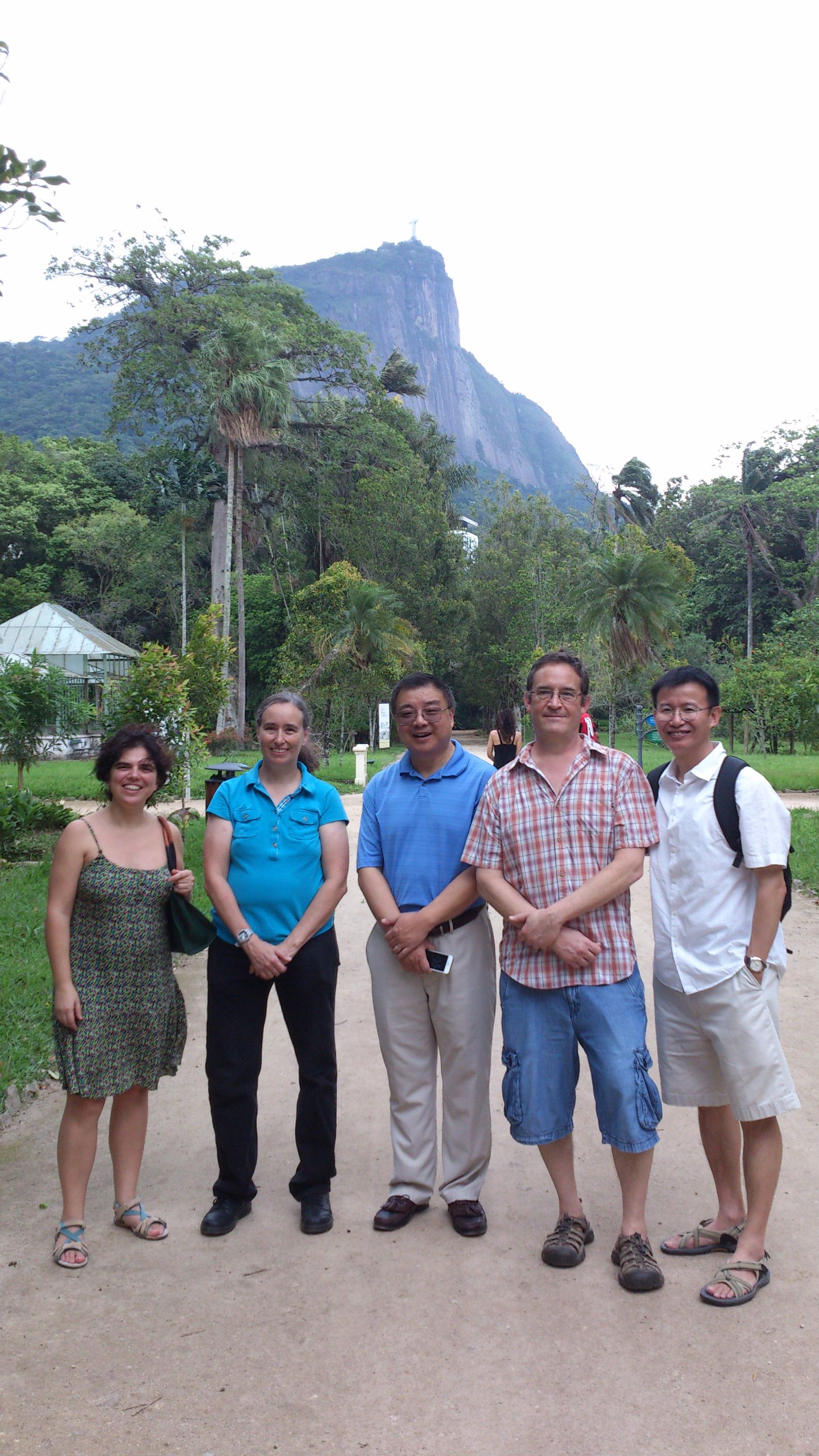
Sue with a group of close collaborators from around the world, at a meeting that she arranged in Rio de Janeiro.
Mentorship of students and colleagues
Coppersmith’s mentorship of junior colleagues and students will also be missed. Both Friesen and Susan Nossal, senior scientist and director of the Physics Learning Center, noted that Coppersmith’s support has been crucial to their success as researchers in the department. They both applauded her as a champion of women and girls in science, citing her participation – with Nossal, Gilbert and several graduate students – in the annual Expanding Your Horizons event at which middle school girls participate in fun, hands-on science activities.
“As a mentor, she is highly dedicated to her students and colleagues,” says Friesen, who co-advised several students with Coppersmith. “For me personally, she has been very supportive of my career path, helping me to obtain promotions and advancements, and providing on-point advice.”
Adds Nossal: “As a scientist, you have your ups and downs, and she helped me through some of the downs. It’s always helpful to have people who believe in you, and she helped me in persisting as a scientist.”
Looking forward
Between Coppersmith and everyone else mentioned in this piece, there were certainly plenty of stories that could be shared. But for now, we’ll let emeritus professor Lou Bruch sum up Coppersmith’s tenacity and well-placed ambition with this anecdote:
“Sue touted the usefulness of the Mathematica package and would at times get into competition on speed of getting to the answer — her using the package and me using ad hoc analyses. I recall only one instance where I won.”
Coppersmith may be retired from UW–Madison, but she is not retiring from science. She is currently Professor and Head of the School of Physics at the University of New South Wales in Australia, where she will continue her research and collaborations with colleagues here and around the world.
“Wisconsin was so good to me. The people are so nice, and we did good work,” Coppersmith says. “I like to feel that I contributed in a positive way. I’ll always be grateful.”
Victor Brar awarded prestigious Sloan Fellowship
Posted on
University of Wisconsin–Madison physics professor Victor Brar has been named a 2021 Sloan Research Fellow, a competitive award given to researchers in the early stages of their careers.
Victor Brar
“A Sloan Research Fellow is a rising star, plain and simple,” says Adam F. Falk, president of the Alfred P. Sloan Foundation. “To receive a Fellowship is to be told by the scientific community that your achievements as a young scholar are already driving the research frontier.”
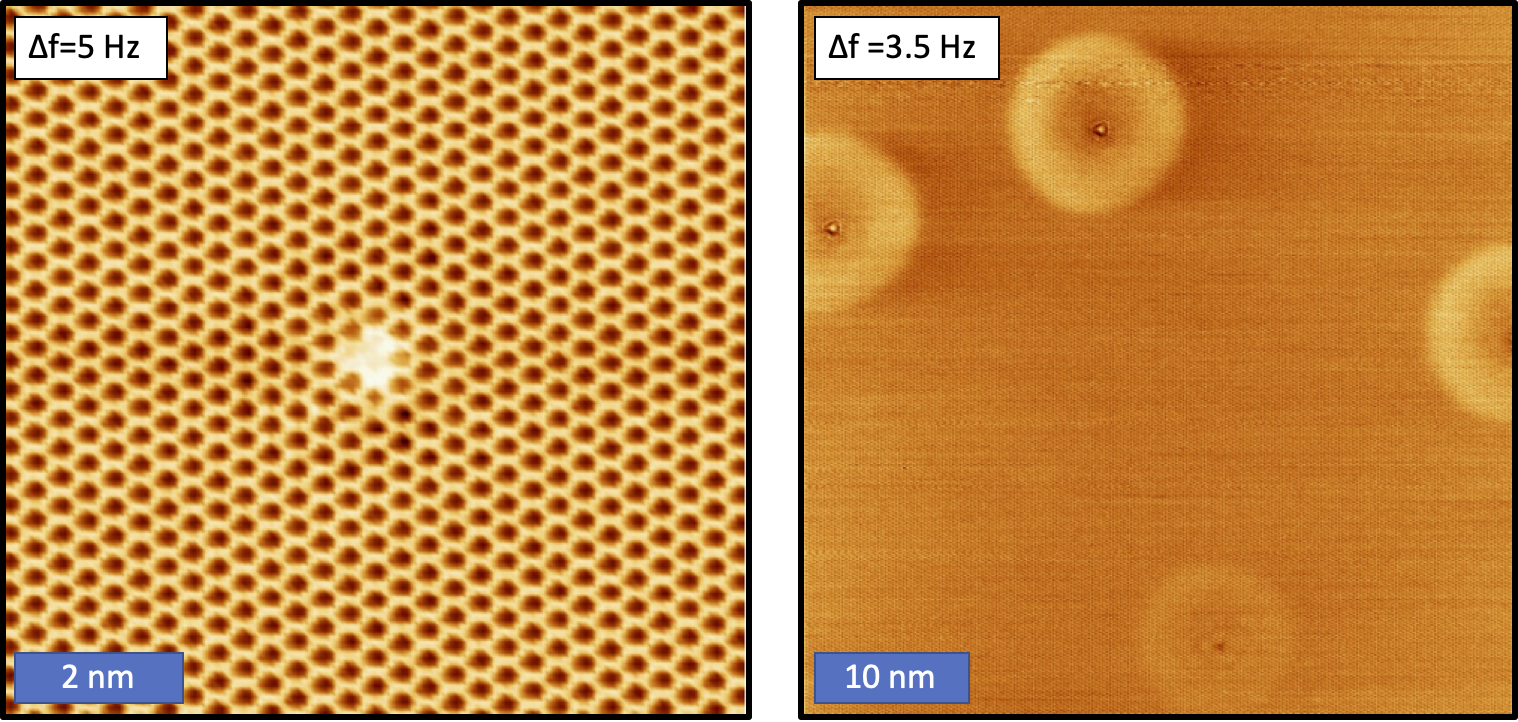
Brar’s research focuses on developing new microscopy techniques to look at quantum systems in ways that current microscopes cannot. Applying these techniques to study defects in materials — where a perfect crystal lattice is disrupted by one or more anomalous atoms — could lead to improvements in quantum computer performance or the discovery of new Physics.
“Everyone in the world is trying to make a quantum computer, but we don’t really have good diagnostics for what all the quantum systems are inside of a material,” Brar says. “One goal with this microscope is to figure out what’s in a material that could interfere with a quantum computer.”
Additionally, Brar hopes that by applying this technique to complex materials, new particles may be identified and studied. For example, many particle physics discoveries, such as the Higgs boson and the positron, have been first theorized based on materials science research and repurposed into high energy physics experiments.
“At CERN, for example, they try to get to higher and higher energies to see particles, and at some point CERN just can’t get high enough,” Brar explains. “But in a material, you can get analogous particles for what CERN scientists are looking for but at much lower energies. There are particles that we’ve never seen outside of a material, but we can see them in a material, and those are the kinds of things that we’d ideally like to study.”
Images of quantum defects embedded in the atomic lattice of tungsten diselenide (credit: Victor Brar)
The technique that Brar is developing combines optical and electron microscopy, two methods he worked on as a graduate student and post-doc. By bringing them together now, he hopes that his unique method will bring significant advances to his field — and that the Sloan Fellowship indicates that other scientists agree.
“The Sloan award has a history behind it, and they have a track record of funding good science,” Brar says. “So, it means a lot to be recognized by Sloan and I hope it will help when we start to try to make our case for why this method is important.”
The Sloan Research Fellowship is open to early-career scientists in one of eight fields, including physics. More than 1000 researchers are nominated each year for 128 fellowship slots. Winners receive a two-year, $75,000 fellowship which can be spent to advance the fellow’s research.
“Prof. Victor Brar winning the Sloan Foundation Fellowship is a very welcome recognition,” says Sridhara Dasu, chair of the UW–Madison physics department. “For decades now, the Sloan Fellowship is a highly sought-after honor amongst young scientists, and it is wonderful to note that our enthusiasm and confidence in Prof. Brar’s research prowess is recognized by an international panel selecting the Sloan Fellows.”