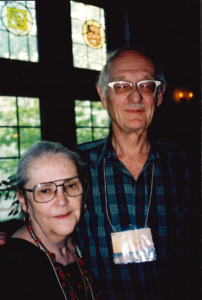
UW–Madison professor emeritus of physics Charles (Charlie) Goebel passed away February 18, 2026. He was 95.
Born, raised, and educated in Illinois, Goebel received a PhD in 1956 from the University of Chicago under the direction of the well-known quantum field theorist Gregor Wentzel. After a post-doctoral position at the Lawrence Radiation Laboratory at the University of California (now Lawrence Berkeley National Lab), he joined the faculty at the University of Rochester. In 1961, he joined the physics faculty at UW–Madison as an associate professor. He was elected a Fellow of the American Physical Society in 1963, promoted to full professor in 1964, and remained a valued member of the faculty until his retirement in 2003.
Goebel had extraordinarily diverse interests in theoretical physics, mostly centered in particle physics, field theory and general relativity. Among his most notable contributions were:
- A method for using pion-nucleon scattering to extract the fundamental, but difficult to measure, characteristics of pion-pion scattering. This method (independently discovered by Chew and Low) was of central importance for numerous experiments in the 70s and 80s.
- The invention of G-parity which generalizes the concept of charge conjugation parity to iso-spin multiplets. This has been a useful, and often a crucial, tool in the analysis of strong interactions.
- The generalization of the famous Veneziano formula to N particles. The Veneziano formula was the starting point in the subsequent development of string theory.
In recommending Goebel for emeritus status, the Physics Department Executive Committee praised him for generously offering insights and advice on teaching and research questions, a thought echoed by several of Goebel’s former colleagues.
“Charlie, as we liked to call him, was a legend in the physics department in numerous ways,” says physics professor Vernon Barger. “I liked to think of him as the physicist’s physicist for his generosity in helping numerous faculty to solve their most difficult research and teaching questions.”
Adds physics professor emeritus Louis Bruch, “Charlie was able to produce ingenious solutions to a great variety of problems and provide important perspective on them.”
Goebel became legendary among generations of graduate students to whom he taught field theory, relativity, and many other subjects. Many remember — some fondly, but all with clarity — his challenging take-home exams.
Goebel loved the outdoors, including hiking, canoeing and camping, preferably in remote areas including the Boundary Waters. He hiked and biked all around Madison and walked to work in all weathers. He loved classical music, and played French horn with family and friends, something physics professor emeritus Bill Friedman recalled fondly:
“Both Charlie and I were players of brass musical instruments, he the French horn and I the trumpet. In the early 1970s, we would occasionally get together to play with a few other wind players from the department, along with Charlie’s son, John, on oboe. This was for our own amusement. We sometimes played from string quartet scores. Charlie provided me with copies of several horn pieces which I enjoyed playing on my own instrument.”
After retiring, Goebel still visited the department nearly every day until 2020, when the COVID-19 pandemic limited building occupancy. He also returned to teach Physics 831, Advanced Quantum Mechanics in Fall 2010.
Please visit the department’s tribute page to Charlie to submit and/or read stories from Jim’s colleagues.
Parts of this obituary were taken from department archives. We also thank Prof. Goebel’s family for providing additional information.