The latest results combined weak lensing and galaxy clustering and incorporated four dark energy probes from a single experiment for the first time.
This story is amended from one published by Fermilab, which includes information about the full results published by the DES collaboration
The Dark Energy Survey (DES) collaboration — including scientists at the University of Wisconsin–Madison — is releasing results that, for the first time, combine all six years of data from weak lensing and galaxy clustering probes. In the paper, which represents a summary of 18 supporting papers, they also present their first results found by combining all four probes — baryon acoustic oscillations (BAO), type-Ia supernovae, galaxy clusters, and weak gravitational lensing — as proposed at the inception of DES 25 years ago.
“We combined multiple approaches to measure dark energy from a single dataset into a summative result,” says Keith Bechtol, physics professor at UW–Madison and DES collaboration scientist. “More than one hundred people have been working on these results for over a decade, and our group is one of many who contributed.”
The analysis yielded new, tighter constraints that narrow down the possible models for how the universe behaves. These constraints are more than twice as strong as those from past DES analyses, while remaining consistent with previous DES results.
“The constraints have gotten tighter and, so far, are consistent with the cosmological model that has withstood ever more stringent tests during past two decades,” Bechtol says. “The results sharpen the mysteries surrounding the detailed physics that would explain dark energy and dark matter.”
UW–Madison contributions
Bechtol, former physics graduate student Megan Tabbutt, and current graduate student Julián Beas-González all contributed to the current results, developing methods to ensure the data products were scientifically validated. Current Bechtol group postdoc Jason Lee worked on the type Ia supernovae analysis as a graduate student at the University of Pennsylvania.
Bechtol was involved with data collection and curation for DES — a dataset that amounted to over 75,000 individual images with almost 700 million individual stars and galaxies.
“I helped coordinate the effort to assemble, scientifically validate, and document the data products that served as the foundation of the cosmology results presented today,” Bechtol says.
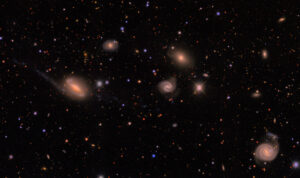
Tabbutt developed a software pipeline to provide detailed characterization for the detection and measurement of stars and galaxies, and Beas-González further refined that pipeline and conducted the final analysis. The analysis used a method known as synthetic source injection, where synthetic stars and galaxies with known properties are inserted into actual night sky images, and the augmented images are consistently re-processed through the regular measurement pipeline.
“From these measurements, we can compare what we measured versus what we injected. It’s a way to translate between the things we measure and the things that are supposed to be out there in the night sky,” Beas-González says. “It can be used as both a diagnostic tool to see how well we’re detecting and measuring things, but it also has other downstream applications.”
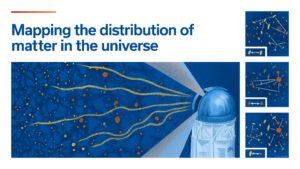
These downstream applications, including calibrating photometric redshifts and obtaining magnification estimates of gravitational weak lensing, are also important to DES collaboration work. Redshifts help explain matter distribution and weak lensing affects galaxy counts or sizes of galaxies, and including both into data analyses is crucial to mapping matter density in the cosmos.
While the DES work is wrapping up, it is also a launching point for more detailed surveys that will help scientists better understand the makeup, origins, and evolution of the universe.
“It’s a very exciting time to be a grad student in the field,” Beas-González says. “I get to see the final stages of DES, and I feel like there’s this whole generation of young scientists like myself that are excited to collaborate on newer projects, see them to their final stages, and get even better and more constrained results.”
More information on the DES collaboration and the funding for this project can be found here.
The Dark Energy Survey is jointly supported by the U.S. Department of Energy’s Office of Science and the U.S. National Science Foundation.