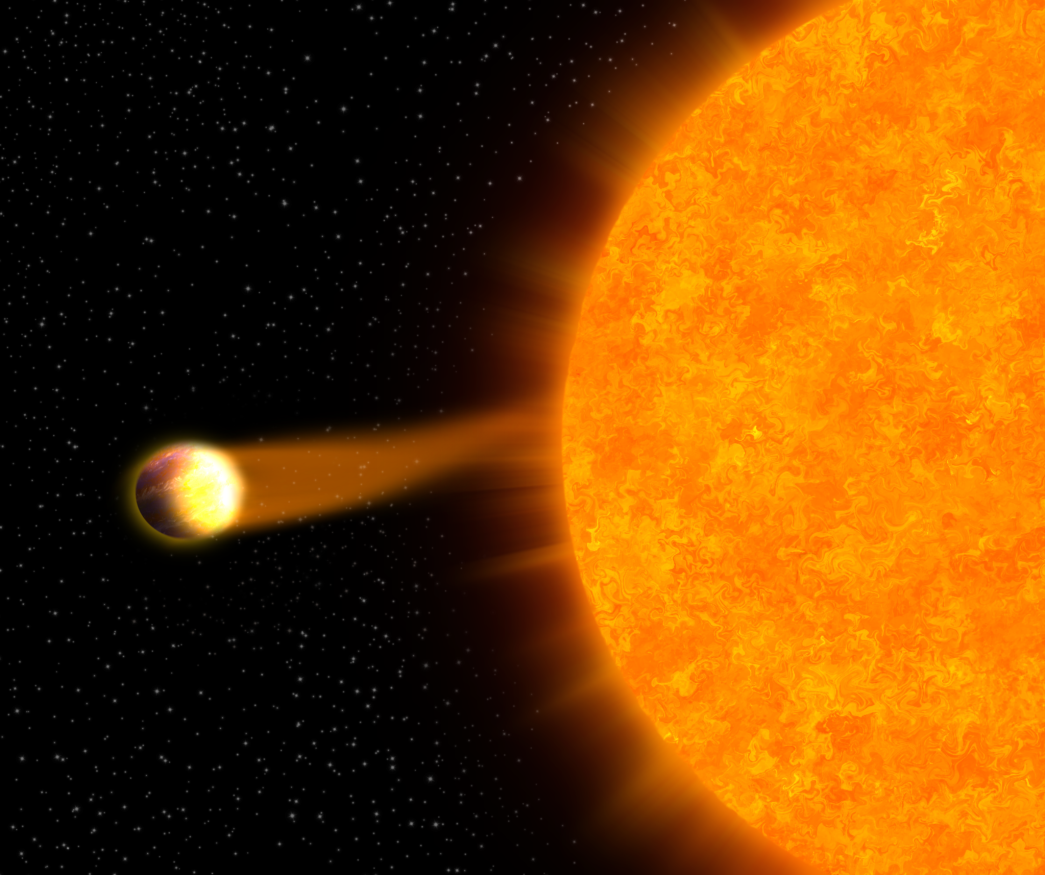
Two recent publications led by UW-Madison astrophysicists were featured in a July 9 New York Times article on planetary engulfment, the process by which a star consumes an orbiting companion. Both center on TOI-5882, an evolved subgiant star hosting a massive brown dwarf (22 Jupiter masses) on a tight, 7-day orbit, and together they reconstruct both the chemical fingerprint and the physical fate of that doomed companion.
The first paper (Kotten et al. 2026) shows that TOI-5882 carries an unusually strong lithium signature, best explained by the star having engulfed a super-Earth to Neptune-mass planet. The second (Narayan et al. 2026) develops a new, self-consistent framework for how tides drain orbital energy and angular momentum from the companion, demonstrating that internal gravity waves accelerate the brown dwarf’s inspiral far faster than classical models predict.
The work was led by two former UW-Madison undergraduates: Brooke Kotten, a former astronomy and physics major who is now an NSF Graduate Research Fellow at the University of Michigan, and Ritvik Sai Narayan, an astronomy major now heading to MIT this fall. Both students were mentored by Professor Soares-Furtado (Depts of Physics and Astronomy), who directed Brooke’s project and co-mentored Ritvik’s alongside Professor Rich Townsend. Townsend (Dept of Astronomy), who holds a Physics affiliation, played a key role in developing the computational model the team built to understand the fate of the brown dwarf. That two undergraduates drove research at this level speaks to the mentorship and research opportunities UW-Madison offers.
This project is closely aligned with the goals of WiCOR (Wisconsin Center for Origins Research; Physics and Astronomy are both department members). When a star consumes a planet, traces of the planet’s chemical makeup are left behind in the stellar atmosphere, allowing us to reconstruct its bulk composition. This matters for the search for life because a planet’s ability to support life depends largely on its interior chemistry. That chemistry determines whether the planet can form a rocky surface, maintain a protective magnetic field, and create an atmosphere. That interior chemistry is normally hidden beneath clouds and surface layers. Engulfment is one of the only ways to probe far beneath a planet’s atmosphere and determine the bulk composition of its interior. Stars like TOI-5882 provide a rare window into the ingredients that determine whether worlds like these could ever support life.