The prevalence of non-thermal, highly energetic particles is one of the most striking features of the universe. Such particles are responsible for some of the most spectacular events in space physics and astrophysics. For instance, these particles are the engines behind the most luminous events in the universe, including Gamma-Ray Bursts and Blazars. They are components of solar flares and coronal mass ejections – outflows of energetic plasma that can damage satellites and disrupt power grids. In laboratory fusion devices, high-energy “runaway electrons” and alpha particles behave like non-thermal populations. Controlling them is vital for achieving fusion energy.
Understanding these particles is a frontier problem in plasma physics and astrophysics. For many decades, scientists have been trying to understand what causes these particles to have so much energy and why they defy the “Maxwell-Boltzmann equilibrium”.
In a recent publication in the Astrophysical Journal Letters, researchers at UW Madison and Los Alamos National Laboratory proposed yet another view on this age-old problem. They analyzed the fact that non-thermal particles often appear in turbulent environments, that is, in systems where the flow of hot ionized gas – plasma – is random. Turbulence, on the other hand, whether it appears in the interstellar medium, Earth’s atmosphere, or a stirred cup of coffee is a rather universal phenomenon. It generates fluid fluctuations, known as “swirling eddies”, whose scales and energies have remarkably universal distributions.
Physicists have long been intrigued by universal laws, which they expect to emerge from theories that explain fundamental physical behavior. These theories can be applied to a variety of systems and environments, often extending well beyond the cases they were first developed for.
In this study, researchers investigated whether the universality observed in the energy distribution of energetic particles is related to the universality of turbulent fluctuations. They focused on the balance of energy between turbulent fluctuations and particles whose gyro-scales (the sizes of their rotational orbits in a magnetic field) are comparable to the scales of these fluctuations. “This energy balance assumption allowed us to analytically predict the particle energy distribution functions,” says Stanislav Boldyrev, one of the study’s authors, “and our predictions aligned with the results of numerical simulations. We may be one step closer to solving the mystery of non-equilibrium particles in space and astrophysical systems.”
He notes, however, that the hypothesis requires further investigation, which may involve both observational and numerical studies. “This study inspires young researchers by highlighting fundamental unsolved problems in plasma dynamics,” continues Boldyrev, “It would not have been possible without the years of hard work by our talented young scientists, which include graduate student Daniel Humphrey and postdoctoral researcher Dr. Cristian Vega, as well as the support from the Department of Energy and the Wisconsin Alumni Research Foundation.”
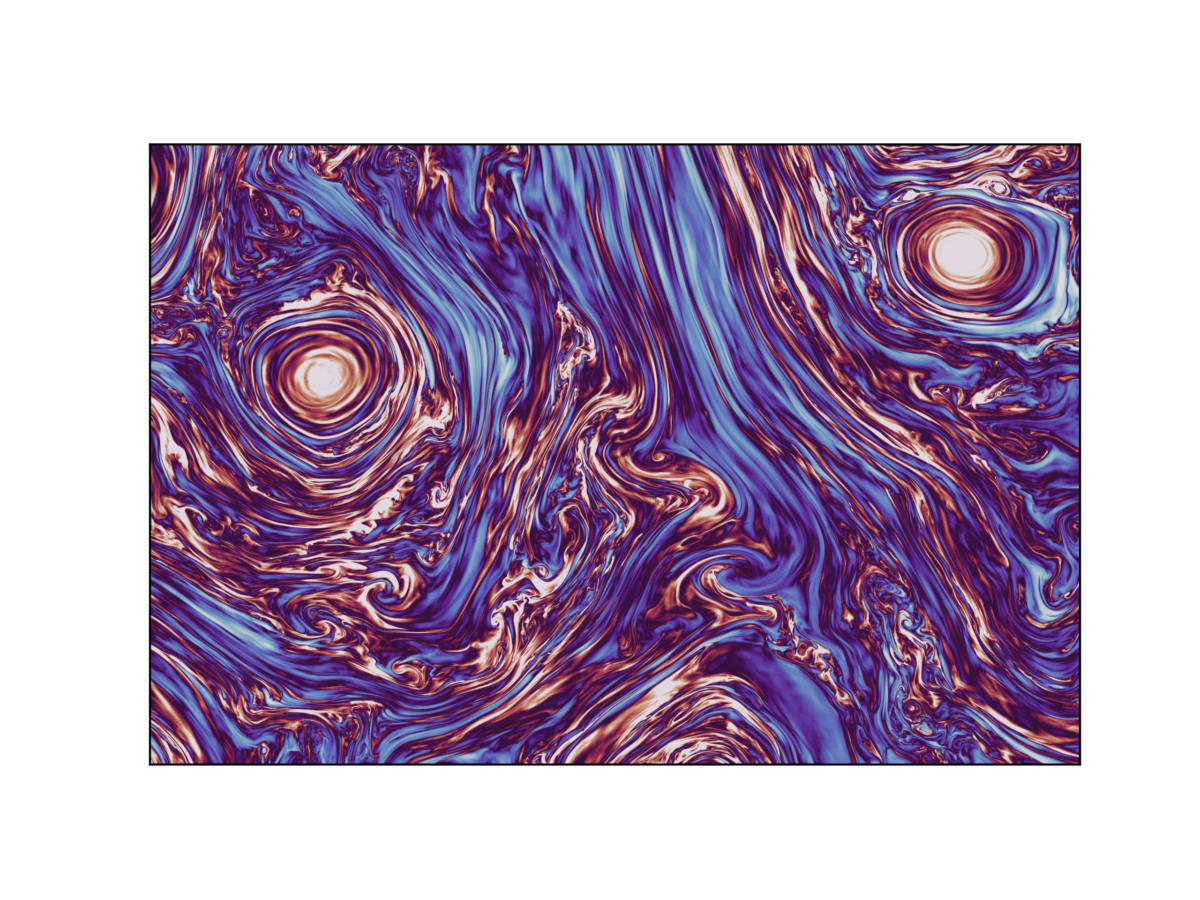
The figure above shows the electron density in turbulent electron-positron pair plasma.
For more information read the published article.
This work was supported by the U.S. Department of Energy, Office of Science, Office of Fusion Energy Sciences under award number DE-SC0024362, and by the University of Wisconsin-Madison, Office of the Vice Chancellor for Research, with funding from the Wisconsin Alumni Research Foundation.