Twelve projects have been chosen for Round 6 of the UW2020: WARF Discovery Initiative, including three from faculty in the Department of Physics (Mark Eriksson, Robert McDermott, and Justin Vandenbroucke). These projects were among 92 proposals submitted from across campus. The initiative is funded by the Office of the Vice Chancellor for Research and Graduate Education and the Wisconsin Alumni Research Foundation.
The projects were reviewed by faculty across the university. The UW2020 Council, a group of 17 faculty from all divisions of the university, evaluated the merits of each project based on the reviews and their potential for making significant contributions to their field of study.
The goal of UW2020 is to stimulate and support cutting-edge, highly innovative and groundbreaking research at UW–Madison and to support acquisition of shared instruments or equipment that will foster significant advances in research.
Acquisition of a cryogen-free Physical Properties Measurement System (PPMS) for characterization of quantum materials and devices
The project addresses a barrier for UW–Madison researchers in measuring electronic, magnetic, and thermal properties of quantum materials at low temperatures, namely the increasing high costs of cryogens (liquid helium) and lack of a convenient means to perform these measurements in a shared facility. Low-temperature electronic, magnetic, and thermal properties of materials are crucial for fundamental materials discovery and for applications in quantum information, nonvolatile memory, and energy conversion devices.
This project will acquire a cryogen-free Physical Properties Measurement System (PPMS) and house it as a shared-user facility instrument within the Wisconsin Centers for Nanotechnology (CNT). This instrument would be open for all UW–Madison users.
Currently, these measurements depend on external collaborations or low-temperature setups in PI labs which either consume large amounts of cryogens or require time-consuming reconfigurations from experiment to experiment. Having a cryogen-free PPMS would allow researchers to spend less time and money in setting up experiments, potentially freeing up resources for scientific investigations that include new superconducting and topological material discoveries and characterizations of materials for advanced microelectronics and magnetic memory systems.
PRINCIPAL INVESTIGATOR
Jason Kawasaki, assistant professor of materials science and engineering
CO-PRINCIPAL INVESTIGATOR
Jerry Hunter, director of the Wisconsin Centers for Nanotechnology
CO-INVESTIGATOR
Paul Voyles, professor of materials science and engineering and MRSEC Director
Song Jin, professor of chemistry
Mark Eriksson, professor of physics
Thomas Kuech, professor of chemical and biological engineering
Daniel Rhodes, assistant professor of materials science and engineering
Chang-Beom Eom, professor of materials science and engineering
Paul Evans, professor of materials science and engineering
Michael Arnold, professor of materials science and engineering
Dakotah Thompson, assistant professor of mechanical engineering
Cracking the structure of ice: establishing a cryogenic electron backscatter diffraction and Raman capability at UW–Madison
The structure and physical properties of ice determine the behavior of glaciers, ice sheets, and polar ice caps (both terrestrial and extraterrestrial). Moreover, ice is of interest because of its unique light transmission properties, which are currently being harnessed by one of the world’s largest astrophysical experiments through the UW–led IceCube collaboration.
This project will develop the capability to perform scanning electron microscopy (SEM) of water and CO2 ice in the UW–Madison Geoscience Department, focusing on electron backscatter diffraction (EBSD) analysis for ice microstructure and Raman spectroscopy for ice composition. EBSD of ice is an extremely rare analytical capability worldwide.
Having this highly specialized type of analysis capability for ice will enable advances in glaciology, climate science, physics, materials science and planetary science. This technology can accelerate research on glacial sliding and ice deformation, and inform long-standing questions about the transformation of air bubbles to clathrates in glacial ice and their potential as archives of Earth’s past atmosphere. In addition, understanding the structure of ice is critical, for example, to accurate measurement of cosmic ray interactions in the IceCube Neutrino Observatory.
As the only lab in the U.S. offering combined ice EBSD analysis and ice Raman analysis, UW–Madison will establish itself as a nexus for cryosphere research, attracting many collaborations from outside UW–Madison.
PRINCIPAL INVESTIGATOR
Chloe Bonamici, assistant professor of geoscience
CO-PRINCIPAL INVESTIGATORS
Lucas Zoet, assistant professor of geoscience
Shaun Marcott, associate professor of geoscience
Justin Vandenbroucke, associate professor of physics/WIPAC
John Fournelle, senior scientist of geoscience
CO-INVESTIGATORS
Pavana Prabhakar, assistant professor of civil and environmental engineering
Richard Hartel, professor of food engineering
Hiroki Sone, assistant professor of geological engineering
Interdisciplinary engineering of quantum information systems
This project represents a synergistic effort toward engineering practical quantum information systems (QIS). The research unites the experimental superconducting and semiconducting qubit teams on campus with advanced materials characterization and microwave engineering expertise to uncover the underlying sources of decoherence that limit qubit performance and develop next-generation quantum devices for scalable quantum computing and quantum sensing. This effort will build new interdisciplinary connections that nourish the quantum ecosystem at UW–Madison, cutting across departmental and disciplinary lines.
The potential of QIS has been recognized recently by the $1.4 billion federal National Quantum Initiative, and the newly formed Wisconsin Quantum Institute at UW is home to world-leading efforts in the physics of QIS. This project is a next step in expanding these directions to incorporate the engineering effort necessary to develop practical systems capable of solving real-world problems.
PRINCIPAL INVESTIGATOR
Robert McDermott, professor of physics
CO-PRINCIPAL INVESTIGATORS
Mark Eriksson, professor of physics
Susan Hagness, professor of electrical and computer engineering
Paul Voyles, professor of materials science and engineering
Kangwook Lee, professor of electrical and computer engineering
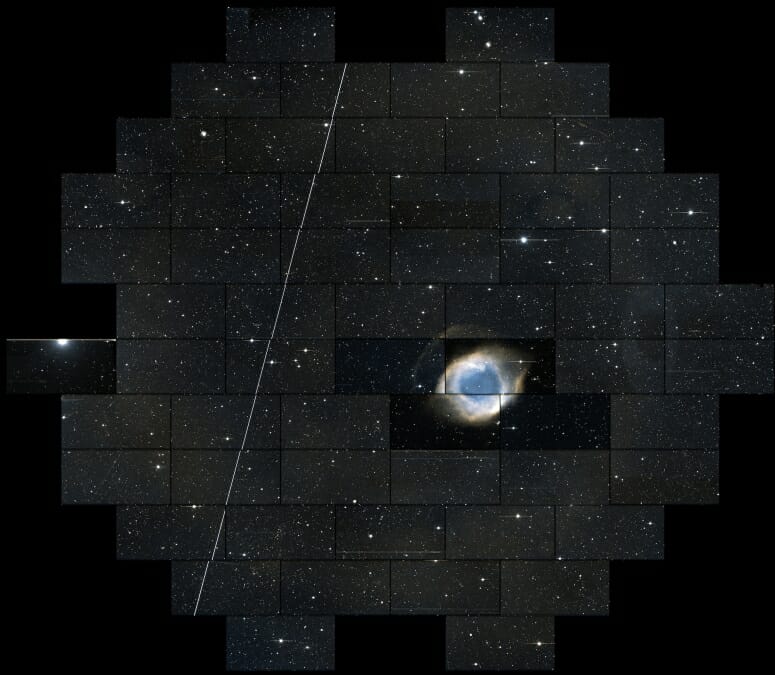 Congrats to Prof. Keith Bechtol and graduate student Rob Morgan for their winning entry in the UW–Madison Cool Science Images contest! Their winning entry — one of 12 selected out of 101 entries — earns them a large-format print which initially will be displayed in a gallery at the McPherson Eye Research Institute’s gallery in the WIMR building.