Velocity gradients key to explaining large-scale magnetic field structure

a whirled, wispy, spiral galaxy has white magnetic field lines overlaid on the image, showing that the magnetic field structure is organized in large, long structures over the entirety of the galaxy

All celestial bodies — planets, suns, even entire galaxies — produce magnetic fields, affecting such cosmic processes as the solar wind, high-energy particle transport, and galaxy formation. Small-scale magnetic fields are generally turbulent and chaotic, yet large-scale fields are organized, a phenomenon that plasma astrophysicists have tried explaining for decades, unsuccessfully. 

In a paper published January 21 in Nature, a team led by scientists at the University of Wisconsin–Madison have run complex numerical simulations of plasma flows that, while leading to turbulence, also develop structured flows due to the formation of large-scale jets. From their simulations, the team has identified a new mechanism to describe the generation of magnetic fields that can be broadly applied, and has implications ranging from space weather to multimessenger astrophysics.

profile photo of Bindesh Tripathi
Bindesh Tripathi

“Magnetic fields across the cosmos are large-scale and ordered, but our understanding of how these fields are generated is that they come from some kind of turbulent motion,” says the study’s lead author Bindesh Tripathi, a former UW–Madison physics graduate student and current postdoctoral researcher at Columbia University. “Given that turbulence is known to be a destructive agent, the question remains, how does it create a constructive, large-scale field?” 

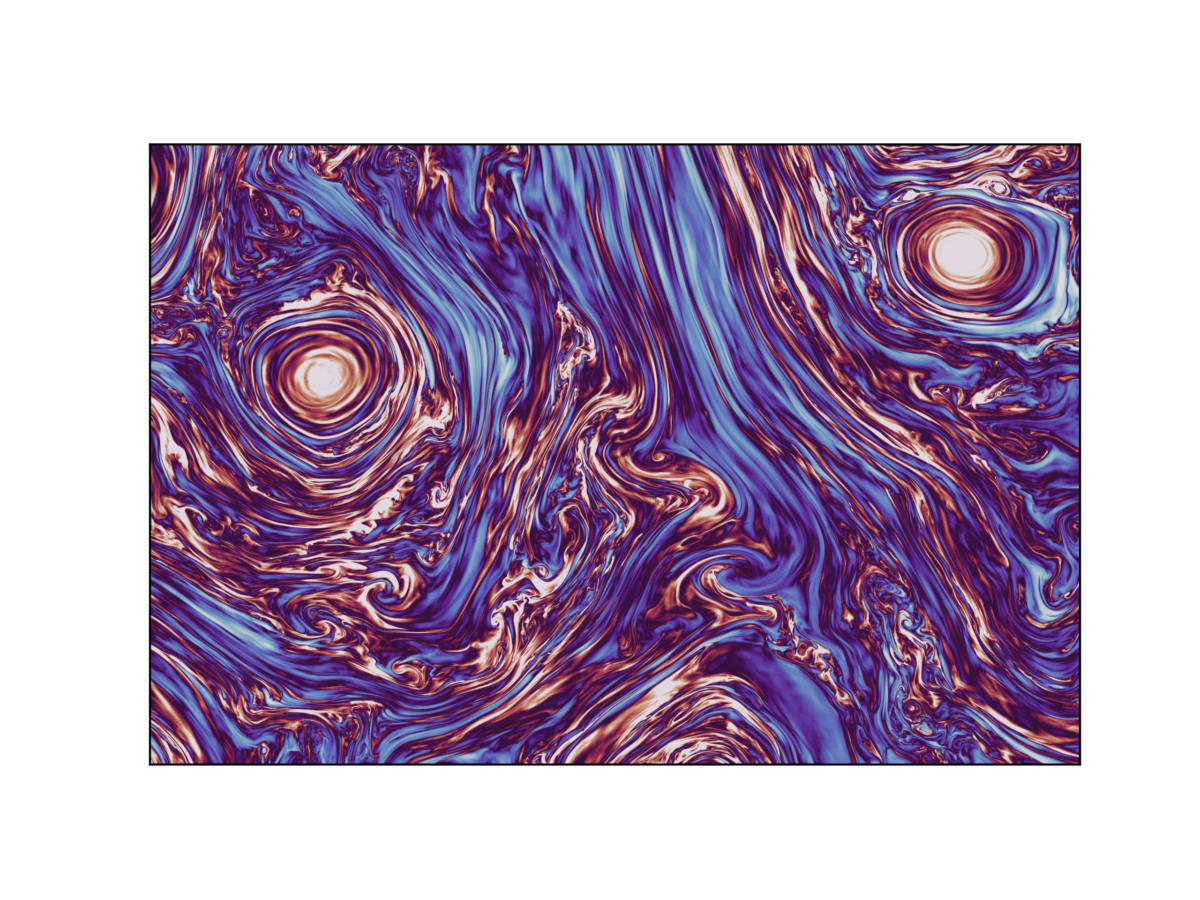
Before working on three-dimensional (3D) magnetic fields, Tripathi investigated systems with hydrodynamic flows and two-dimensional (2D) magnetic fields. After staring at the movies and images of 3D magnetic turbulence, he noticed similarities in the shapes of large-scale flows and large-scale magnetic field structures. But it wasn’t as simple as applying fluid dynamic theory to magnetic field generation: the former may be solved as a 2D problem, whereas the latter must be solved in 3D, making it a much more complex, difficult-to-solve problem.

Tripathi and his colleagues decided to tackle the problem with two key changes from previous research. 

The first difference was the input: a constantly replenished velocity gradient. A cyclist hitting a curb head-on, say, experiences a velocity gradient: the wheels stop, but momentum can cause the cyclist to fly over the handlebars. Velocity gradients exist throughout the universe; for example, within different layers of the sun or when two neutron stars merge. The team reasoned that this gradient is likely important to include while studying 3D magnetic fields. 

Second, they ran perhaps the most complex simulation to date of magnetic fields in the presence of an unstable velocity gradient — 137 billion grid points in 3D space. Altogether, they ran around 90 simulations, generating 0.25 petabytes of data and using nearly 100 million CPU hours on the Anvil supercomputer at Purdue University.

Ordered magnetic fields spontaneously emerge out of chaotic, tangled fields. This finding is consistent with astrophysical observations. Streamlines of magnetic fields are 3D-rendered and are colored red–blue by the x-component of the field. Streamlines of the electric current density are shown in green; color represents magnitude. Poloidal fields are displayed on the (y,z)-plane, after averaging them over the azimuthal (x) direction. Credit: Tripathi et al.

“We start our simulations with a flow that has a velocity gradient, then we add some tiny perturbations, like moving one fluid particle infinitesimally, we let that perturbation propagate over the system and grow, and then analyze the data over time,” Tripathi says. “Initially, these perturbations lead to turbulent flows and magnetic fields in small-scale structures, then, over time, they emerge into larger, ordered structures.” 

When Tripathi ran the same simulations where the initial velocity gradient had decayed over time, the simulation only produced the chaotic, small-scale patterns. “So that’s really the main key: to have a steady, large-scale gradient in velocity,” he emphasizes. 

Adds Paul Terry, physics professor at UW–Madison and senior author of the study: “Magnetic field generation via dynamos has been extensively studied for 70 years, with the frustrating result that the generated fields almost always end up at small scales and highly disordered, unlike observations. This work, therefore, potentially resolves a long-standing issue.”

Though the theory cannot be tested in the distant universe, a lab-based experiment does support the team’s findings: in 2012, colleagues at the Wisconsin Plasma Physics Laboratory were trying to better understand the nature of the magnetic field generation process in a laboratory experiment, but their data did not fit any of the previous models. Tripathi and colleagues’ new theory of magnetic field generation more closely matches the experimental data and helps to resolve the confounding findings.

“This work has the potential to explain the magnetic dynamics relevant in, for example, neutron star mergers and black hole formation, with direct applications to multimessenger astronomy,” Tripathi says. “It may also help better understand stellar magnetic fields and predict gas ejections from the sun toward the earth.”

Top image: The magnetic fields in large-scale structures are organized despite local areas of turbulence. The magnetic field in the Whirlpool Galaxy (M51), captured by NASA’s flying Stratospheric Observatory for Infrared Astronomy (SOFIA) observatory superimposed on a Hubble telescope picture of the galaxy. The image shows infrared images of grains of dust in the M51 galaxy. Their magnetic orientation largely follows the spiral shape of the galaxy, but it is also being pulled in the direction of the neighboring galaxy at the right of the frame. (Credit: NASA, SOFIA, HAWC+, Alejandro S. Borlaff; JPL-Caltech, ESA, Hubble)


This work was supported by the National Science Foundation (2409206) and U.S. Department of Energy (DE-SC0022257) through the DOE/NSF Partnership in Basic Plasma Science and Engineering. Anvil at Purdue University was used through allocation TG-PHY130027 from the Advanced Cyberinfrastructure Coordination Ecosystem: Services & Support (ACCESS) program, which is supported by National Science Foundation (2138259, 2138286, 2138307, 2137603 and 2138296).


Tiancheng Song earns DOE Early Career award

Photo of Tiancheng Song
Tiancheng Song

Professor Tiancheng Song has been selected for an Early Career Research Program (ECRP) award by the U.S. Department of Energy. Established in 2010, this prestigious program aims to support outstanding scientists early in their careers and stimulate cutting-edge research. This award will fund the Song Lab’s work on exploring novel superconductors based on two-dimensional (2D) materials for designing next-generation quantum devices.

Developing superconductors and superconducting devices is crucial for quantum information science, ranging from building superconducting qubits based on Josephson junctions to exploring topological qubits via the superconducting proximity effect. Complementary to conventional material systems, 2D materials and their van der Waals (vdW) heterostructures provide an emerging material platform for designing new superconducting quantum devices.

“Leveraging the recent breakthroughs in 2D quantum materials, we will discover new vdW superconductors, fabricate Josephson junctions, and engineer hybrid superconducting systems,” Song says.

The Song Lab will employ 2D superconductors to fabricate Josephson junctions and investigate unconventional Josephson effects enabled by the highly crystalline nature of junction materials, which can even unlock new opportunities in topological quantum computation. 

“We are excited to leverage the recent advances in the two rapidly developing fields, 2D materials and quantum information science, to harness unique opportunities enabled by their synergistic combination,” Song says.

Mark Saffman wins Bell Prize

This post is derived from content originally published by the University of Toronto

Mark Saffman poses in front of equipment in his lab
Mark Saffman

Congrats to Mark Saffman, the Johannes Rydberg Professor of Physics and director of the Wisconsin Quantum Institute, on earning the ninth Biennial John Stewart Bell Prize for Research on Fundamental Issues in Quantum Mechanics and Their Applications.

He shares the prize with Antoine Browaeys (CNRS, Université Paris-Saclay) and Mikhail Lukin (Harvard) for their pioneering contributions to quantum simulation and quantum computing with neutral atoms in optical tweezer arrays, including the development of large-scale programmable arrays for scalable quantum computation. The prize will be given at the eleventh international conference on Quantum Information and Quantum Control, University of Toronto.

Saffman’s career-spanning work was also recognized last month with the American Physical Society’s Ramsey Prize in AMO Physics and in Precision Tests of Fundamental Laws and Symmetries, a prize he shares with Browaeys.

The John Stewart Bell Prize for Research on Fundamental Issues in Quantum Mechanics and their Applications (short form: “Bell Prize”) was established in 2009, and is awarded every other year, for significant contributions first published in the preceding 6 years. The award is meant to recognize major advances relating to the foundations of quantum mechanics and to the applications of these principles – this covers, but is not limited to, quantum information theory, quantum computation, quantum foundations, quantum cryptography, and quantum control. The award is not intended as a “lifetime achievement” award, but rather to highlight the continuing rapid pace of research in these areas, and the fruitful interplay of fundamental research and potential applications. It is intended to cover even-handedly both of these aspects, and to include both theoretical and experimental contributions.

Game on! New course explores the physics of sports

two people stand and balance on either side of a plank with a fulcrum under it. both their arms are out like they are trying not to fall.

By Francesca Smith, physics communications intern

Students who signed up for a course about the physics of sports probably did not expect to take a field trip to the Kohler Art Library at the beginning of the semester. But the unexpected is the norm with Jim Reardon, the instructor for Physics 106: Physics of Sports. While many science courses on campus consist largely of memorizing equations and staying ahead of the class curve, Reardon takes a multifaceted, participatory approach to teaching his students.

“You’re trying to put on a show that grabs their attention and effortlessly keeps it because you’re presenting a spectacle, like a movie,” Reardon says. “You don’t have to force yourself to pay attention to something that’s inherently interesting, it just sort of naturally goes there.”

“Abe Eddington at the trot” is the first sports movie ever made. Eadweard Muybridge pioneered a method of showing images using a zoopraxiscope. This animated GIF, compiled by Jim Reardon from Library of Congress images, helps to recreate the movie.

At the library, Reardon has students flip through a first-edition copy of Eadweard Muybridge’s Animal Locomotion from 1887, which shows phases of movement through photo sequences. Motion — so fundamental a concept to physics that Isaac Newton developed a set of laws around it — is commonly taught using a quantitative approach. Reardon uses Muybridge’s images to illustrate the concept of motion in a more intuitive way.

Reardon first developed Physics 106 with the help of fellow UW–Madison physics professor Cary Forest. The two were inspired by a similar course taught by one of Forest’s colleagues at UC Irvine, which was a favorite among students there. Physics of Sports was first taught at UW–Madison in Spring 2023, and initially resulted in 36 student enrollments. Now, three years later, course registration numbers have skyrocketed to approximately 300 undergraduates.

While the course’s theme attracts sports fans, Reardon’s unique methods of teaching also resonate with students, especially those intimidated by the idea of taking a college-level physics course. He follows a hands-on approach to teaching, where students are encouraged to, for example, run and jump in front of the classroom to demonstrate momentum. Field trips such as the aforementioned visit to the Kohler Art Library are also common in the course. Reardon used to work with The Wonders of Physics — the physics department’s educational outreach program — and noticed how audiences responded better to participation compared to lectures alone.

a man kneels down next to a tall mesh cylinder with a vertical column of fire inside it
A fire tornado shows the link between oxygen consumption and energy burned as exercise intensity increases.

The course model also emphasizes lots of extra credit opportunities, which offer students a chance to improve their grades through additional work. If a student performs poorly on an exam, for instance, they then have the option to redeem their grade on the exam by demonstrating mastery of concepts they missed. In that sense, Reardon also uses Physics 106 to broaden the traditional standards of technical education. He points out that it’s as if students, when they were young, were divided into black-and-white categories of “good” and “bad” at math, which affects the confidence and success of students later on.

“And then we, at the college level, have to deal with that,” Reardon says. “Many of them I think would be quite successful, if they only didn’t have these mental blocks left from earlier.”

By utilizing a topic — sports such as baseball, basketball, football and more — that students find engaging, he can use this initial interest to help teach them about fundamental physics concepts such as impulse and energy. In that sense, Reardon seems to be his own kind of coach for the students in Physics 106: Physics of Sports. He considers an individual student’s success a team win, through a joint effort on their end and his.

“If I’m engaged to teach these students physics, then they’re going to get taught physics,” Reardon says. “So it takes a lot of extra work for me, but I do feel that there are a lot of gains to be made, too.”


Top photo: Everyone is an expert in torque even if they don’t know it yet, says Jim Reardon. Reardon (right, with teaching specialist Mitch McNanna PhD’23), uses familiar concepts — like a seesaw that most students played on at some point in their childhood — to illustrate physics topics such as torque.